Αναζήτηση αναρτήσεων

Κυριακή 23 Αυγούστου 2020

Space-based spectrometer enters neutron lifetime debate

Space-based spectrometer enters neutron lifetime debate

20 Jul 2020 Isabelle Dumé
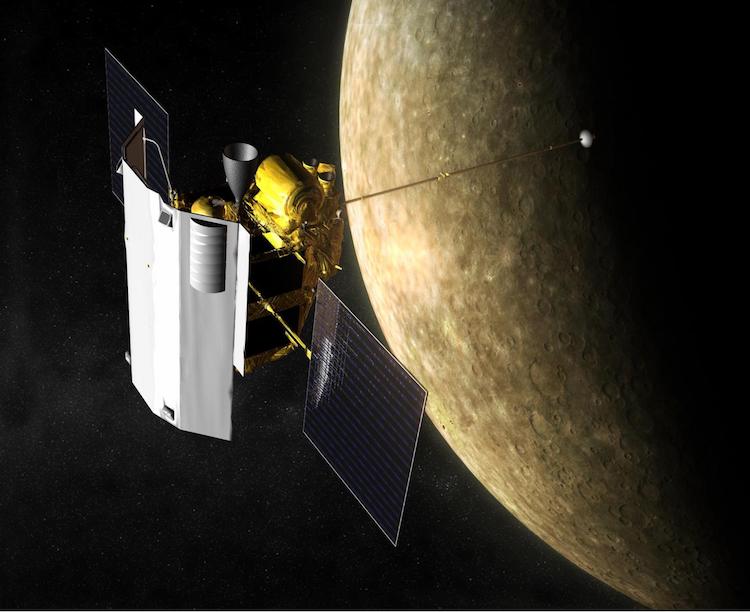


While protons remain stable for at least 1034 years outside the nucleus, a free neutron survives for just under 15 minutes before it decays. The neutron’s precise lifetime is, however, a matter of some debate, as the two techniques commonly used to measure it have produced conflicting results of 880 and 888 seconds.

A team of researchers at the Johns Hopkins University Applied Physics Laboratory in the US led by Jack Wilson has now put forward a third, radically different technique that involves measuring the number of neutrons near a planet. Using data acquired by the neutron spectrometer on NASA’s MESSENGER spacecraft during flybys of Venus and Mercury in 2007 and 2008, they calculated the neutron lifetime to be 780 +/- 90 seconds. While this measurement has a large uncertainty, the researchers note that the MESSENGER instrument was never designed to perform studies of this type – meaning that a dedicated instrument on a future mission could produce a measurement with much higher precision.

ASA launches Mars Perseverance rover

ASA launches Mars Perseverance rover

31 Jul 2020


The summer of Mars launches continued yesterday as NASA successfully sent its Mars 2020 on a seven-month journey to the red planet. Taking off from the Kennedy Space Center in Florida at 7:50 a.m. local time, the probe is the third mission sent to Mars in just 10 days following China’s Tianwen-1 orbiter and rover as well as the United Arab Emirates’ Hope orbiter. All three craft will reach the red planet in February 2021.


The Mars 2020 mission is set to land in a river delta within Jezero Crater and it will aim to repeat the same thrilling entry, descent and landing that happened for NASA’s Curiosity rover in 2012, which continues to roam the martian surface today. The main aspect of Mars 2020 is the Perseverance rover that will use seven instruments to explore Mars’ geology and climate and look for signs of past microbial life. “The science goal ultimately is to search for signs of life,” says Mars 2020 team member Melissa Rice, “like biosignatures that would be preserved in the rocks and to understand the geologic context in which these rocks formed.”

Microwave anomalies strengthen the case for loop quantum cosmology, say physicists

Microwave anomalies strengthen the case for loop quantum cosmology, say physicists

17 Aug 2020


A theory of quantum gravity that describes the universe as beginning in a “Big Bounce” rather than a Big Bang has succeeded in explaining several anomalies in the cosmic microwave background (CMB) radiation.


Loop quantum gravity (LQG) is an alternative to string theory, and describes space itself as being quantized at the smallest scales, known as the Planck length, about 10–35 m. According to LQG, space cannot be crushed down any smaller than this, and the application of LQG to the broader Universe is known as loop quantum cosmology (LQC).

In standard Big Bang cosmology, were we to run the history of the universe backwards so that it collapses rather than expands, the universe would contract into an unknowable singularity. However, in LQC, the collapsing universe would stop collapsing at the Planck length, and then rebound. This suggests that if LQC is correct, there was no Big Bang singularity, but a Big Bounce resulting from the collapse of a previous universe.

Artificial spider web gets an ionic boost

Artificial spider web gets an ionic boost

13 Aug 2020 Isabelle Dumé


An artificial material with the same elastic, adhesive, self-cleaning, sensing and tensile properties as natural spider silk has been created by researchers in South Korea. The synthetic web, which is made from a semi-solid stretchy gel, works using electrostatics and might have applications in artificial muscles, grippers and self-cleaning wall-climbing devices.

Spider silk has a tensile strength five times higher than that of steel, and its stretchable threads boast an adhesive coating that enables spiders to capture and trap prey in their webs. This adhesive coating does have a down side, however, which is that it attracts contaminants from the environment, causing the webs’ capturing efficiency to deteriorate.

Electronics drawn directly on the skin creates robust biosensors

Electronics drawn directly on the skin creates robust biosensors

19 Aug 2020 Samuel Vennin


Researchers from the University of Houston have developed a new form of bioelectronics known as “drawn-on-skin” (DoS) electronics, in which multifunctional sensors and circuits can be drawn directly onto the skin with a specialized ink pen. Their study, published in Nature Communications, shows that information collected using DoS electronics is more reliable and consistent than that obtained with electrodes commonly used in wearable bioelectronics.

“[The circuits are] applied like you would use a pen to write on a piece of paper,” says senior author Cunjiang Yu. “We prepare several electronic materials and then use pens to dispense them. Coming out, it is liquid. But like ink on paper, it dries very quickly.”Senior author Cunjiang Yu.

Yu and colleagues used three different inks to draw the various elements of the bioelectronic platform (conductors, semiconductors and dielectrics) into the outlines of a stencil. Any imperfection can be corrected by simply drawing on top of it. Once dried, the drawn structure can deform with the skin and collect a wealth of physiological signals.

Δευτέρα 3 Αυγούστου 2020

Superhydrophobic surfaces toughen up

Superhydrophobic surfaces toughen up

15 Jul 2020 Isabelle Dumé


A schematic representation of how the surface looks


A micron-scale “armour” that protects highly water-repellent nanostructures from damage has been developed by researchers in China and Finland. The new extra-durable coating could make it possible to employ these “superhydrophobic” surfaces on devices such as solar panels and vehicle windscreens that experience tough environmental conditions.

As their name suggests, superhydrophobic materials repel water extremely well. They owe this impressive ability to a thin layer of air that develops around nanometre-scale structures on their surface. By ensuring that droplets barely touch the solid part of the surface at all, the air layer effectively acts as a lubricant, allowing water droplets to roll off with near-zero friction.

Mediator atoms help graphene self-heal

Mediator atoms help graphene self-heal

16 Jul 2020 Isabelle Dumé
figure-4-2


Graphene and other carbon materials are known to change their structure and even self-heal defects, but the processes involved in these atomic rearrangements often have high energy barriers and so shouldn’t occur under normal conditions. An international team of researchers in Korea, the UK, Japan, the US and France has now cleared up the mystery by showing that fast-moving carbon atoms catalyse many of the restructuring processes.

Graphene – a carbon sheet just one atomic layer thick – is an ideal system for studying defects because of its simple two-dimensional single-element structure. Until now, researchers typically explained the structural evolution of graphene defects via a mechanism known as a Stone-Thrower-Wales type bond rotation. This mechanism involves a change in the connectivity of atoms within the lattice, but it has a relatively large activation energy, making it “forbidden” without some form of assistance.