Αναζήτηση αναρτήσεων

Παρασκευή 27 Νοεμβρίου 2020

Perovskites could be platforms for exciton condensates
 

Perovskites could be platforms for exciton condensates

24 Nov 2020 Isabelle Dumé
emerging exciton vortices
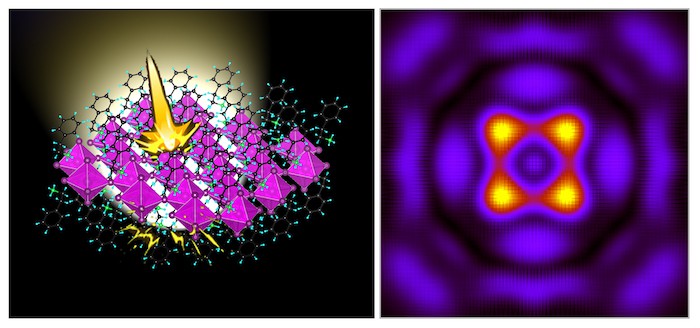
Laser pumping applied on a perovskite monolayer and the emerging exciton vortices. Courtesy: D Zhang


Organic–inorganic perovskite materials are usually studied in the context of making solar cells and other photovoltaic devices. Now researchers from the Institute of Semiconductors at the Chinese Academy of Sciences in Beijing have shown that these hybrid halide materials could also be ideal platforms for realizing Bose–Einstein condensates of excitons (electron–hole pairs). Such condensates, which appear as vortex patterns, could be produced at liquid nitrogen temperatures – positively balmy, by the standard of the field – thanks to the long lifetimes of the excitons in the materials and their huge binding energies.

Bose–Einstein condensation (BEC) occurs when all the bosonic atoms or particles in a gas collapse into the same quantum ground state and can therefore be described by the same wavefunction. Such collapses are triggered by cooling the gas until the de Broglie wavelength of its constituent atoms or particles is comparable to the distance between them. Once in this state, the atoms or particles behave as a superfluid, flowing without friction.

Why Google builds quantum computers, the LGBT+ experience in physics, CERN’s carbon footprint


Why Google builds quantum computers, the LGBT+ experience in physics, CERN’s carbon footprint

01 Oct 2020 Hamish Johnston


In this episode of the Physics World Weekly podcast Google’s Sergio Boixo explains why the tech giant is building its own quantum computers. Boixo will be a plenary speaker at the upcoming Quantum 2020 virtual conference, and we will be interviewing other plenary speakers in future episodes of the podcast.

Next up is Ramon Barthelemy – a physicist at the University of Utah who has surveyed more than 300 LGBT+ physicists about their careers. Barthelemy chats with Physics World’s Matin Durrani about the survey and the issues faced by the LGBT+ physics community, which are also described in a paper in the European Journal of Physics.

Pathways to scalable quantum technologies


Pathways to scalable quantum technologies

15 Oct 2020 Hamish Johnston


This episode of the Physics World Weekly podcast features interviews with two leaders in the race to build practical quantum computers.


Michelle Simmons is director of Australia’s Centre of Excellence for Quantum Computation and Communication Technology. She talks about how her early work on fabricating solar cells kindled a passion for building electronic devices that she now pursues by leading a research group at the University of New South Wales that is building solid-state quantum computing devices at the atomic scale.

Hunting dark matter with quantum sensors, working abroad brings career advantages


Hunting dark matter with quantum sensors, working abroad brings career advantages

19 Nov 2020 Hamish Johnston


Dark-matter detectors usually conjure up images of large underground facilities, but relatively small quantum sensors such as atomic clocks and magnetometers have also joined the search for the elusive stuff. In this episode of the Physics World Weekly podcast, Andrei Derevianko at the University of Nevada, Reno explains how it is done.

Πέμπτη 26 Νοεμβρίου 2020

Quantum software company tackles big computing challenges


Quantum software company tackles big computing challenges

26 Nov 2020 Hamish Johnston


My mission is to demystify quantum computing,” says Ilyas Khan, who is founder and chief executive of Cambridge Quantum Computing (CQC) – a UK-based provider of software for quantum computers. Khan is our guest in this episode of the Physics World Weekly podcast, and he explains how CQC helps its clients use quantum computers to solve big problems in the design of pharmaceuticals, machine learning and cybersecurity.