Αναζήτηση αναρτήσεων

Πέμπτη 17 Δεκεμβρίου 2020

China launches sample-return mission to the Moon


China launches sample-return mission to the Moon

24 Nov 2020
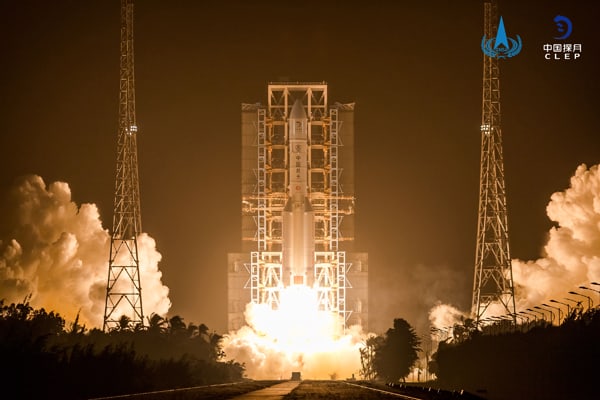


China has successfully launched a mission to bring back rocks from the Moon– the first attempt to do so for nearly 45 years. Chang’e-5 was launched at 4:30 a.m. local time today by a Long March 5 rocket from Wenchang Satellite Launch Center. Once it lands on the Moon it is expected to grab up to two kilograms of soil from an area not previously sampled to better understand the evolution history of our closest neighbour.

Chang’e-5, weighing 8.2 tonnes, consists of four parts: an ascender, lander, returner and orbiter. Upon entering the Moon’s orbit, the ascender and lander will separate and touch down in the Mons Rümker region — a volcanic mound in the northwestern part of the Moon’s near side.

Little book, big science


Little book, big science

16 Dec 2020
Taken from the December 2020 issue of Physics World. Members of the Institute of Physics can enjoy the full issue via the Physics World app.


In the latter half of the 20th century physicists undertook a shrewd move: they began to take the entire universe as their laboratory. It was a clever manoeuvre based on real-estate values alone, but it had other advantages as well. Floor space was essentially unlimited, maintenance fees were negligible, it cost nothing to heat and cool, and no insurance policies were required. But getting through the door, or even watching through a window, was costly. Of course, astronomers and physicists have always used observations of the universe to hone their understanding of the world.

As Lyman Page – the eminent Princeton University cosmologist – recounts in The Little Book of Cosmology, it was the discovery of the cosmic microwave background (CMB) that started the age of cosmology we’re in now, something that hadn’t much interested astronomers until then.

“We cosmologists,” writes Page, who studies temperature variations in the CMB, near the end of this clearly written, delectable book, “feel fortunate to have been alive in the decades when the explosion of knowledge about the universe took place.”

Τετάρτη 16 Δεκεμβρίου 2020

Fundamental constant measured at highest precision yet


Fundamental constant measured at highest precision yet

15 Dec 2020 Isabelle Dumé


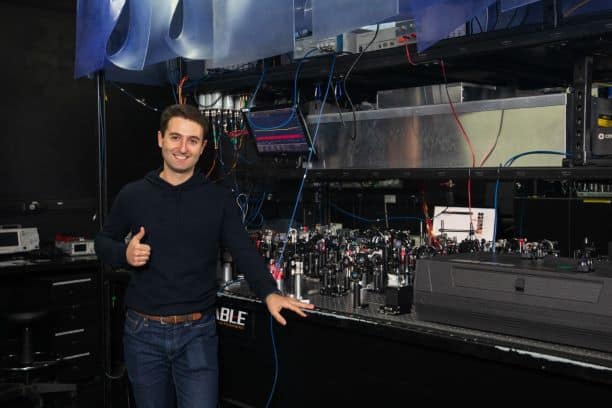
The most precise measurement ever of the fine-structure constant has placed new constraints on theories that predict the existence of “dark sector” particles. The new value, which researchers in France measured using clouds of cold rubidium atoms, provides a stringent test of the Standard Model of particle physics while also further limiting the properties of dark matter – the substance thought to make up more than 90% of the matter in our universe.

The fine-structure constant α is a composite of several physical quantities (including e, the charge on an electron, and c, the speed of light) that, together, characterize the strength of the electromagnetic interaction.

Aspiring astronaut and Space Age ambassador


Aspiring astronaut and Space Age ambassador

14 Dec 2020
Taken from the December 2020 issue of Physics World. Members of the Institute of Physics can enjoy the full issue via the Physics World app.


When the Apollo 11 astronauts landed on the Moon in 1969 the whole world stopped, just for a moment, and looked up. We stepped out into the universe and firmly entered the Space Age, which had begun with Sputnik just 12 years earlier. For many Physics World readers, the scientific and engineering exploits of those early achievements are a source of intrigue and no little excitement. From those crackled first words on the Moon, to images of the boot print in the lunar surface, or the new perspective of our world – the fragile blue marble suspended in darkness – humanity’s most impressive engineering effort has had a huge impact on our collective consciousness.

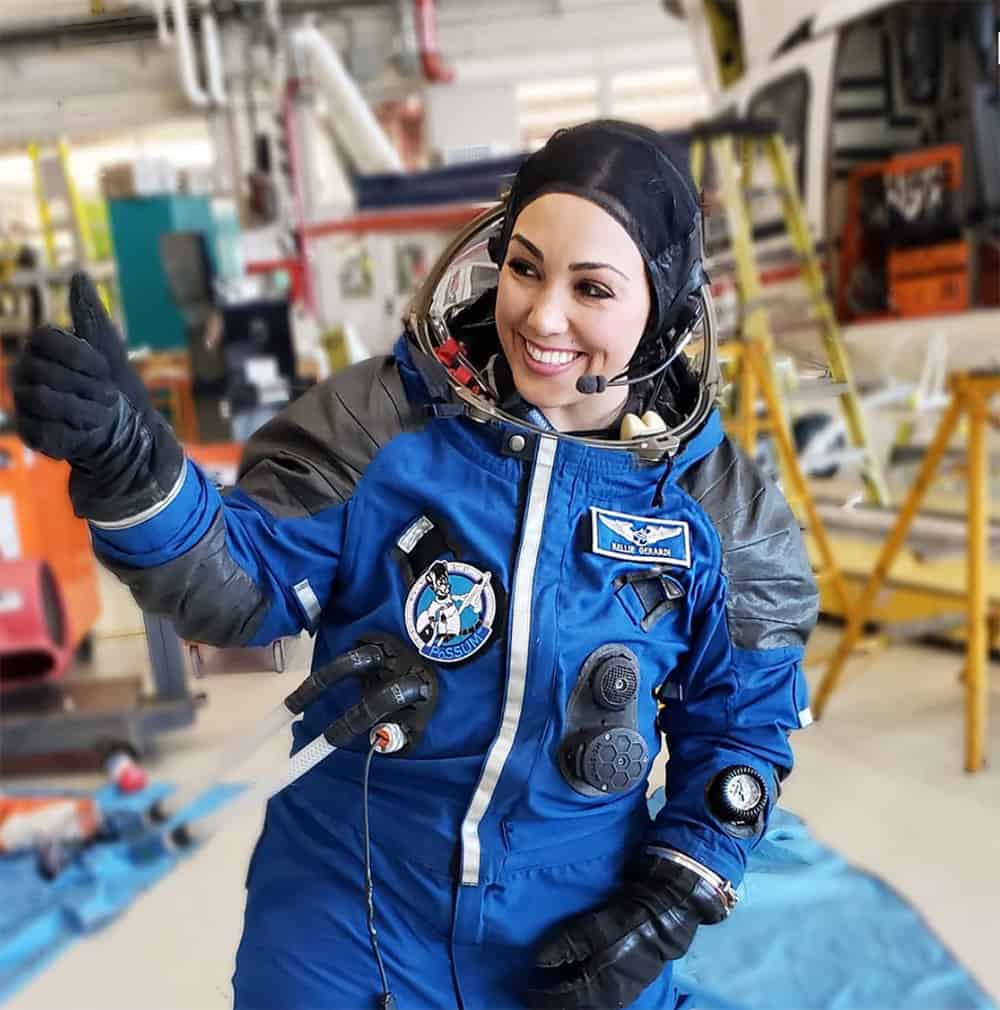
Commercial spaceflight industry professional and science communicator Kellie Gerardi was one of the many who wanted to be part of the nascent Space Age. But with a degree in film studies rather than aerospace engineering, her non-traditional path in the space industry is a key theme of her new book Not Necessarily Rocket Science: a Beginner’s Guide to Life in the Space Age. With more than 122,000 followers on Instagram, Gerardi is something of a social-media star, and her book serves as part mission statement, part witness statement and part manifesto.

Balloon-borne telescopes could keep cool with less


Balloon-borne telescopes could keep cool with less

11 Dec 2020 Isabelle Dumé


Balloon-borne telescopes can observe a wealth of astrophysical phenomena that ground-based instruments cannot, but onerous cooling requirements limit how much equipment can be taken aloft. Researchers at NASA’s Goddard Space Flight Center found a way to minimize this problem by drastically reducing the weight of a telescope’s cooling system. The researchers have tested their approach on a mission called the Balloon-Borne Cryogenic Testbed (BOBCAT) and have a follow-up mission planned to study it further.

Distant galaxies and star- and planet-forming clouds of gas and dust emit photons in the infrared region of the spectrum.

Ultracold atoms put high-temperature superconductors under the microscope


Ultracold atoms put high-temperature superconductors under the microscope

27 Nov 2020 Margaret Harris


Physicists have deployed a Bose–Einstein condensate (BEC) as a “quantum microscope” to study phase transitions in a high-temperature superconductor. The experiment marks the first time a BEC has been used to probe such a complicated condensed-matter phenomenon, and the results – a solution to a puzzle involving transition temperatures in iron pnictide superconductors – suggest that the technique could help untangle the complex factors that enhance and inhibit high-temperature superconductivity.

Fast quantum random number generator could advance cryptography on the cheap


Fast quantum random number generator could advance cryptography on the cheap

09 Dec 2020


While world events are often difficult to predict, true randomness is surprisingly hard to find. In recent years, physicists have turned to quantum mechanics for a solution, using the inherently unpredictable behavior of photons to generate the truly random numbers that underpin many modern cryptographic protocols. Now, a new study promises to make this process of quantum random number generation more accessible, by showing that it is possible to produce certifiably random numbers quickly using a system built with off-the-shelf components.

When numbers are used to securely encode information, the randomness of those numbers is crucial: a string of truly random numbers is one that a hacker can never guess.