Αναζήτηση αναρτήσεων

Τρίτη 2 Φεβρουαρίου 2021

Severe wildfires create towering thunderstorms, how to launch a new scientific society


Severe wildfires create towering thunderstorms, how to launch a new scientific society

21 Jan 2021 Hamish Johnston


Some wildfires produce so much heat that they create their own thunderstorms, which drive huge amounts of smoke high up into the atmosphere. In this episode of the Physics World Weekly podcast, the meteorologist David Peterson of the US Naval Research Laboratory describes how these pyrocumulonimbus events occur and why it is important to understand how the resultant smoke plumes affect the atmosphere on a huge scale.

from physicsworld.com 2/2/2021

Optical technique sorts nanoparticles by their quantum properties


Optical technique sorts nanoparticles by their quantum properties

30 Jan 2021 Isabelle Dumé


A method of optically selecting and sorting nanoparticles according to their quantum mechanical properties has been developed by researchers in Japan. The method could prove a crucial tool for makers of nanostructures that have applications in quantum sensing, biological imaging and quantum information technology.

Nanophotonic biosensor tests for COVID-19, hot topics in medical physics


Nanophotonic biosensor tests for COVID-19, hot topics in medical physics

28 Jan 2021 Hamish Johnston


In this episode of the Physics World Weekly podcast, we meet Laura Lechuga, who is coordinating the EU-funded CONVAT programme to develop a nanophotonic biosensor for detecting the coronavirus responsible for the COVID-19 pandemic. Based at the Catalan Institute of Nanoscience and Nanotechnology near Barcelona, Lechuga explains how the biosensor works and talks abouts its benefits compared to existing coronavirus tests.

ENHANCE PLASMONIC RESPONSE IN SILVER NANOPARTICLES


Localized Surface Plasmon Resonance (LSPR) is gaining interest as a highly sensitive analytical technique to detect chemical and biological molecules in low concentrations. Plasma treatment is utilized to clean patterned substrates, specifically designed for LSPR, and has been found to significantly enhance signal response.

LSPR relies on the coupling of electromagnetic radiation (typically incident laser light) to surfaces covered with metallic nanostructures and nanoparticles (NPs), resulting in collective excitation and coherent oscillation of surface conduction electrons in the metal. The resulting LSPR spectrum plots optical extinction (light that is absorbed and elastically scattered) as a function of wavelength and gives rise to sharp peaks at distinct wavelengths (resonance frequency). As the resonance frequency greatly depends on the size, shape, and material of the nanostructured surface, the LSPR wavelength can be tuned by varying these parameters [1,2].

Δευτέρα 1 Φεβρουαρίου 2021

Life at CERN during the pandemic


Life at CERN during the pandemic

22 Jan 2021 James Dacey


In this episode of the Physics World Stories podcast, scientists and engineers from the CERN describe how the pandemic has affected the particle physics lab and the way they collaborate with colleagues.

CERN’s large hadron collider (LHC) is currently in shutdown ahead of its third run scheduled for later in 2021. José Miguel Jimenez, head of CERN’s technology department, explains how engineers have adapted in order to limit the delays brought about by the pandemic.

Nanotubes show their true colours


Nanotubes show their true colours

15 Jan 2021 Isabelle Dumé


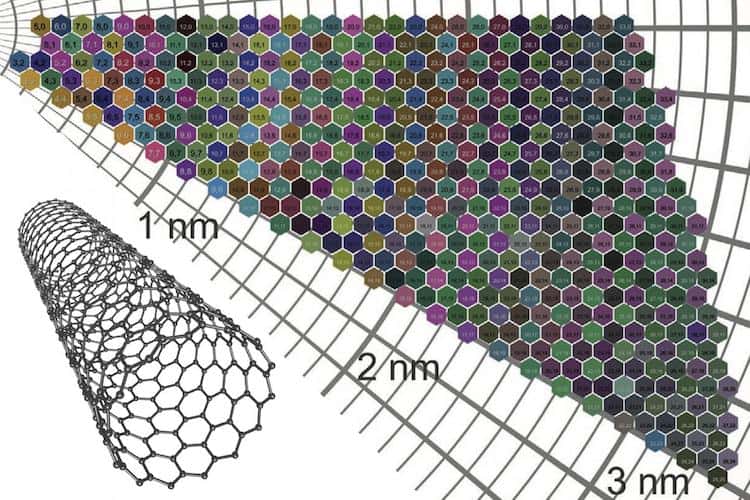
Why do some thin films of single-wall carbon nanotubes take on colourful hues even though as-synthesized films are usually black? A team of researchers in Finland, the US and China has now come up with a possible answer in a development that could prove useful for future display screens and solar cells.

Single-wall carbon nanotubes (SWCNTs) are rolled-up sheets of carbon just one atom thick, with a diameter of about 1 nm. Atoms in these sheets are arranged in a hexagonal lattice and the direction in which the sheet is rolled – its chirality – dictates whether the tube is a metal or a semiconductor.

Gas flows follow conventional theory even at the nanoscale


Gas flows follow conventional theory even at the nanoscale

19 Jan 2021 Isabelle Dumé


Gases flow through a porous membrane at ultrahigh speeds even when the pores’ diameter approaches the atomic scale. This finding by researchers at the University of Manchester in the UK and the University of Pennsylvania in the US shows that the century-old Knudsen description of gas flow remains valid down to the nanoscale – a discovery that could have applications in water purification, gas separation and air-quality monitoring.