Αναζήτηση αναρτήσεων

Πέμπτη 15 Απριλίου 2021

Majorana-based quantum computation gets a handy new platform


Majorana-based quantum computation gets a handy new platform

14 Apr 2021 Jacob Marks
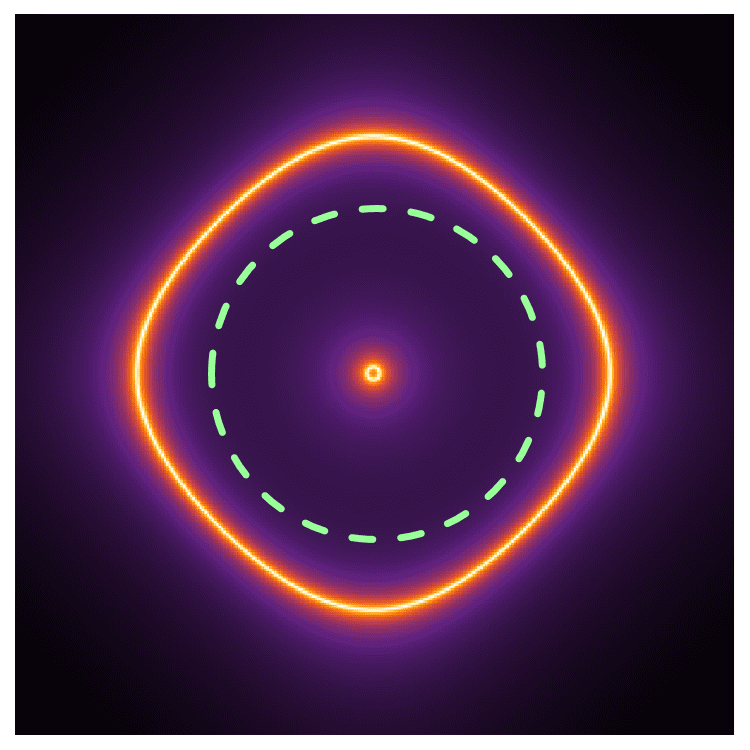


The errors that arise from the volatile nature of quantum technologies are a major roadblock on the path to practical quantum computing. We can imagine getting past this blockade by driving straight through it, using a car built to withstand the impact: this is quantum error correction. Alternatively, we might try to drive around the obstacle, bypassing the original problem entirely. To that end, researchers are investigating Majorana fermions – curious quantum objects that are their own antiparticles and are thought to be naturally resilient to quantum errors.

Παρασκευή 9 Απριλίου 2021

Attosecond streaking clocks the ultrafast emission of Auger electrons


Attosecond streaking clocks the ultrafast emission of Auger electrons

29 Jan 2021
Attosecond streaking


The decay lifetime associated with the emission of Auger electrons from atoms has been measured to sub-femtosecond precision using a technique called self-referencing attosecond streaking. Daniel Haynes of the Max Planck Institute for the Structure and Dynamics of Matter in Hamburg and an international team of scientists are the first to make such a measurement using an X-ray free electron laser (XFEL).

Molecular qubits stick around for longer


Molecular qubits stick around for longer

13 Mar 2021 Isabelle Dumé
molecular qubit lab


Researchers in China have shown that the spin of a molecular quantum bit (qubit) can remain coherent for more than 1 millisecond – long enough to perform 145 000 basic logic operations. This number, known as the qubit “figure of merit”, is 40 times higher than previously reported for this molecule, raising the chances that such qubits could be used in quantum computing applications as well as in biomedical imaging and quantum sensing.

Quantum computers can, in principle, solve certain problems much faster than classical computers because they exploit a quantum particle’s ability to be in a superposition of two or more states at the same time (as opposed to classical bits that have only 0 and 1 states).

Nanoparticle-based vaccine offers new approach to COVID-19 immunity


Nanoparticle-based vaccine offers new approach to COVID-19 immunity

19 Mar 2021 Ben Lewis 
Jae Jung
Jae Jung, from Cleveland Clinic's Global Center for Pathogen Research & Human Health, and collaborators have developed a promising new COVID-19 vaccine candidate. (Courtesy: Cleveland Clinic)


As the international effort to vaccinate the population against COVID-19 gathers pace, the demand for vaccine doses that can be used in all countries and climates is enormous. Researchers from Cleveland Clinic and Chungbuk National University have described a new vaccine candidate that triggers an immune response using antigens attached to nanoparticles, potentially bypassing the need for cold storage during delivery. They report their findings in mBio.

All vaccines approved to date cause an immune response against the same part of the SARS-CoV-2 virus: the receptor binding domain (RBD) of the spike protein.

Has a new particle called a ‘leptoquark’ been spotted at CERN?


Has a new particle called a ‘leptoquark’ been spotted at CERN?

23 Mar 2021 Hamish Johnston
Beauty quark decay
Fleeting glance: decay of a beauty quark involving an electron and positron as observed by LHCb. (Courtesy: CERN)


A hint of the possible existence of a hypothetical particle called a leptoquark has appeared as an unexpected difference in how beauty quarks decay to create electrons or muons. Measured by physicists working on the LHCb experiment on the Large Hadron Collider (LHC) at CERN, the difference appears to violate the principle of “lepton universality”, which is part of the Standard Model of particle physics. The measurement has been made at a statistical significance of 3.1σ, which is well below the 5σ level that is usually considered a discovery. If the violation is confirmed, it could provide physicists with important clues about physics beyond the Standard Model – such as the existence of leptoquarks.

How sidewinder snakes slither sideways, the challenges of creating sustainable infrastructure


How sidewinder snakes slither sideways, the challenges of creating sustainable infrastructure

11 Feb 2021 Hamish Johnston


In this episode of the Physics World Weekly podcast we meet physicist Jennifer Rieser who has just moved from the Georgia Institute of Technology to Emory University, where she studies how snakes use tiny structures on their undersides to help propel themselves. Rieser talks about her recent research that suggests that microscopic pits on the bellies of sidewinder snakes help the reptiles achieve their sidewinding motion.

Graphene gives neural interfaces a boost, the amazing physics of hearing and vision


Graphene gives neural interfaces a boost, the amazing physics of hearing and vision

08 Apr 2021 Hamish Johnston


This episode of the Physics World Weekly podcast looks at how new technologies can improve our health and how we perceive our surroundings.


First up is Kostas Kostarelos of the UK’s University of Manchester, who talks about the exciting role that graphene can play in the development of medical devices that connect to the brain with minimal invasiveness. He also chats about his involvement with the Spanish company Inbrain Neuroelectronics, which is developing graphene-based technologies for treating epilepsy, Parkinson’s disease, and other brain related disorders.