Αναζήτηση αναρτήσεων

Τρίτη 5 Οκτωβρίου 2021

Syukuro Manabe, Klaus Hasselmann and Giorgio Parisi win the 2021 Nobel Prize for Physics


Syukuro Manabe, Klaus Hasselmann and Giorgio Parisi win the 2021 Nobel Prize for Physics

05 Oct 2021 Hamish Johnston


Syukuro Manabe, Klaus Hasselmann and Giorgio Parisi have won the 2021 Nobel Prize for Physics.

The prize is awarded for “for groundbreaking contributions to our understanding of complex physical systems”.

The prize is worth 10 million Swedish krona ($1.1 million). Manabe and Hasselmann will share one half of the prize and Parisi takes the other half.

Parisi bagged his half of the prize for “for the discovery of the interplay of disorder and fluctuations in physical systems from atomic to planetary scales”.

Δευτέρα 4 Οκτωβρίου 2021

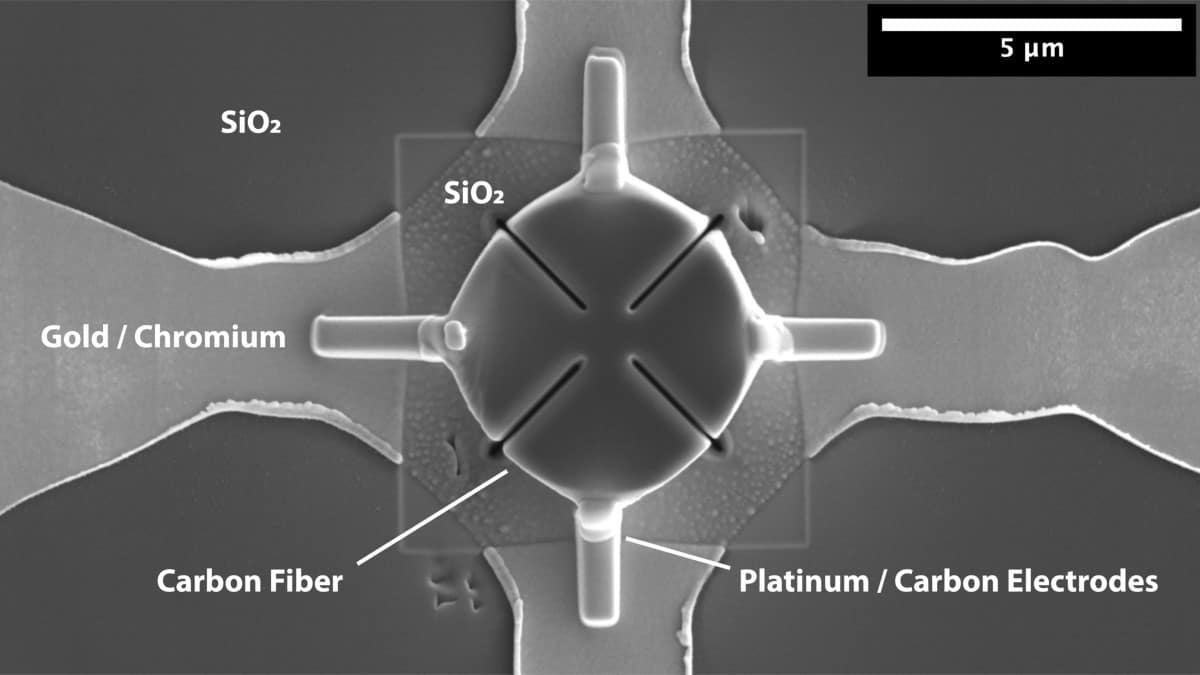
Carbon fibres have directional electrical properties


Carbon fibres have directional electrical properties

04 Oct 2021


The electrical properties of a carbon fibre are very different when measured across its width or along its length, according to a new study by Satoshi Matsuo and Nancy Sottos at the University of Illinois at Urbana-Champaign in the US. Using a technique designed to probe the electrical resistivity of 2D materials, the duo has showed for the first time that fibres are significantly less conductive in the transverse direction.

Distillation method strengthens quantum entanglement in a single pair of photons


Distillation method strengthens quantum entanglement in a single pair of photons

04 Oct 2021 Chunyang Ding


Quantum entanglement is a valuable resource, enabling spy-proof communications and allowing quantum algorithms to be faster than classical ones. But like other quantum phenomena, entanglement is also extremely delicate and sensitive to environmental noise. Because many quantum communication protocols require high levels of entanglement to operate properly, preserving that entanglement is crucial.

Life beyond the Nobel: Andrea Ghez eyes up new research directions


Life beyond the Nobel: Andrea Ghez eyes up new research directions

04 Oct 2021 Matin Durrani


In the run-up to the announcement of the 2021 Nobel Prize for Physics on 5 October, we’re running a series of blog posts looking at previous recipients and what they did after their Nobel prize-winning work. Last year’s winner Andrea Ghez tells Matin Durrani how the award is already opening up new opportunities for her.


Physicists around the world are gearing up for tomorrow’s big reveal of who has won the 2021 Nobel Prize for Physics. Part of the prize’s appeal is that no-one – apart from the members of the Nobel Committee for Physics – currently knows who this year’s winners will be. Even the Royal Swedish Academy of Sciences only grants final approval on the very morning the prize is announced, which sounds seat-of-the-pants, but that’s the way it is.

Green jobs for physics graduates: decarbonizing energy sources


Green jobs for physics graduates: decarbonizing energy sources

04 Oct 2021 Laura Hiscott
Taken from the October 2021 issue of Physics World. Members of the Institute of Physics can enjoy the full issue via the Physics World app.


With their mix of technical knowledge and problem-solving skills, physics graduates are ideally placed to tackle the world’s environmental challenges. In the third of a series of articles, Laura Hiscott speaks to three physicists who are doing their bit to build a greener, more sustainable future in the field of decarbonizing energy sources


Ann Davies, chief operations officer, Lightsource BP

Taking advantage of new technologies will be essential if the world is to achieve its net-zero goals. Renewable energy sources are perhaps the most obvious of these, and the transition to them is already under way.

Κυριακή 3 Οκτωβρίου 2021

Physicists explain why unexpectedly small temperature fluctuations occur in objects exposed to extreme heat


Physicists explain why unexpectedly small temperature fluctuations occur in objects exposed to extreme heat

06 Jul 2021


A new explanation for why thermal systems subjected to extreme heat fluxes display far lower temperature fluctuations than expected has been developed by researchers in France. By adding two additional components to a widely-used theorem for predicting fluctuations, Alex Fontana, and colleagues at ENS de Lyon have explained a key discrepancy between theory and experimental observations of silicon cantilevers exposed to extreme temperature gradients. Their discovery could improve high-precision experiments and the design of tiny machines.

Head-mounted magnetic device shrinks brain tumour


Head-mounted magnetic device shrinks brain tumour

21 Sep 2021


A team of US-based researchers has used an innovative head-mounted device to shrink a brain tumour – potentially paving the way for a powerful new non-invasive therapy for glioblastoma.

In recent studies, the team – which includes researchers based at the Peak Center for Brain and Pituitary Tumor Treatment and Research at Houston Methodist Neurological Institute – found that the oscillating magnetic field-generating device, dubbed an “oncomagnetic device”, was able to rapidly kill glioblastoma cells in culture and shrink human glioblastoma tumours implanted in mice, prolonging their survival.