Αναζήτηση αναρτήσεων

Πέμπτη 9 Μαρτίου 2023

Debris ejected from the DART impact helped give asteroid Dimorphos an extra push


Debris ejected from the DART impact helped give asteroid Dimorphos an extra push

06 Mar 2023


Impact zone: snapshots of the impact taken by Hubble show the evolution of the ejecta streams in the hours and days after DART impacted Dimorphos. (Courtesy: NASA, ESA, STScI, Jian-Yang Li (PSI), Joseph DePasquale (STScI)).

The impact of a spacecraft into the asteroid Dimorphos last year changed the asteroid’s orbital period around its companion asteroid, Didymos, by 33 minutes, with much of the momentum change coming from the ejecta liberated by the impact. That is one of the findings from a quintet of new papers that has now verified the amount by which the impact knocked the 177 m-wide Dimorphos from its orbit.

Machine learning joins the search for extra-terrestrial intelligence


Machine learning joins the search for extra-terrestrial intelligence

02 Mar 2023 Hamish Johnston
In this episode of the Physics World Weekly podcast we meet three scientists who are trying to answer a question that humanity has long pondered: does intelligent life exist elsewhere in the universe?


Peter Ma and Leandro Rizk of the University of Toronto and Cherry Ng of the French National Centre for Scientific Research in Orleans are part of a team that has used machine learning to identify eight potential “technosignatures” in data from the Robert C Byrd Green Bank Telescope. The trio explain how they look for signs of intelligent life in radio-telescope data and how machine learning gives a helping hand.

Researchers grow electronics directly inside living tissue


Researchers grow electronics directly inside living tissue

06 Mar 2023 Tami Freeman


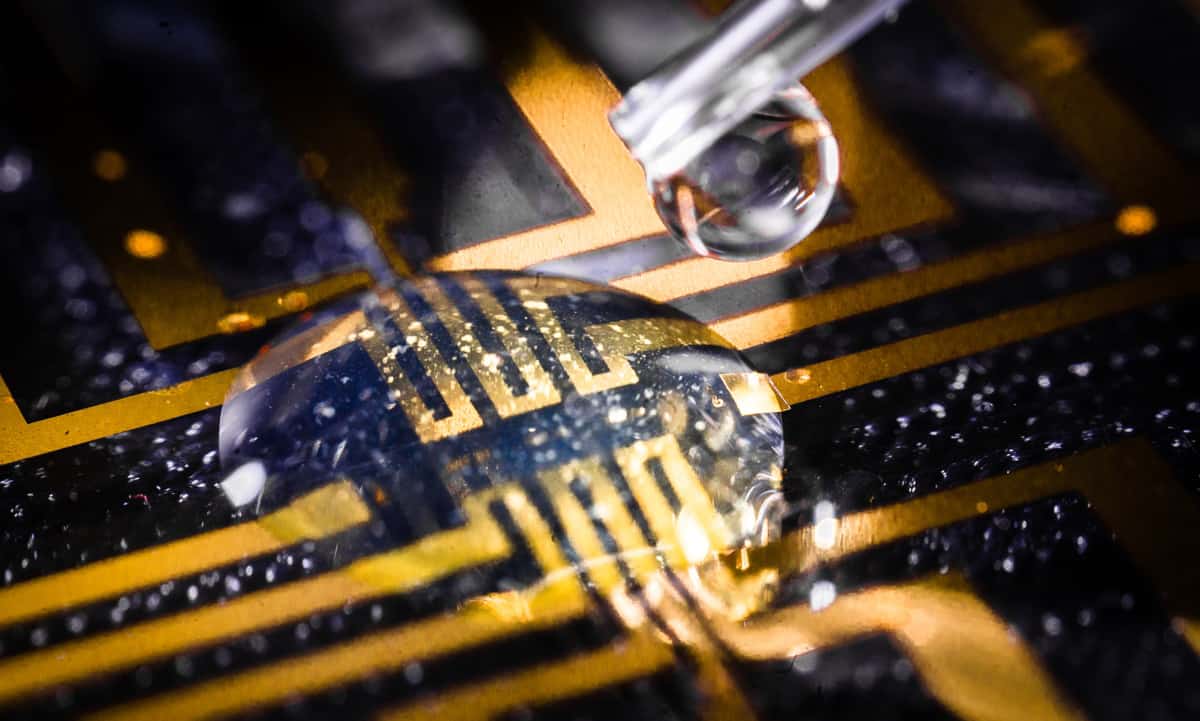
A complex cocktail The injectable gel being tested on a microfabricated circuit. (Courtesy: Thor Balkhed)

Interfacing neural tissue with electronics provides a way to investigate the complex electrical signalling characteristics of the nervous system. Implanted electronic devices can also be used to modulate neural circuitry to prevent or treat various diseases. Unfortunately, there’s a fundamental mismatch between rigid electronic substrates and soft tissues that risks damage to delicate living systems.

Researchers in Sweden have come up with a way around this mismatch, by generating electrodes within the body. The team – from Linköping University, Lund University and the University of Gothenburg – has developed a method of creating soft, substrate-free conducting materials directly inside living tissue, using the body’s molecules as triggers.

Advanced electron microscopy: new paradigms for studying nanomaterials


Advanced electron microscopy: new paradigms for studying nanomaterials

23 Feb 2023 Sponsored by IUVSTA


Join the audience for a live webinar at 1 p.m. GMT on 22 March 2023 exploring the progress achieved by electron microscopy instruments and methods to aid the study of nanomaterials


Want to take part in this webinar?


In this webinar, you will learn about the remarkable progress achieved by electron microscopy instrument to answer applied and basic questions raised by the constantly growing field of nanotechnology.

We will present a series of studies of nano objects (such as molecules, nanoparticles, nanotubes, nanowires) to provide examples on the need to change our views of experiment design, execution and analysis. Previously, it was common to think that electron microscopy as a very useful but qualitative atom resolution imaging tool for materials science. At present, researchers must use these advanced tools in association with physicochemical simulations, machine learning, big data, etc. to target the generation of reliable and quantitatively verified physical models from the measurements.

Παρασκευή 24 Φεβρουαρίου 2023

New single-photon detector targets high-speed quantum communications


New single-photon detector targets high-speed quantum communications

22 Feb 2023


Quantum fan: the new single-photon detector comprises 32 superconducting nanowires. (Courtesy: Ryan Lannom, JPL-Caltech/NASA)

A new photon detector called PEACOQ can register the arrival times of individual photons with the best timing resolution to date. Developed by Matthew Shaw and colleagues at NASA’s Jet Propulsion Laboratory, the detector achieved a maximum count rate of some 1.5 billion photons per second, while maintaining high efficiency and low noise.

Πέμπτη 23 Φεβρουαρίου 2023

Short electrical pulses switch superconductivity on and off in magic-angle graphene


Short electrical pulses switch superconductivity on and off in magic-angle graphene

22 Feb 2023 Isabelle Dumé


Superconductivity switch: This figure shows a device with two graphene layers (dark grey and inset) sandwiched between boron nitride layers (blue and purple). The angle and alignment of each layer enables the researchers to turn superconductivity on and off with a short electric pulse. (Courtesy: Pablo Jarillo-Herrero, Dahlia Klein, Li-Qiao Xia, David MacNeill et. al)

Compact mass spectrometer could search for life on distant moons


Compact mass spectrometer could search for life on distant moons

15 Feb 2023


Made for space: an Orbitrap cell. (Courtesy: Ricardo Arevalo)

A compact prototype instrument that could one day search for signs of life in the solar system has been unveiled by a team of researchers in the US, France, and Germany. Led by Ricardo Arevalo at the University of Maryland, the team’s Orbitrap LDMS instrument can non-invasively identify complex molecules, despite taking up just a fraction of the size and weight of commercially available counterparts.