Αναζήτηση αναρτήσεων

Κυριακή 26 Μαρτίου 2023

Novel imaging platform reveals the neuronal basis of a drifting mind


Novel imaging platform reveals the neuronal basis of a drifting mind

22 Mar 2023 Simon Lichtinger


Daydreaming brain A rat engaged in self-referential processing. The image also shows the default mode network as revealed by fMRI. (Courtesy: CC BY 4.0/Shih Lab, Long-Evans rat image provided by Tzu-Hao Harry Chao)

When was the last time you daydreamt? Paying no particular attention to the outside world, engaged in introspection or memory recall, your mental state feels altered. This difference is reflected in global patterns of brain activity – the default mode network (DMN). Identified 20 years ago and the focus of much research activity since, the DMN connects several brain regions through distinct low-frequency oscillations.

An expanding universe is simulated in a quantum droplet


An expanding universe is simulated in a quantum droplet


Big and small: illustration of how a tiny Bose–Einstein condensate has been used to simulate the expansion of space that occurred moments after the Big Bang. (Courtesy: Campbell McLauchlan)

Unfortunately for the field of cosmology, there is only one universe. This makes performing experiments in the same way as other scientific fields quite a challenge. But it turns out that the universe and the quantum fields that permeate it are highly analogous to quantum fluids like Bose–Einstein condensates (BECs), at least from a mathematical point of view. These fluids can be the subject of experiments, allowing cosmology to be studied in the lab.

Τετάρτη 22 Μαρτίου 2023

Gravitational waves from merging black holes go nonlinear


Gravitational waves from merging black holes go nonlinear

21 Mar 2023


Soon to be ringing: artist’s impression of two black holes that are about to merge. (Courtesy: NASA)

Two independent teams have shown that gravitational waves emanating from the distorted remnants of black hole mergers should interact with themselves. By including these nonlinear effects in their models, one team, led by Keefe Mitman at Caltech, found they could replicate gravitational wave signals from simulated “ringing” black holes up to 100 times more accurately than previous approaches. The other team came to a similar conclusion and was led by Mark Ho-Yeuk Cheung at Johns Hopkins University

Black holes destroy nearby quantum superpositions, thought experiment reveals


Black holes destroy nearby quantum superpositions, thought experiment reveals

02 Mar 2023


Killing horizon: a thought experiment suggests that the presence of a black hole can decohere a quantum superposition. (Courtesy: Shutterstock/Rost9)

A new thought experiment suggests that the mere presence of a black hole can destroy a nearby quantum spatial superposition. Developed by physicists in the US, the experiment implies that the long-range gravitational field of the particle in the superposition will interact with the black hole’s event horizon, causing cause the quantum superposition to decohere within finite time.

Breakthrough in quantum error correction could lead to large-scale quantum computers


Breakthrough in quantum error correction could lead to large-scale quantum computers

20 Mar 2023
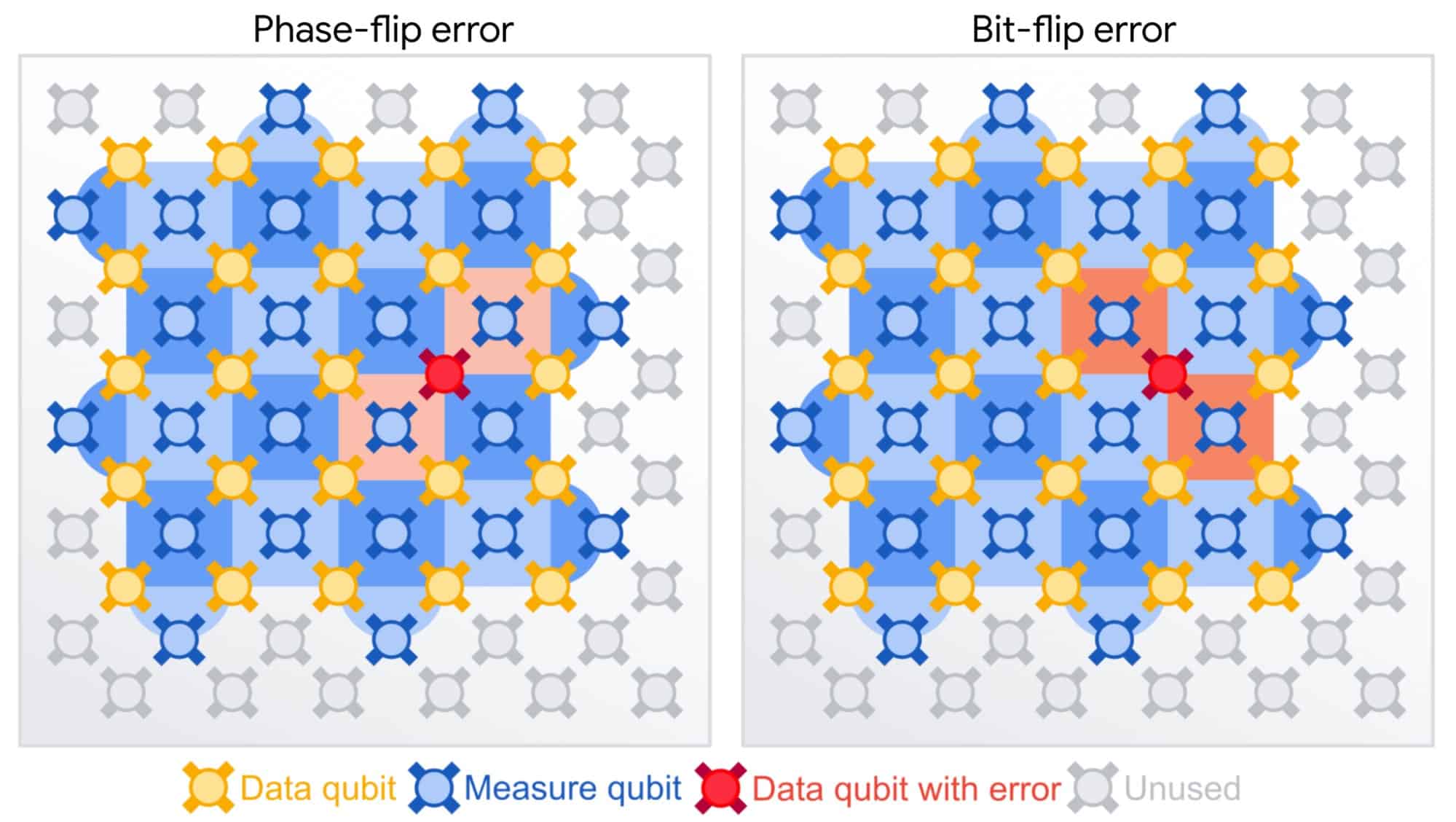
Surface code: illustration of how error correction works for bit and phase flips. The measure qubits on light blue backgrounds check for phase flip errors while the measure qubits on dark blue backgrounds check for bit flip errors. In this example the measure qubits on reddish backgrounds are registering the errors. (Courtesy: Google Quantum AI)

Researchers at Google Quantum AI have made an important breakthrough in the development of quantum error correction, a technique that is considered essential for building large-scale quantum computers that can solve practical problems. The team showed that computational error rates can be reduced by increasing the number of quantum bits (qubits) used to perform quantum error correction. This result is an important step towards creating fault-tolerant quantum computers.

Laser interferometry moves closer to shot-noise-limited measurements


Laser interferometry moves closer to shot-noise-limited measurements

13 Mar 2023 Isabelle Dumé


Mapping thermomechanical resonance: thermomechanical modes in a calcium niobate resonator device. (Courtesy: Chinese Phys. Lett. 10.1088/0256-307X/40/3/038102)

Researchers have moved a step closer to achieving quantum-noise-limited measurements using laser interferometry – a technique routinely employed for detecting the motion and displacement of tiny objects such as nanomechanical resonators with ultrasensitive precision. By reducing the contribution of all noises other than shot noise from 92.6% to 62.4%, they achieved a displacement sensitivity of 1.2 fm/Hz1/2. The team says that this is the best value reported to date for any resonator based on two-dimensional (2D) materials using interferometry.

Photoexcited electrons from fullerene help create high-speed switch


Photoexcited electrons from fullerene help create high-speed switch

20 Mar 2023 Isabelle Dumé


Fullerene switch: artist’s rendering of a fullerene switch with incoming electron and red laser light pulses. (Courtesy: ©2023 Yanagisawa et al.)

Light-induced electron emissions from fullerene, a carbon-based molecule, can be used to make an ultrafast switch. The new device, developed by a team headed up at the University of Tokyo, Japan, has a switching speed that’s four to five orders of magnitude faster than that of current solid-state transistors used in modern-day computers. The path of the electrons produced from the emission sites in the molecule can be controlled on the sub-nanometre scale using pulses of laser light.