Αναζήτηση αναρτήσεων

Παρασκευή 2 Μαΐου 2025

An exoplanet could be in a perpendicular orbit around two brown dwarfs


An exoplanet could be in a perpendicular orbit around two brown dwarfs

30 Apr 2025
Exoplanet and brown dwarfs
Right angle Illustration of 2M1510 showing the orbits of the two brown dwarfs (in blue) and that of the planet (in orange). (Courtesy: ESO/L Calçada)
Astronomers in the UK and Portugal have observed the first strong evidence for an exoplanet with an orbit perpendicular to that of the binary system it orbits. Based on observations from the ESO’s Very Large Telescope (VLT), researchers led by Tom Baycroft, a PhD student at the University of Birmingham, suggest that such an exoplanet is required to explain the changing orientation in the orbit of a pair of brown dwarfs – objects that are intermediate in mass between the heaviest gas-giant planets and the lightest stars.

UK launches first-ever industrial materials strategy


UK launches first-ever industrial materials strategy

16 Jan 2025 Michael Banks
Graphene
Materials world: advanced materials are used in energy-efficient supercomputers, implantable electrotherapy devices to treat brain cancer, and carbon-neutral steel (courtesy: Shutterstock/Inozemtsev-Konstantin)
Increased collaboration between different materials research and development areas will be needed if the UK is to remain a leader in the field, according to the National Materials Innovation Strategy, which claims to be the first document to boost materials-based innovation in the UK. The strategy says failing to adopt a “clear, national strategy” for materials will hamper the UK’s ability to meet its net-zero and other sustainability goals.

Led by the Henry Royce Institute—the UK’s national institute for advanced materials—the strategy included the input of over 2000 experts in materials science, engineering, innovation, policy, and industry. It says that some 50,000 people in the UK work or contribute to the materials industry, adding about £4.4bn to the UK economy each year. Of the 2700 companies in materials innovation in the UK, 70% are registered outside of London and the South East, with 90% being small and medium-sized enterprises.

Layer-spintronics makes its debut


Layer-spintronics makes its debut

29 Apr 2025 Isabelle Dumé
Artist's image showing robot arms controlling a group of spins (represented by an array of red arrows all pointing up) that are sandwiched between two layers of CrS material (represented by ball-and-stick models). A blue lightning-like line in the middle represents electric field control
Altermagnetics: Electrical current flowing in an altermagnetic bilayer CrS can become spin-polarized using an external electric field, thus paving a way towards all-electrical spintronic devices for future computing technology. (Courtesy: SUTD)
Researchers at the Singapore University of Technology and Design (SUTD) have developed a new all-electrical way of controlling spin-polarized currents. By using bilayers of recently discovered materials known as alter magnets, the researchers developed a tunable and magnetic-free alternative to current approaches—something they say could bring spintronics closer to real-world applications.

Spintronics stores and processes information by exploiting electrons' quantum spin (or intrinsic angular momentum) rather than their charge. The technology works by switching electronic spins, which can point either “up” or “down”, to perform binary logical operations in the same way electronic circuits use electric charge.

Photonic computer chips perform as well as purely electronic counterparts, say researchers


Photonic computer chips perform as well as purely electronic counterparts, say researchers

30 Apr 2025 Isabelle Dumé
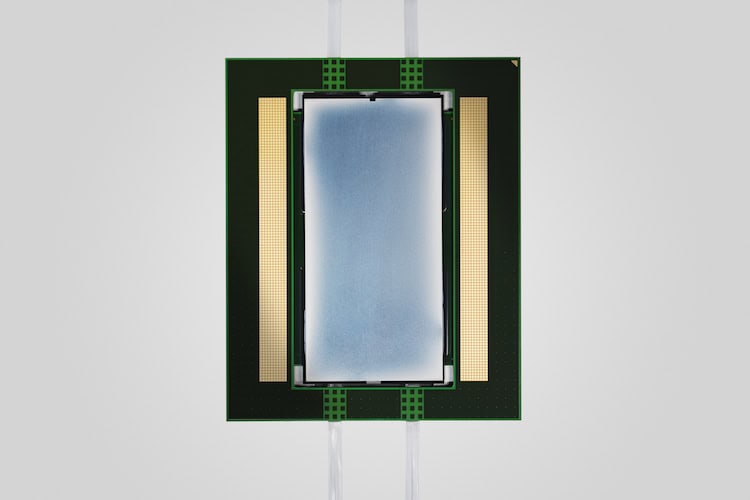
Photo of the Lightmatter device. A long bluish-grey rectangle flanked by thinner gold rectangles is mounted on a larger black rectangle. Wires lead in and out of the device.
Chip package: Lightmatter's design consists of six chips in a single package with high-speed interconnects between vertically aligned photonic tensor cores and control dies. (Courtesy: Lightmatter)


Researchers in Singapore and the US have independently developed two new types of photonic computer chips that match existing purely electronic chips in terms of their raw performance. Integrated with conventional silicon electronics, the chips could be used in energy-hungry technologies such as artificial intelligence (AI).

For nearly 60 years, the development of electronic computers proceeded according to two rules of thumb: Moore’s law (which states that the number of transistors in an integrated circuit doubles every two years) and Dennard scaling (which says that as the size of transistors decreases, their power density will stay constant).

Fluid electrodes make soft, stretchable batteries


Fluid electrodes make soft, stretchable batteries

01 May 2025 Isabelle Dumé
Photo showing four blue-gloved hands pulling at the corners of the battery, which resembles a coil of black gel on a clear plastic surface. The gel and the surface are visibly deformed by being pulled.
Bendy battery: Researchers at Linköping University have developed a battery that can take any shape. (Courtesy: Thor Balkhed)


Researchers at Linköping University in Sweden have developed a new fluid electrode to make a soft, malleable battery that can recharge and discharge over 500 cycles while maintaining its high performance. The device, which continues to function even when stretched to twice its length, might be used in next-generation wearable electronics.

Futuristic wearables such as e-skin patches, e-textiles, and even internal e-implants on the organs or nerves will need to conform far more closely to the contours of the human body than today’s devices can. To fulfil this requirement of being soft, stretchable, and flexible, such devices will need to be made from mechanically pliant components powered by soft, supple batteries. Today’s batteries, however, are mostly rigid. They also tend to be bulky because long-term operations and power-hungry functions such as wireless data transfer, continuous sensing, and complex processing demand plenty of stored energy.

Two-dimensional metals make their debut


Two-dimensional metals make their debut

14 Apr 2025 Isabelle Dumé
a researcher working in a glovebox
A researcher from the Chinese Academy of Sciences' Institute of Physics conducts research on two-dimensional (2D) metals in Beijing. (Courtesy: Chinese Academy of Sciences' Institute of Physics/Handout via Xinhua)

Researchers from the Institute of Physics of the Chinese Academy of Sciences have produced the first two-dimensional (2D) metal sheets. At just angstroms thick, these metal sheets could be an ideal system for studying the fundamental physics of the quantum Hall effect, 2D superfluidity and superconductivity, topological phase transitions, and other phenomena that feature tight quantum confinement. They might also be used to make novel electronic devices such as ultrathin low-power transistors, high-frequency devices, and transparent displays.

Axion quasiparticle appears in a topological antiferromagnet

Axion quasiparticle appears in a topological antiferromagnet

02 May 2025 Isabelle Dumé
Photo of Jian-Xiang Qiu and Suyang Xua posing with the apparatus they used to detect axion quasiparticles. The apparatus comprises lasers and other components mounted on an optical table. They're wearing laser safety glasses.
Adventures with axions: Jian-Xiang Qiu (left) and Suyang Xu with their experiment. (Courtesy: Dylan Goodman/The Harvard Gazette)
Physicists have observed axion quasiparticles for the first time in a two-dimensional quantum material. In addition to having applications in materials science, the discovery could aid the search for fundamental axions, which are promising (but so far hypothetical) candidates for the unseen dark matter pervading our universe.

Theorists first proposed axions in the 1970s to solve a puzzle involving the strong nuclear force and charge-parity (CP) symmetry. In systems that obey this symmetry, the laws of physics are the same for a particle and the spatial mirror image of its oppositely charged antiparticle.