Αναζήτηση αναρτήσεων

Πέμπτη 2 Οκτωβρίου 2025

Delft Circuits: cryogenic RF cable innovations offer a flexible path to quantum scalability


Delft Circuits: cryogenic RF cable innovations offer a flexible path to quantum scalability

22 Sep 2025 Sponsored by Delft Circuits

The Dutch manufacturer Delft Circuits is rewriting the rules of I/O cabling technology for full-stack quantum computing systems

As manufacturers in the nascent quantum supply chain turn their gaze towards at-scale commercial opportunities in quantum computing, the scenic city of Delft in the Netherlands is emerging as a heavyweight player in quantum science, technology, and innovation. At the heart of this regional quantum ecosystem is Delft Circuits, a Dutch manufacturer of specialist I/O cabling solutions, which is aligning its product development roadmap to deliver a core enabling technology for the scale-up and industrial deployment of next-generation quantum computing, communications, and sensing systems.

NASA criticized over its management of $3.3bn Dragonfly mission to Titan


NASA criticized over its management of $3.3bn Dragonfly mission to Titan

30 Sep 2025
Artist's impression of Dragonfly mission
Up in the air Cost overruns and delay have hit the drone-like rotorcraft Dragonfly mission to Titan. (Courtesy: NASA/Johns Hopkins APL/Steve Gribben)
An internal audit has slammed NASA over its handling of the Dragonfly mission to Saturn’s largest moon, Titan. The drone-like rotorcraft, designed to land on and gather samples from Titan, has faced a two-year delay, with costs surging by $1 billion to $3.3 billion. NASA now envisions a launch date of July 2028 with Dragonfly arriving at Titan in 2034.


NASA chose Dragonfly in June 2019 as the next mission under its New Frontiers programme. Managed by the Johns Hopkins University Applied Physics Laboratory, it is a nuclear-powered, car-sized craft with eight rotors.

Large-scale commercial applications of quantum computing remain a distant promise, claims report


Large-scale commercial applications of quantum computing remain a distant promise, claims report

28 Jun 2025
quantum computer conceptual illustration
Growing demand: the Massachusetts Institute of Technology (MIT) Quantum Index Report 2025 finds that jobs in the quantum sector have tripled in the US since 2018. (Courtesy: istock/olemedia)
Quantum technology is rapidly growing, with job demand tripling in the US, alongside venture capital investments bringing in billions of dollars to the field. That is according to the inaugural Massachusetts Institute of Technology (MIT) Quantum Index Report 2025, which finds, however, that large-scale commercial applications for quantum computing still remain “far off”.
Conducted by the Initiative on the Digital Economy (IDE) at MIT, the report is based on data collected from academia, industry, and policy sources. It aims to track, measure, and visualize trends across various areas, including education, funding, research, and development.

Quantum gas keeps its cool


Quantum gas keeps its cool

19 Sep 2025 Isabelle Dumé
many-body dynamical localization
A frozen state Despite being continually kicked and strongly interacting, the atoms no longer absorb energy. The system localizes in momentum space, the momentum distribution literally freezes, a remarkable phenomenon termed many-body dynamical localization. (Courtesy: Universität Innsbruck)
Adding energy to a system usually heats it up, but physicists at the University of Innsbruck in Austria have now discovered a scenario in which this is not the case. Their new platform – a one-dimensional fluid of strongly interacting atoms cooled to just a few nanokelvin above absolute zero and periodically “kicked” using an external force – could be used to study how objects transition from being quantum and ordered to classical and chaotic.
Our everyday world is chaotic, and chaos plays a crucial and often useful role in many areas of science – from nonlinear complex systems in mathematics, physics, and biology to ecology, meteorology, and economics.

Physicists extend the wave nature of large objects


Physicists extend the wave nature of large objects

19 Sep 2025 Candice Chua 
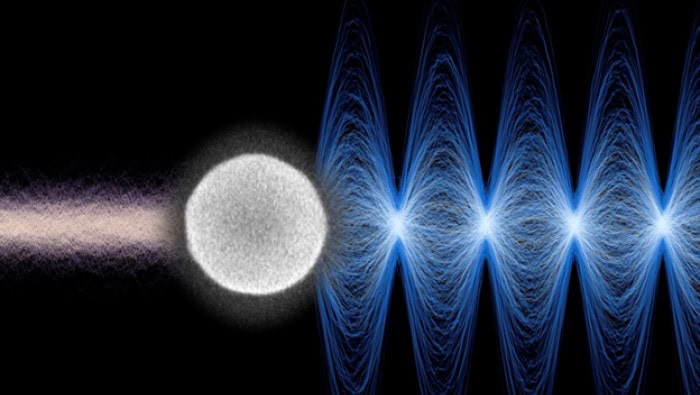
Illustration of strong delocalization in a nanoparticle
Quantum delocalization In an artistic rendering, a silica nanoparticle is held by laser light. The uncertainty in the particle’s position spreads and recompresses (blue trajectories), illustrating extended wave behaviour known as quantum delocalization. (Courtesy: Nicola Carlon Zambon)
Can quantum mechanics fully describe macroscopic reality? Everyday objects are typically well-described by classical mechanics, whereas atomic-scale objects are governed by quantum mechanics. Exploring the boundary between the two domains could enable fundamental tests of quantum mechanics and the development of new sensing technologies for gravitational measurements.
Now, a team of researchers at Switzerland’s ETH Zürich and Spain’s Institute of Photonic Sciences in Barcelona has taken an important step towards bridging the two regimes by extending the quantum wave nature of nanoparticles — objects a thousand times larger than atoms.

Negative time observed in photon-atom interaction


Negative time observed in photon-atom interaction

23 Sep 2025
Abstract rotating clock spiral
Surprising finding New results lead researchers to think more deeply about the meaning of “negative time”. (Courtesy: iStock/FlashMovie)
“Negative time” might sound like science fiction, but an international team of theorists and experimentalists has determined that a photon can, in fact, spend a negative amount of time in an excited atomic state while passing through a cloud of atoms. The finding could have applications in studies of light-matter interactions and quantum sensing – though not, alas, in time travel or other sensational effects.

Quantum mechanics has yielded numerous unexpected results, and the latest one originated in 2022 with an experiment conducted by physicists at the University of Toronto in Canada.

Παρασκευή 6 Ιουνίου 2025


New analysis of M67 cluster helps decode the sound of stars

03 Jun 2025 Sabnam Shrestha
Listening to starquakes Artistic impression of acoustic waves in the interior of a star. Red and blue represent displacements in opposite directions. (Courtesy: ESO)

Stars are cosmic musical instruments: they vibrate with complex patterns that echo through their interiors. These vibrations, known as pressure waves, ripple through the star, similar to the earthquakes that shake our planet. The frequencies of these waves hold information about the star’s mass, age and internal structure.