Accelerator experiment sheds light on missing blazar radiation
24 Nov 2025
Stable discovery The Fireball experiment installed in the HiRadMat irradiation area at CERN. (Courtesy: Gianluca Gregori)
New experiments at CERN by an international team have ruled out a potential source of intergalactic magnetic fields. The existence of such fields is invoked to explain why we do not observe secondary gamma rays originating from blazars.
Led by Charles Arrowsmith at the University of Oxford, the team suggests that the absence of gamma rays could result from an unexplained phenomenon that occurred in the early universe.
A blazar is an extraordinarily bright object with a supermassive black hole at its core. Some of the matter falling into the black hole is accelerated outwards in a pair of opposing jets, creating intense beams of radiation.
Did cannibal stars and boson stars populate the early universe?
26 Nov 2025
Early exotica: Were cannibal stars and boson stars created just after the Big Bang? (Courtesy: Shutterstock/Tomertu)
In the early universe, moments after the Big Bang and cosmic inflation, clusters of exotic, massive particles could have collapsed to form bizarre objects called cannibal stars and boson stars. In turn, these could have then collapsed to form primordial black holes – all before the first elements were able to form.
This curious chain of events is predicted by a new model proposed by a trio of scientists at SISSA, the International School for Advanced Studies in Trieste, Italy.
Their proposal involves a hypothetical period in the early universe known as the early matter-dominated (EMD) epoch.
Dark centre? A simulated version of the Milky Way galaxy. (Courtesy: AIP/ A. Khalatyan)
Astronomers have long puzzled over the cause of a mysterious “glow” of very high-energy gamma radiation emanating from the centre of our galaxy. One possibility is that dark matter – the unknown substance thought to make up more than 25% of the universe’s mass – might be involved. Now, a team led by researchers at Germany’s Leibniz Institute for Astrophysics Potsdam (AIP) says that a flattened rather than spherical distribution of dark matter could account for the glow’s properties, bringing us a step closer to solving the mystery.
Dark matter is believed to be responsible for holding galaxies together. However, because it does not interact with light or other electromagnetic radiation, it can be detected only through its gravitational effects.
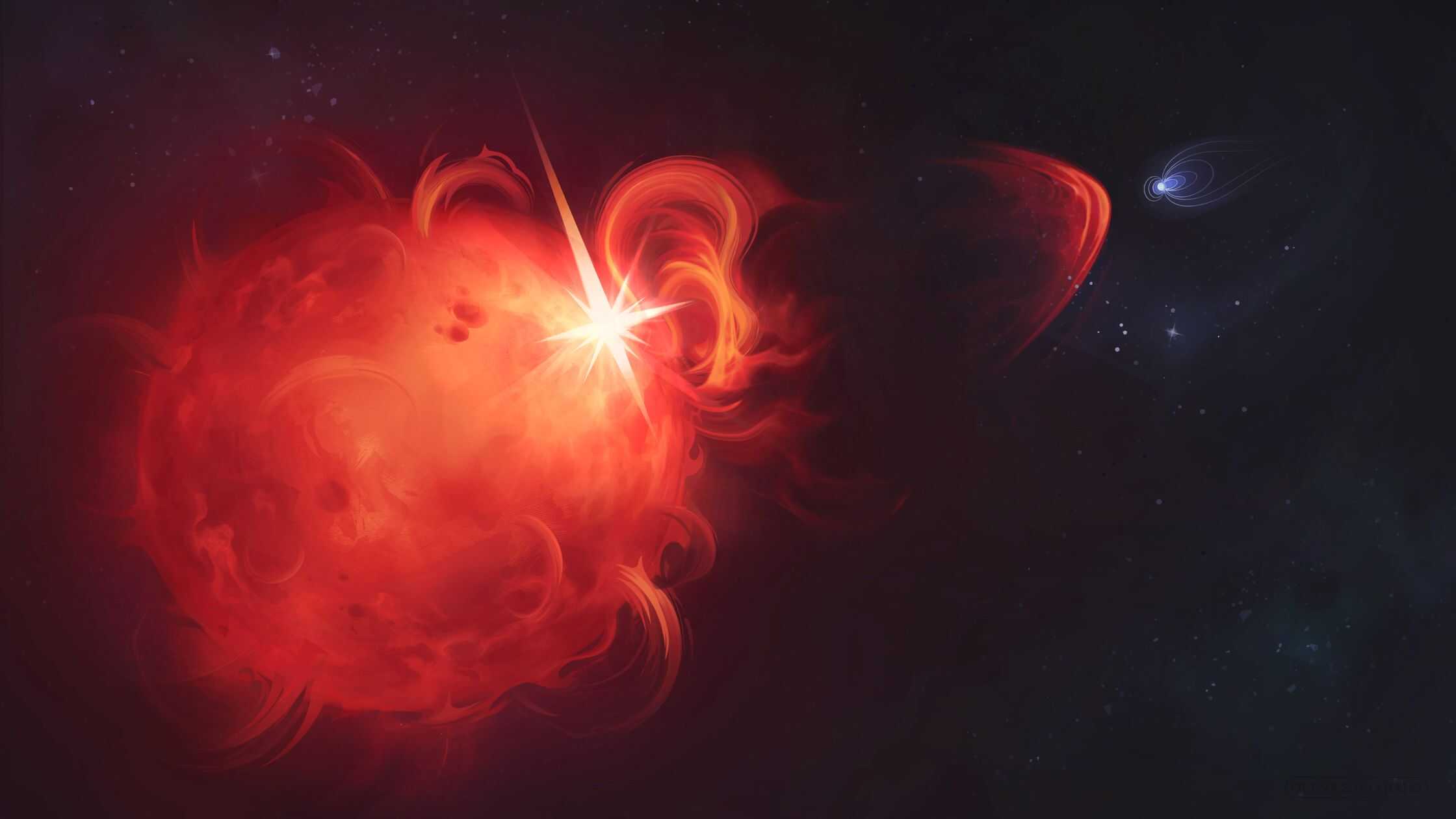
Explosive: An artist’s impression of a coronal mass ejection from another star. (Courtesy: Olena Shmahalo/Callingham et al.)
The Sun regularly produces energetic outbursts of electromagnetic radiation called solar flares. When these flares are accompanied by flows of plasma, they are known as coronal mass ejections (CMEs). Now, astronomers at the Netherlands Institute for Radio Astronomy (ASTRON) have spotted a similar event occurring on a star other than our Sun – the first unambiguous detection of a CME outside our solar system.
The Eigenstate Thermalization Hypothesis by Jorge Kurchan
ORGANIZERS: Jacopo De Nardis (Cergy Paris University, France), Gautam Mandal (ICTS-TIFR, Bengaluru, India), and Tridib Sadhu (TIFR, Mumbai, India)
DATE: 01 December 2025 to 12 December 2025
VENUE: Ramanujan Lecture Hall, ICTS Bengaluru
Understanding nonequilibrium thermodynamics remains a major challenge across statistical physics. Over the past two decades, significant progress has been made across multiple fronts.
In classical systems, nonlinear fluctuating hydrodynamics has revealed universal structures in ballistic transport, while the Macroscopic Fluctuation Theory (MFT) has provided access to thermodynamic fluctuations in stochastic systems.
Parallel breakthroughs in isolated quantum systems—driven by cold-atom experiments—have prompted a rethinking of thermalization, chaos, and transport. Concepts such as Generalized Gibbs Ensembles, Generalized Hydrodynamics (GHD), many-body localization, and dynamical and measurement-induced phase transitions have emerged. Many of these quantum tools mirror classical ones: GHD is a deformation of hard-rod gas theory, and charge-transport statistics in chaotic quantum matter are governed by classical MFT, with quantum corrections superimposed. Even the complete counting statistics of quantum charge flow echo current fluctuations in classical lattice gases.
A third front arises from string theory, particularly through the AdS/CFT correspondence. Here, black hole geometries map onto relativistic Navier–Stokes equations via the fluid-gravity duality; thermal relaxation corresponds to quasi-normal mode decay, and entanglement growth becomes geometric surface evolution. Matrix-model techniques likewise illuminate thermalization in low-dimensional fermionic systems.
Despite these converging themes, the classical, quantum, and string-theory communities rarely interact. This workshop aims to bring these three communities together through focused talks, pedagogical lectures, and discussion sessions, fostering new collaborations on nonequilibrium hydrodynamics.
CONTACT US
hydrodynamics@icts.res.in
PROGRAM LINK
https://icts.res.in/program/hydrodyna... Hydrodynamics in an Exclusion
Process with Long-Range Interactions
Jérôme Dubail
Dutch-Finnish industry partnership establishes a ‘one-stop shop’ to deliver scalable cryogenic I/O cabling assemblies for quantum science and technology applications.
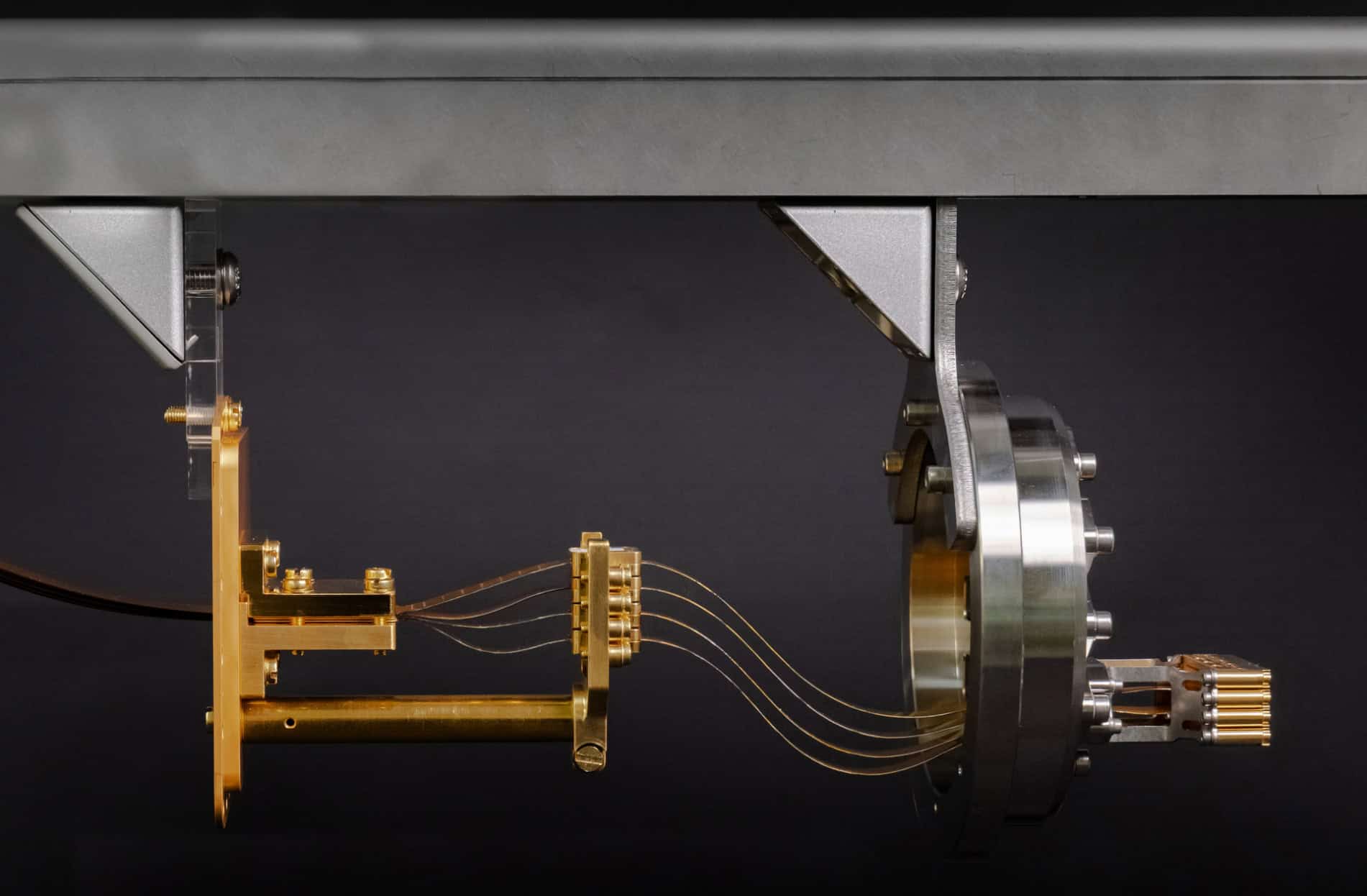
At-scale quantum. By integrating Delft Circuits’ Cri/oFlex® cabling technology (above) into Bluefors’ dilution refrigerators, the vendors’ combined customer base will benefit from an industrially proven and fully scalable I/O solution for their quantum systems. Cri/oFlex® cabling combines fully integrated filtering with a compact footprint and low heat load. (Courtesy: Delft Circuits)
Better together. That’s the headline take on a newly inked technology partnership between Bluefors, a heavyweight Finnish supplier of cryogenic measurement systems, and Delft Circuits, a Dutch manufacturer of specialist I/O cabling solutions designed for the scale-up and industrial deployment of next-generation quantum computers.
The drivers behind the tie-up are clear: as quantum systems evolve – think vastly increased qubit counts plus ever-more exacting requirements on gate fidelity – developers in research and industry will reach a point where current coax cabling technology doesn’t cut it anymore.
Ερευνητές πέτυχαν την πρώτη κβαντική τηλεμεταφορά μεταξύ φωτονίων – Βήμα προς το κβαντικό διαδίκτυο
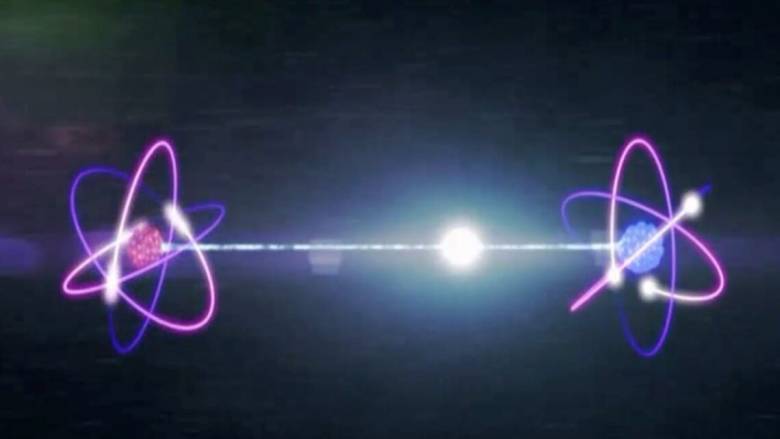
Καλλιτεχνική απεικόνιση κβαντικής τηλεμεταφοράς μεταξύ φωτονίων BlueQubit
Η ασφάλεια της ψηφιακής ζωής παραμένει εύθραυστη, καθώς οι κυβερνοεπιθέσεις γίνονται ολοένα πιο σύνθετες χάρη στην τεχνητή νοημοσύνη.
Η κβαντική κρυπτογραφία προβάλλει ως μια πιθανή απάντηση στο παραπάνω πρόβλημα: αξιοποιεί θεμελιώδεις αρχές της κβαντικής φυσικής για τη μετάδοση πληροφοριών με τρόπο που καθιστά σχεδόν αδύνατη την υποκλοπή χωρίς να εντοπιστεί ο δράστης. Ωστόσο, η ανάπτυξη της τεχνολογίας που απαιτείται για ένα λειτουργικό κβαντικό διαδίκτυο εξακολουθεί να προσκρούει σε σημαντικά επιστημονικά εμπόδια, αναφέρει το SciTechDaily.