Αναζήτηση αναρτήσεων

Πέμπτη 25 Δεκεμβρίου 2025

Quantum gravity: we explore spin foams and other potential solutions to this enduring challenge


Quantum gravity: we explore spin foams and other potential solutions to this enduring challenge

27 Nov 2025 Hamish Johnston

Earlier this autumn I had the pleasure of visiting the Perimeter Institute for Theoretical Physics in Waterloo Canada – where I interviewed four physicists about their research. This is the second of those conversations to appear on the podcast – and it is with Bianca Dittrich, whose research focuses on quantum gravity.
Albert Einstein’s general theory of relativity does a great job at explaining gravity, but it is thought to be incomplete because it is incompatible with quantum mechanics. This is a critical shortcoming because quantum mechanics is widely regarded as one of science’s most successful theories.

Τετάρτη 24 Δεκεμβρίου 2025

Quantum-scale thermodynamics offers a tighter definition of entropy

Quantum-scale thermodynamics offers a tighter definition of entropy

03 Dec 2025
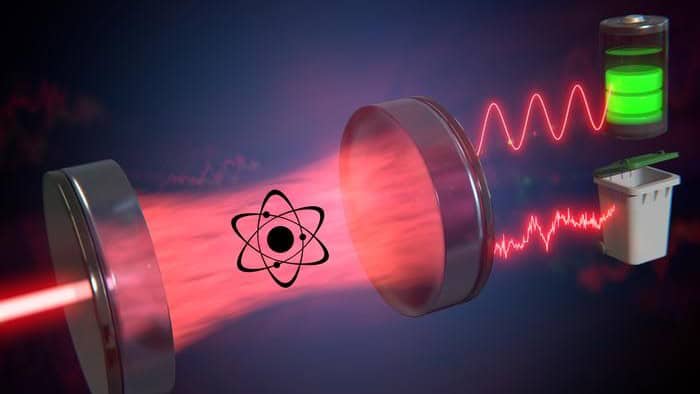
Illustration of the application of the new thermodynamics
How it works: When laser light passes through a cavity filled with atoms, part of it can do practical work. In this example, the work is used to charge a quantum battery (top). The remainder of the light is converted into "heat" (bottom). (Courtesy: Enrique Sahagún, Scixel/University of Basel, Department of Physics)
Researchers in Switzerland and Germany have proposed a new microscopic formulation of the second law of thermodynamics for coherently driven quantum systems. The researchers applied their formulation to several canonical quantum systems, such as a three-level maser. The result provides a tighter definition of entropy in such systems and could serve as a basis for further exploration.
In any physical process, the first law of thermodynamics states that the total energy must be conserved, with some converted to practical work and the remainder dissipated as heat. The second law of thermodynamics says that, in any allowed process, the total amount of heat (the entropy) must always increase.

Κυριακή 21 Δεκεμβρίου 2025

Looking for inconsistencies in the fine structure constant


Looking for inconsistencies in the fine structure constant

01 Dec 2025 Isabelle Dumé
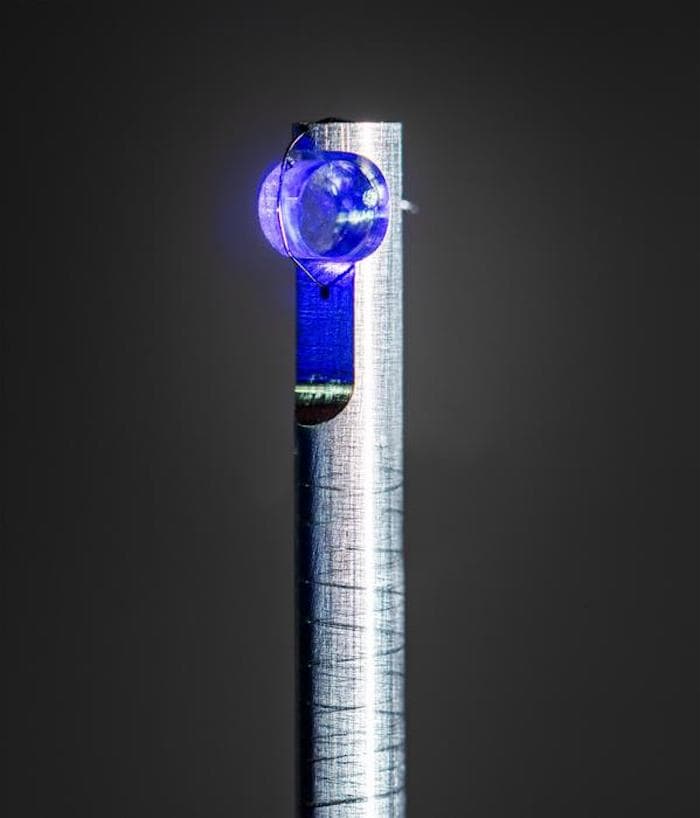
a crystal containing thorium atoms

New high-precision laser spectroscopy measurements on thorium-229 nuclei could shed more light on the fine structure constant, which determines the strength of the electromagnetic interaction, say physicists at TU Wien in Austria.

The electromagnetic interaction is one of the four known fundamental forces in nature, with the others being gravity and the strong and weak nuclear forces. Each of these fundamental forces has an interaction constant that quantifies its strength relative to the others. The fine structure constant, α, has a value of approximately 1/137. If it had any other value, charged particles would behave differently, chemical bonding would manifest in another way, and light-matter interactions as we know them would not be the same.

As the name ‘constant’ implies, we assume that these forces are universal and have the same values at all times and everywhere in the universe,” explains study leader Thorsten Schumm from the Institute of Atomic and Subatomic Physics at TU Wien.

Σάββατο 20 Δεκεμβρίου 2025

Physicists use a radioactive molecule’s own electrons to probe its internal structure


Physicists use a radioactive molecule’s own electrons to probe its internal structure

04 Dec 2025 Isabelle Dumé
the radium atom’s pear-shaped nucleus
Where the electrons hang out: This image depicts the radium atom’s pear-shaped nucleus of protons and neutrons in the centre, surrounded by a cloud of electrons (yellow), and an electron (yellow ball with arrow) that has a probability to be inside the nucleus. In the background is the spherical nucleus of a fluoride atom, which joins to form the overall molecule of radium monofluoride. (Courtesy: Ronald Fernando Garcia Ruiz, Shane Wilkins, Silviu-Marian Udrescu et al
Physicists have obtained the first detailed picture of the internal structure of radium monofluoride (RaF) thanks to the molecule’s own electrons, which penetrated the nucleus of the molecule and interacted with its protons and neutrons. This behaviour is known as the Bohr-Weisskopf effect, and study co-leader Shane Wilkins says that this marks the first time it has been observed in a molecule. The measurements themselves, he adds, are an essential step towards testing for nuclear symmetry violation, which might explain why our universe contains much more matter than antimatter.

‘Patchy’ nanoparticles emerge from new atomic stencilling technique


‘Patchy’ nanoparticles emerge from new atomic stencilling technique

25 Nov 2025 Isabelle Dumé
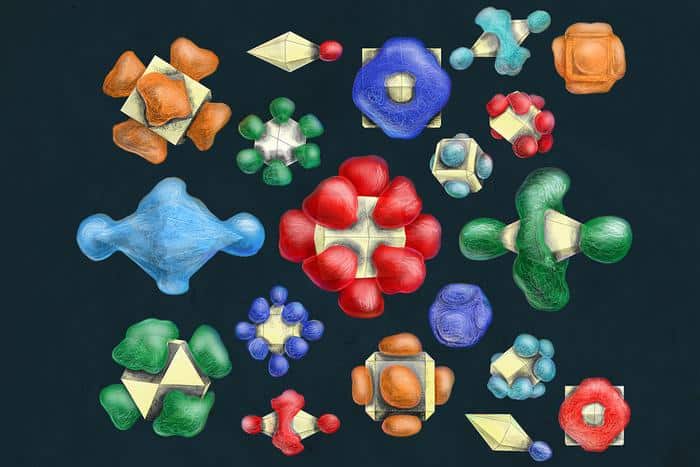
Image showing a variety of patterned patchy nanoparticles with new shapes and properties. They're brightly coloured against a black background
Patch as patch can: With atomic stencilling, researchers have made a variety of patterned patchy nanoparticles with new shapes and properties. (Courtesy: University of Illinois/Illustration by Maayan Harel)
Researchers in the US and Korea have created nanoparticles with carefully designed “patches” on their surfaces using a new atomic stencilling technique. These patches can be controlled with incredible precision and could find use in targeted drug delivery, catalysis, microelectronics, and tissue engineering.

The first step in the stencilling process is to create a mask on the surface of gold nanoparticles. This mask prevents a “paint” composed of grafted polymers from adhering to some regions of the nanoparticles.

Will this volcano explode, or just ooze? A new mechanism could hold some answers


Will this volcano explode, or just ooze? A new mechanism could hold some answers

15 Dec 2025 Isabelle Dumé
A figure containing a diagram of a volcanic system and a photo of bubbles forming in a container
An international team of researchers has discovered a new mechanism that can trigger the formation of bubbles in magma – a major driver of volcanic eruptions. The finding could improve our understanding of volcanic hazards by improving models of magma flow through conduits beneath Earth’s surface.

Volcanic eruptions are thought to occur when magma deep within the Earth’s crust decompresses. This decompression allows volatile chemicals dissolved in the magma to escape as gas, producing bubbles. The more bubbles there are in the viscous magma, the faster it will rise, until eventually it tears itself apart.