Αναζήτηση αναρτήσεων

Πέμπτη 5 Φεβρουαρίου 2026

Using AI boosts scientific productivity and career prospects, finds study

 

Using AI boosts scientific productivity and career prospects, finds study

04 Feb 2026
AI logo on a chip, with blue light glowing against a dark.
Lab bot: AI chatbots are increasingly being used as collaborators in day-to-day research, from experiment planning and literature synthesis to mathematical reasoning and data analysis. (Courtesy: Shutterstock/Anggalih Prasetya)
Using artificial intelligence (AI) increases scientists’ productivity and impact but collectively leads to a shrinking of research focus. That is according to an analysis of more than 41 million research papers by scientists in China and the US, which finds that scientists who produce AI-augmented research also progress faster in their careers than their colleagues who do not (Nature 649 1237).

The study was conducted by James Evans, a sociologist at the University of Chicago, and his colleagues, who analysed 41.3 million papers listed in the OpenAlex dataset, published between 1980 and 2025. They examined papers in physics and five other disciplines: biology, chemistry, geology, materials science, and medicine.

The Future Circular Collider is unduly risky – CERN needs a ‘Plan B.’


The Future Circular Collider is unduly risky – CERN needs a ‘Plan B.’

29 Jan 2026

The fragmenting world order makes plans to build the Future Circular Collider questionable, warns Michael Riordan

Artist's illustration of the FCC
Cost measures CERN is proposing the Future Circular Collider to study the Higgs boson in great detail, but can it afford the $18bn price tag? (Courtesy: CERN/Polar Media)
Last November, I visited the CERN particle-physics lab near Geneva to attend the 4th International Symposium on the History of Particle Physics, which focused on advances in particle physics during the 1980s and 1990s. As usual, it was a refreshing, intellectually invigorating visit. I’m always inspired by the great diversity of scientists at CERN – complemented this time by historians, philosophers, and other scholars of science.

As noted by historian John Krige in his opening keynote address, “CERN is a European laboratory with a global footprint. Yet for all its success, it now faces a turning point.” During the period under examination at the symposium, CERN essentially achieved the “world laboratory” status that various leaders of particle physics had dreamt of for decades.

Twenty-three nominations, yet no Nobel prize: how Chien-Shiung Wu missed out on the top award in physics


Twenty-three nominations, yet no Nobel prize: how Chien-Shiung Wu missed out on the top award in physics

03 Feb 2026

Many have wondered why the Chinese-American physicist Chien-Shiung Wu never won a share of the 1957 Nobel Prize for Physics for her experimental verification of parity violation. Mats Larsson and Ramon Wyss reveal the true story after becoming the first people to open that year’s Nobel archives

Experienced experimentalist Chien-Shiung Wu in 1958, the year after she first missed out on the Nobel Prize for Physics. (Courtesy: Smithsonian Institution Archives)

The facts seem simple enough. In 1957, Chen Ning Yang and Tsung-Dao Lee won the Nobel Prize for Physics “for their penetrating investigation of the so-called parity laws, which have led to important discoveries regarding the elementary particles”. The idea that parity is violated shocked physicists, who had previously assumed that every process in nature remains the same if you reverse all three spatial coordinates.

String-theory concept boosts understanding of biological networks


String-theory concept boosts understanding of biological networks

27 Jan 2026
Artist's impression of a biological neural network
Branching out The new model addresses higher order junctions like those shown in this artist’s impression of a biological neural network. (Courtesy: iStock/Ktsimage)
Many biological networks – including blood vessels and plant roots – are not organized to minimize total length, as long assumed. Instead, their geometry is governed by a principle of surface minimization, a rule also prevalent in string theory. That is the conclusion of physicists in the US, who have created a unifying framework that explains structural features long seen in real networks but poorly captured by traditional mathematical models.

Biological transport and communication networks have fascinated scientists for decades. Neurons branch to form synapses, blood vessels split to supply tissues, and plant roots spread through soil.

Τετάρτη 4 Φεβρουαρίου 2026

Bidirectional scattering microscope detects micro- and nanoscale structures simultaneously


Bidirectional scattering microscope detects micro- and nanoscale structures simultaneously

09 Jan 2026 Isabelle Dumé
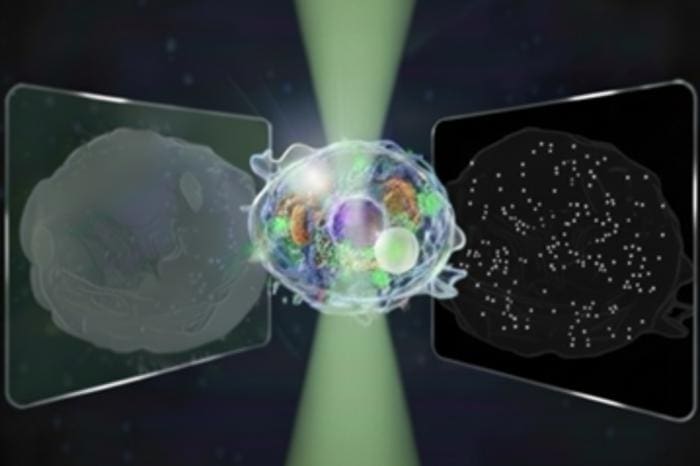
Conceptual illustration of the bidirectional quantitative scattering microscope
Two techniques in one Conceptual illustration of the bidirectional quantitative scattering microscope, which detects both forward and backward scattered light from cells. This dual detection enables visualization of structures ranging from whole-cell morphology to nanoscale particles. (Courtesy: Horie et al 2025)
A new microscope that can simultaneously measure forward- and backward-scattered light from a sample could enable researchers to image micro- and nanoscale objects simultaneously. The device could be used to observe structures as small as individual proteins, as well as the environment in which they move, say the researchers at the University of Tokyo who developed it.

“Our technique could help us link cell structures with the motion of tiny particles inside and outside cells,” explains Kohki Horie of the University of Tokyo’s department of physics, who led this research effort. “Because it is label-free, it is gentler on cells and better for long observations. In the future, it could help quantify cell states, holding potential for drug testing and quality checks in the biotechnology and pharmaceutical industries.”

Light pollution from satellite mega-constellations threatens space-based observations


Light pollution from satellite mega-constellations threatens space-based observations

04 Dec 2025 Michael Banks
Streaks from Starlink satellites
Obstructed view: The study finds that 96% of images from planned telescopes could be compromised by satellite constellations. (Courtesy: CTIO/NOIRLab/NSF/AURA/DECam DELVE Survey)
Almost every image that will be taken by future space observatories in low-Earth orbit could be tainted due to light contamination from satellites. That is according to a new analysis by NASA researchers, who emphasize that satellite-induced light pollution must be reduced to ensure that astronomical research is not affected.

The number of satellites orbiting Earth has increased from about 2000 in 2019 to 15 000 today. Many of these are part of so-called mega-constellations that provide global Internet coverage, including in areas previously unable to access it. Examples of such constellations include SpaceX’s Starlink, as well as Amazon’s Kuiper and Eutelsat’s OneWeb.

New cosmic map will put dark-matter theories to the test


New cosmic map will put dark-matter theories to the test

03 Feb 2026
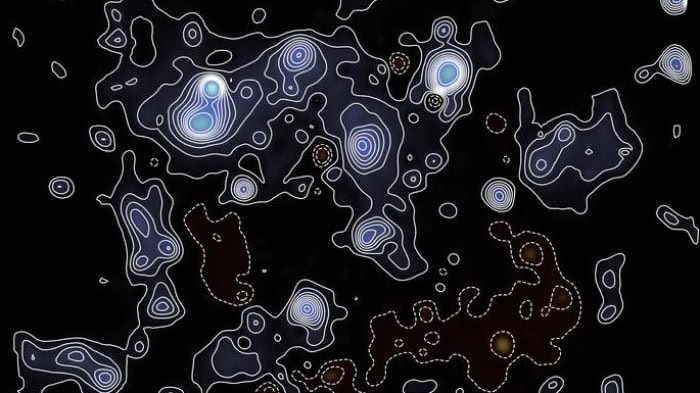
JWST map of a portion of the cosmic web
Cosmic web Created using data from the JWST, this map shows how dark matter acts as the hidden framework on which visible galaxies are built. The overlaid contours mark regions of equal dark-matter density, highlighting where this invisible matter (shown in blue false colour) is most strongly concentrated. (Courtesy: Gavin Leroy/COSMOS-Webb collaboration)
Astronomers have created the most detailed map to date of the vast structures of dark matter that appear to permeate the universe. Using the James Webb Space Telescope (JWST), the team, led by Diana Scognamiglio at NASA’s Jet Propulsion Laboratory, used gravitational lensing to map the dark matter filaments and clusters with unprecedented resolution. As a result, physicists have new and robust data to test theories of dark matter.

Dark matter is a hypothetical substance that appears to account for about 85% of the mass in the universe – yet it has never been observed directly. Dark matter is invoked by physicists to explain the dynamics and evolution of large-scale structures in the universe.