Αναζήτηση αναρτήσεων

Σάββατο 7 Φεβρουαρίου 2026

Feynman Explains Why the Past Still Exists Right Now?


 

Feynman Explains Why the Past Still Exists Right Now?

Feynman Explains Why and How Magnets Work?


 Feynman Explains Why and How Magnets Work?

Understanding Gravity with Richard Feynman


 Understanding Gravity with Richard Feynman

24 Minutes of Richard Feynman Explaining Force | The Hidden Rules Behind Motion


 24 Minutes of Richard Feynman Explaining Force | The Hidden Rules Behind Motion

Feynman Explains Why light does not move


Feynman Explains Why light does not move
 

Πέμπτη 5 Φεβρουαρίου 2026

Saving the Titanic: the science of icebergs and unsinkable ships


Saving the Titanic: the science of icebergs and unsinkable ships

30 Jan 2026 Margaret Harris
Photo showing a raft of six battered-looking metal tubes floating on the surface of a water. Everything is bathed in blue light and a few bubbles are present.
Out of the depths: Multiple unsinkable metal tubes linked together in a raft formation could be the basis for the ships, buoys, and floating platforms of the future. (Courtesy: University of Rochester photo / J Adam Fenster)
When the Titanic was built, her owners famously described her as “unsinkable”. A few days into her maiden voyage, an iceberg in the North Atlantic famously proved them wrong. But what if we could make ships that really are unsinkable? And what if we could predict exactly how long a hazardous iceberg will last before it melts?

These are the premises of two separate papers published independently this week by Chunlei Guo and colleagues at the University of Rochester, and by Daisuke Noto and Hugo N Ulloa of the University of Pennsylvania, both in the US. The Rochester group’s paper, which appears in Advanced Functional Materials, describes how applying a superhydrophobic coating to an open-ended metallic tube can make it literally unsinkable – a claim supported by extensive tests in a water tank. Noto and Ulloa’s research, which they describe in Science Advances, likewise involved a water tank.
Extra carbon in the atmosphere may disrupt radio communications


Extra carbon in the atmosphere may disrupt radio communications

02 Dec 2025 Isabelle Dumé
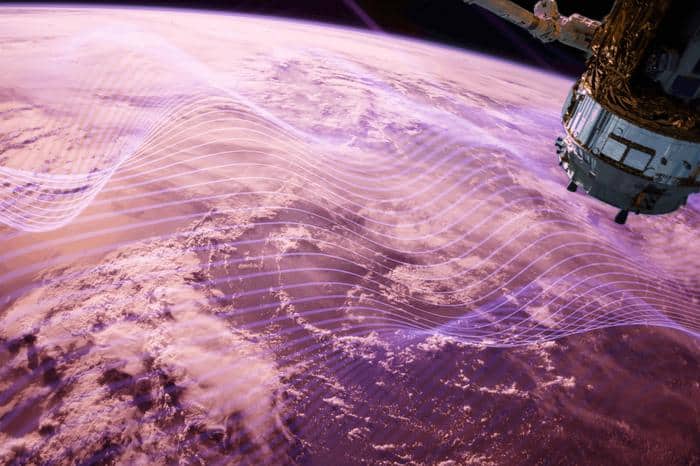
photo of satellite above Earth showing a visualization of radio waves in the ionosphere
Radio waves in the ionosphere. Photo of the Earth with radio waves, depicted in purple, flowing across it. HF and VHF waves travel through the ionosphere, but a phenomenon called sporadic-E can interfere with these frequencies. (Courtesy: Huixin Liu/Kyushu University)
Higher levels of carbon dioxide (CO2) in the Earth’s atmosphere could harm radio communications by enhancing a disruptive effect in the ionosphere. According to researchers at Kyushu University, Japan, who modelled the effect numerically for the first time, this little-known consequence of climate change could have significant impacts on shortwave radio systems such as those employed in broadcasting, air traffic control, and navigation.

“While increasing CO2 levels in the atmosphere warm the Earth’s surface, they actually cool the ionosphere,” explains study leader Huixin Liu of Kyushu’s Faculty of Science. “This cooling doesn’t mean it is all good: it decreases the air density in the ionosphere and accelerates wind circulation. These changes affect the orbits and lifespan of satellites and space debris and also disrupt radio communications through localized small-scale plasma irregularities.”