Αναζήτηση αναρτήσεων

Παρασκευή 26 Απριλίου 2019

Piezoelectric performance doubles up

Piezoelectric performance doubles up

25 Apr 2019 Belle Dumé


Piezoelectric materials are widely employed as transducers and sensors in a variety of applications, including ultrasound medical imaging systems. Researchers have now nearly doubled the performance of a class of piezoelectrics, known as relaxor ferroelectrics, which were discovered 20 years ago, by adding trace amounts of the element samarium (Sm) to them. The rare-earth doping technique, which appears to increase local structural heterogeneity in the crystals, could be a general strategy for enhancing the piezoelectricity of these materials. Lead author of the story, Fei Li. Courtesy: Fei Li

The discovery of relaxor ferroelectric single crystals, such as Pb(Mg1/3Nb2/3)O3-PbTiO3 (PMN-PT) and Pb(Zn1/3Nb2/3)O3-PbTiO3 (PZN-PT), was a milestone achievement in ferroelectric research, explain the researchers of Xi’an Jiaotong University in China, Pennsylvania State University in the US and the University of Wollongong in Australia. These materials, which have been optimized over time, have very high piezoelectric coefficients (the amount of charge generated for each unit of force) of 1200 to 2500 picocoulombs per newton.


Exotic nuclear decay observed in dark-matter detector

Exotic nuclear decay observed in dark-matter detector


24 Apr 2019 Hamish Johnston


 An exotic and extremely rare nuclear decay that involves the simultaneous capture of two atomic electrons by a xenon-124 nucleus has been observed in a dark-matter detector. Physicists in the XENON Collaboration have measured the half-life of the two-neutrino double electron capture process to be about 1022 years, which is about one trillion times the age of the universe. Studying this rare decay could shed light on a related process called neutrinoless double electron capture, which if observed, would reveal important information about the nature of the neutrino that goes beyond Standard Model of particle physics.

Electron capture is a common mode of nuclear decay that occurs when an atomic electron interacts with a proton in the nucleus to create a neutron and an electron neutrino. Two-neutrino double electron capture occurs when two electrons are captured at once and is a much rarer process.

Acoustic tracking shows thresher sharks are early birds

Acoustic tracking shows thresher sharks are early birds

25 Apr 2019
Pelagic thresher shark, Alopias pelagicus, at Monad Shoal near Malupascua island in the Philippines. The sharks visit this seamount where bluestreak cleaner wrasse, Labroides dimidiatus, remove parasites from their skin, gills and cloacal region. (Image courtesy: Louise Murray)

Pelagic thresher sharks visit the Monad Shoal seamount in the Philippines so that cleaner wrasse eat the parasites that infest their skin and gills. In turn, the sharks attract scuba divers from around the world. The local economy near Malupascua Island receives 80% of its income from dive tourism and local people have taken measures to protect the sharks – the Bantay Dagat community–based organisation guards the area against illegal fishing day and night.


When they venture further afield, these sharks, which are found in the Indian and Pacific Oceans, are at risk from fishing lines set for smaller fish, and from capture for their meat, fins, skin, and liver oil. Combined with the animals’ slow reproduction, these pressures mean that numbers of pelagic thresher sharks are declining. The species is listed as vulnerable by the International Union for the Conservation of Nature.

Until recently, however, scientists had little idea how far individuals that visit the seamount roam. With that in mind, Simon Oliver of the University of Chester, UK, and his colleagues tagged pelagic thresher sharks and tracked their whereabouts acoustically.

“We decided that we needed to understand how these animals use this part of the Indo-Pacific Ocean in order to better protect them,” said Oliver, who has studied threshers for 15 years and was the first to explain why these sharks frequent the seamount.

Huge Chinese cosmic-ray observatory begins operation

Huge Chinese cosmic-ray observatory begins operation

26 Apr 2019 Michael Banks


One of the world’s largest and most sensitive cosmic-ray facilities has begun operation with its first set of detectors. Located about 4410 m above sea level in the Haizi Mountain in Sichuan Province in southwest China, the 1.2 billion yuan ($180m) Large High Altitude Air Shower Observatory (LHAASO) will attempt to understand the origins of high-energy cosmic rays.

Cosmic rays are particles that originate in outer space and are accelerated to energies higher than those that can be achieved in even the largest man-made particle accelerators.

Did the Romans build seismic invisibility cloaks?

Did the Romans build seismic invisibility cloaks?


Ancient Romans may have built structures that acted like invisibility cloaks long before physicists had any idea about metamaterials or transformation optics. That is the surprising claim from researchers in France, who found that the pattern of foundations in some Roman theatres and amphitheatres very closely resembles the features of electromagnetic cloaking devices. They say that these “archaeological metamaterials” could have indirectly provided protection against earthquakes, by bending seismic waves around the arenas.

Supersolid behaviour spotted in dipolar quantum gases

Supersolid behaviour spotted in dipolar quantum gases

20 Apr 2019


Atomic systems that behave very much like supersolids have been created independently by teams of physicists in Italy, Germany have Austria. The teams have shown that dipolar quantum gases trapped by magnetic fields can spontaneously separate into arrays of coherent droplets, providing a system closer to the original conception of a supersolid.

The supersolid phase is a counterintuitive quantum state of matter that has both crystalline order and frictionless flow at very low temperatures. The phenomenon is related to superfluidity and was predicted 50 years ago by Soviet physicists Alexander Andreev and Ilya Lifschitz. However, supersolidity has proved frustratingly difficult to observe.

Παρασκευή 19 Απριλίου 2019

Negative order appears in liquid crystals

Negative order appears in liquid crystals

18 Apr 2019 Belle Dumé


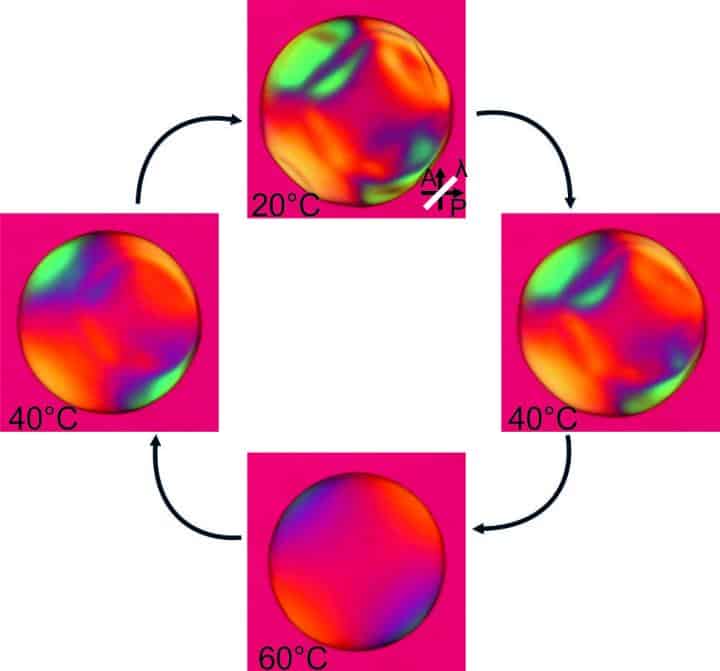
Researchers have observed spontaneous negative orientational order in a liquid crystal material for the first time. The result, obtained quite by chance, could help in the development of applications such as artificial muscles for soft robotics.

Liquid crystals are non-solid materials in which molecules arrange themselves in an ordered way. “This order, which is described by a scalar parameter is a very central concept in liquid crystal physics, but the negative range is frequently forgotten,” explains research team leader Jan Lagerwall of the University of Luxembourg. “Although the equation describing the parameter ranges from -1/2 to +1, it is often said that it goes from 0 for fully disordered to 1 for fully ordered.