Αναζήτηση αναρτήσεων

Κυριακή 30 Οκτωβρίου 2022

Liquid crystals bring robotics to the microscale


Liquid crystals bring robotics to the microscale

05 Oct 2022 Katherine Skipper
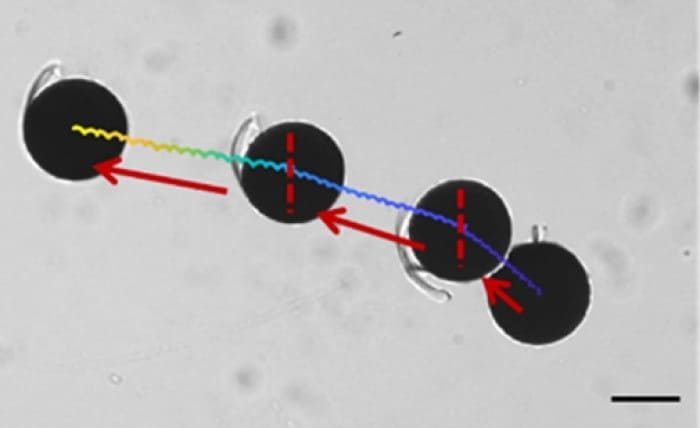

On the move: Time sequence showing a robot swimmer following a curved trajectory to the upper left. The motion occurs over 520 s and the period of the external field is changed at the locations indicated by the red dashed lines. The scale bar is 50 microns. (Courtesy: T Yao et al/Science Advances)

‘Speed limit’ on changes in non-equilibrium systems confirmed by new experiment


‘Speed limit’ on changes in non-equilibrium systems confirmed by new experiment

22 Feb 2022


New uncertainty: A relationship between time and dissipation rate has been established in the laboratory. (Courtesy: iStock Greyfebruary)

A “speed limit” on changes in non-equilibrium systems that was first predicted in 2020 has been confirmed by a new experiment done in China. By carefully controlling the electronic states of a single trapped ion, a team led by Mang Feng at the Chinese Academy of Sciences in Wuhan, showed that the rate at which entropy was created during electronic transitions was intrinsically linked to the speed at which the transition occurred. Their discovery could lead to a better understanding of systems as diverse as living organisms and quantum computers.

Six-qubit silicon quantum processor sets a record


Six-qubit silicon quantum processor sets a record

19 Oct 2022


Six of the best: Image of the six-qubit quantum processor. The qubits are created at the sites labelled 1-6 by tuning the voltage on the red, blue and green wires. (Courtesy: QuTech)

A team of researchers in the Netherlands has placed a record number of silicon spin qubits on a chip. By combining an advanced modular software stack, efficient calibration routines and reliable device fabrication, the researchers showed that they could operate the new six-qubit chip with high fidelity, clearing the way for even larger qubit numbers in silicon-based devices.

Shorter courses of radiation therapy prove safe and effective


Shorter courses of radiation therapy prove safe and effective

28 Oct 2022 Tami Freeman


Faster treatments: Delivering fewer, but higher, doses of radiation means less hospital visits, less time off work and reduced costs for cancer patients. (Courtesy: iStock/Mark Kostich)

Hypofractionated radiotherapy – in which higher doses of radiation are delivered over fewer treatment sessions – offers advantages for both patients and healthcare providers. Completing their treatment in fewer weeks means that patients require less trips to the hospital, less time off work, and reduced transportation and parking costs. For the hospitals, faster patient throughput can increase treatment capacity and reduce costs.

Ultrasound-induced gas bubbles reduce optical scattering

Ultrasound-induced gas bubbles reduce optical scattering

27 Oct 2022 Isabelle Dumé


Evaluating the imaging performance of US-OCM. (Courtesy: Jin Ho Chang)

Optical scattering is a real problem for biological imaging. By preventing light from being focused deeply into biological tissue, scattering effects limit imaging depths to around 100 microns, producing only blurred images beyond. A new technique called ultrasound-induced optical clearing microscopy could increase this distance by more than a factor of six, thanks to the somewhat counterintuitive step of inserting a layer of gaseous bubbles in the area being imaged. Adding this bubble layer ensures that the photons do not deviate as they propagate through the sample.

Polaritonic condensate reveals universal law in an out-of-equilibrium system


Polaritonic condensate reveals universal law in an out-of-equilibrium system

24 Oct 2022 Charly Leblanc


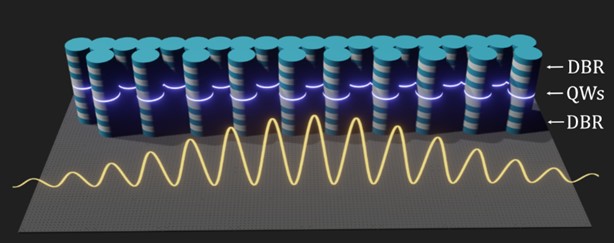
How it works: the wave in the foreground is an illustration of the phase of an out-of-equilibrium Bose-Einstein condensate in a 1D cavity, which belongs to the Kardar-Parisi-Zhang universality class. In the background is an illustration of the Fabry-Perot cavity, composed of two distributed Bragg reflectors (DBRs), with quantum wells (QWs) embedded inside. (Courtesy: Charly Leblanc)

Cataclysmic binary star has the shortest known orbital period


Cataclysmic binary star has the shortest known orbital period

26 Oct 2022


Feeding frenzy: artist’s illustration of a cataclysmic variable with a white dwarf (right) feeding upon a Sun-like donor star. (Courtesy: M Weiss/Center for Astrophysics/Harvard & Smithsonian)

Astronomers have discovered a pair of stars that circle each other in just 51 minutes, which is the most rapid orbit ever seen in such a pairing. The system has been dubbed ZTF J1813+4251 and is an example of a cataclysmic variable  –  an arrangement consisting of a star in a tight orbit around a dead star called a white dwarf.