Αναζήτηση αναρτήσεων

Τετάρτη 9 Αυγούστου 2023

China mulls plan to Build a $640m Super Tau-Charm Factory


China mulls plan to Build a $640m Super Tau-Charm Factory

27 Jul 2023

Researchers in China want to build a $640m Super Tau-Charm Factory to test the Standard Model of particle physics and put the country at the forefront of precision studies. Ling Xin reports


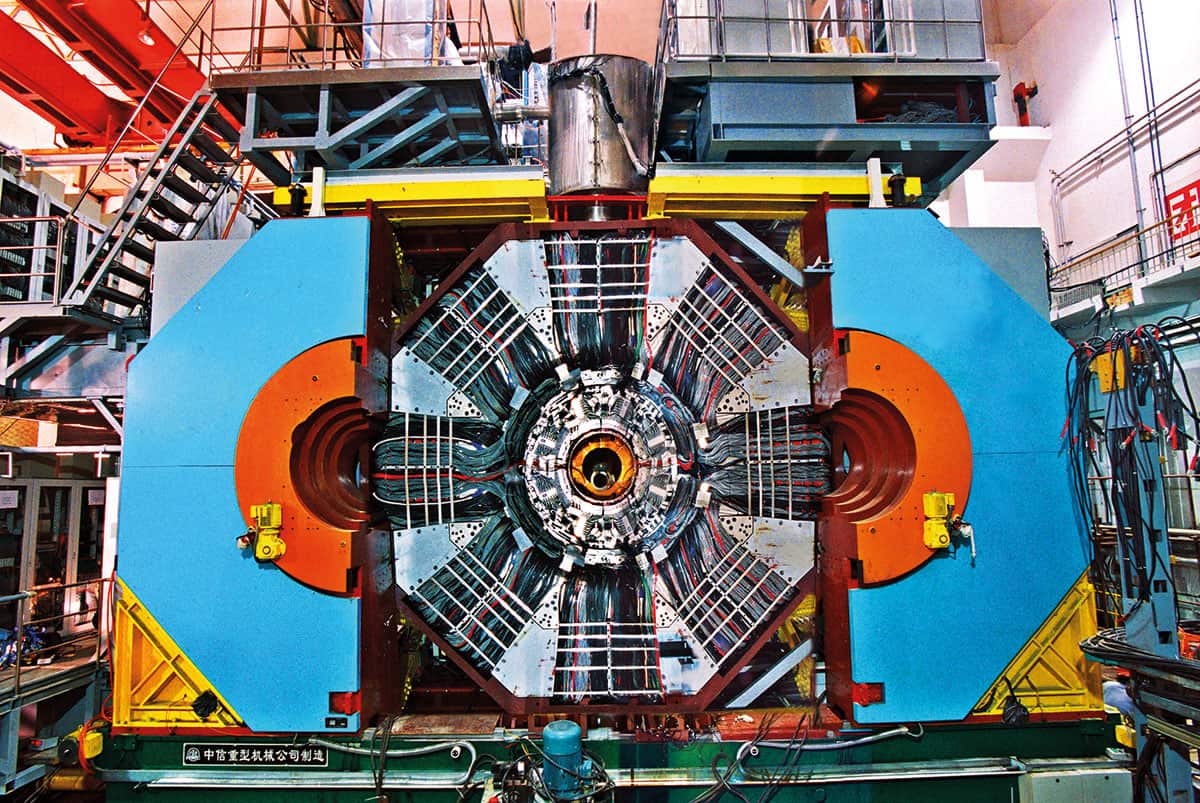
One for the future The proposed Super Tau-Charm Factory would be a successor to the Beijing Electron Positron Collider, which has been in operation since 1990. (Courtesy: USTC)

Scientists in China want to build a new electron–positron collider to test the Standard Model of particle physics in unprecedented detail and keep the country at the forefront of precision studies on charm quarks and tau leptons. If approved, construction of the 4.5-billion-yuan ($640m) Super Tau-Charm Factory (STCF) in Hefei could begin in 2026. Operations would then start about five years later.

The STCF is seen as a natural successor to the Beijing Electron Positron Collider (BEPC), which opened in 1990. It consists of some 240 m of underground tunnels in the west of the city, where electrons and positrons are first accelerated to near the speed of light before being smashed into each other to generate a variety of subatomic particles. The trajectories, energies and electric charges are then recorded by the Beijing Spectrometer (BES) to reconstruct the reaction processes.

Working in the 2–5 GeV energy range, the BEPC has made a series of important discoveries, especially in charm quark and tau lepton physics. In 1996, for example, researchers used the collider to carry out precision measurements on the mass of the tau particle. It has also been used to study “exotic” particles containing four or more quarks.

Δευτέρα 7 Αυγούστου 2023

Medical devices take design tips from the animal kingdom


Medical devices take design tips from the animal kingdom

26 Jun 2023 Tami Freeman


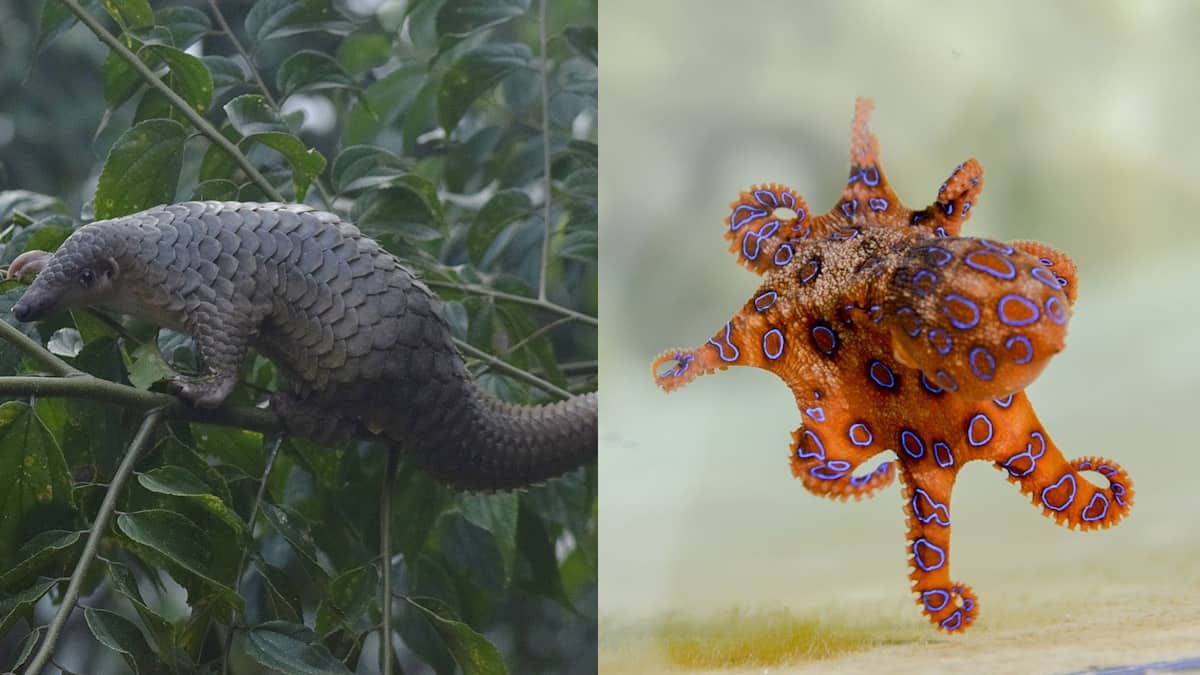
Inspired by nature The pangolin and the blue-ringed octopus provide inspiration for the development of new medical devices. (Courtesy: CC BY-SA 4.0/Frendi Apen Irawan; pen_ash)

The animal kingdom has benefited from millions of years of biological evolution to adapt processes and characteristics to meet specific needs. Using an approach known as bioinspiration, scientists and engineers are employing insights from biology to solve today’s technology challenges and optimize the design of new materials, devices and structures.

New fibre laser technology from NKT Photonics


New fibre laser technology from NKT Photonics

01 Mar 2023 Sponsored by NKT Photonics


Sascha Häuser, vice president of sales at NKT Photonics, outlines in this video how the company is developing fibre-laser technology and high power frequency conversion for the emerging cold-atom quantum-sensing community. “Fibre lasers can scale single-mode power like no other laser technology,” says Häuser in the video, which was filmed at Photonics West 2023 meeting in January.


Sponsored by NKT Photonics

FROM PHYSICSWORLD.COM  8/8/2023

Quantum fluctuations are controlled for the first time, say optics researchers


Quantum fluctuations are controlled for the first time, say optics researchers

07 Aug 2023


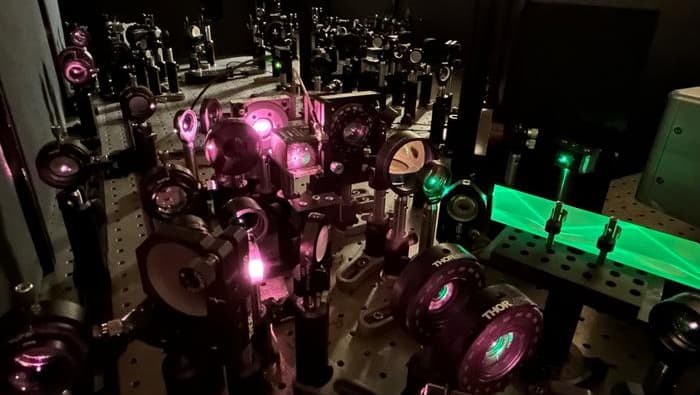
Quantum control: the experimental setup used to generate tunable random numbers from vacuum fluctuations. (Courtesy: Charles Roques-Carmes, Yannick Salamin)

A new technique for exploiting the random energy fluctuations present in empty space and biasing the fluctuations with an applied field has been demonstrated by US scientists. The researchers believe the technique could have applications from sensing to random number generation in probabilistic optical computing.

Physicists track biochemical reactions in Darwin’s ‘warm little ponds’


Physicists track biochemical reactions in Darwin’s ‘warm little ponds’

07 Aug 2023 Isabelle Dumé


Two neighbouring urea molecules in an aqueous solution exchange protons. (Courtesy: DESY, Ludger Inhester)

When life first appeared on Earth four billion years ago, it may have got its start in what the 19th-century naturalist Charles Darwin called “warm little ponds”: volcanically heated pools containing a soup of initially lifeless organic molecules. In a recent study, researchers in Switzerland and Germany shed further light on this topic by examining how one such molecule, urea, responds to pulses of ionizing radiation. The results of their work, which used ultrafast X-ray absorption spectroscopy to follow chemical reactions in real time, could advance our understanding of the biochemical origins of life.

Magnetic trap keeps a superconducting microsphere levitated and stable


Magnetic trap keeps a superconducting microsphere levitated and stable

07 Jun 2023 Isabelle Dumé


Tiny levitator: In this photo of the experiment, the arrow marks the position of the 48µm-diameter particle. Courtesy: W Wieczorek

It might not look like much, but this tiny levitating particle could be the key to a new generation of quantum sensors. Using a carefully designed magnetic trap, physicists in Sweden and Austria succeeded in levitating a 48-μm-diameter sphere of superconducting material and keeping it stable enough to characterize its motion – an achievement they describe as a “critical first step” towards using the sphere’s position to create quantum states. Such position-based quantum states could have applications in several areas, including metrology and searches for the mysterious dark matter thought to make up 85% of the universe’s mass.

Our universe is humming with gravitational waves


Our universe is humming with gravitational waves

07 Aug 2023 James Dacey


In recent Iweeks the astrophysics community has been buzzing following the discovery that the universe appears to be filled with a background hum of gravitational waves. Using radio telescopes in the Africa, Asia, Australia, Europe and the US, several teams have noted the same thing: that gravitational waves leave a faint fingerprint in the signals received from pulsars within our galaxy. The discovery is another exciting breakthrough within multimessenger astronomy.