Αναζήτηση αναρτήσεων

Τετάρτη 15 Νοεμβρίου 2023

Pairs of rogue planets found wandering in the Orion Nebula


Pairs of rogue planets found wandering in the Orion Nebula

12 Oct 2023


Going rogue: Jupiter-mass planets have previously been found floating freely without a parent star, but not in such large numbers and never as binary pairs until the current study. (Courtesy: NASA/JPL-Caltech)

More than 500 free-floating planetary-mass objects have been discovered wandering through the Orion Nebula thanks to new observations by the James Webb Space Telescope (JWST). Most bizarrely, about 40 of these newfound objects in the nebula’s Trapezium Cluster exist in wide binary pairs, confounding expectations about how these so-called “rogue planets” form.

Free-floating planetary-mass objects that do not orbit a star have been discovered in star-forming regions before, but never in the numbers seen by the JWST’s Near-Infrared Camera (NIRCam). These objects are visible because they are still young and glowing with the heat of their formation. Over time, they will cool and fade from view.

Seismic waves reveal complexities in Mars’ mantle


Seismic waves reveal complexities in Mars’ mantle

14 Nov 2023


Complex interior: illustration showing the two different layers of the Martian mantle between the core and crust. Also shown is how the layers affect seismic waves detected by InSight. (Courtesy: IPGP-CNES)

Mars’ mantle is divided into a partially molten outer layer and a fully molten, silicon-rich layer that lies closer to the planet’s core. This discovery was made by two independent teams and challenges the previous view that the mantle – which lies between the Martian crust and core – has a uniform composition and structure. The new analyses used seismic data from NASA’s InSight Mars lander and could help shape our understanding of how the red planet formed and evolved.

Some of the seismic waves studied were created by meteorites impacting the planet. The waves will have traveled deep within Mars before they reach InSight’s seismometer, and studying them provides important information about the Martian interior.

Multidisciplinary collaboration opens the way to strategic innovation in wireless technology


Multidisciplinary collaboration opens the way to strategic innovation in wireless technology

18 Sep 2023 Sponsored by BAE Systems Digital Intelligence


BAE Systems Digital Intelligence offers early-career physicists the opportunity to deliver game-changing technology innovations within its Wireless Products team

Into the field The Wireless Products team at BAE Systems Digital Intelligence uses digital signal processing to manipulate the electromagnetic world, with an emphasis on advanced software-defined radio (SDR) technologies. (Courtesy: BAE Systems)

Lancaster University physics graduate Ben is a member of the Wireless Products team at BAE Systems Digital Intelligence, a company that employs more than 4500 digital, cyber and intelligence experts to help government, military and commercial customers defend against advanced threats. He talked to Physics World about the joys of working at the cutting edge in electronics and digital signal processing while applying his mathematics and physics skills to diverse engineering problems.

All-electric organic laser is a first


All-electric organic laser is the first

14 Nov 2023 Isabelle Dumé


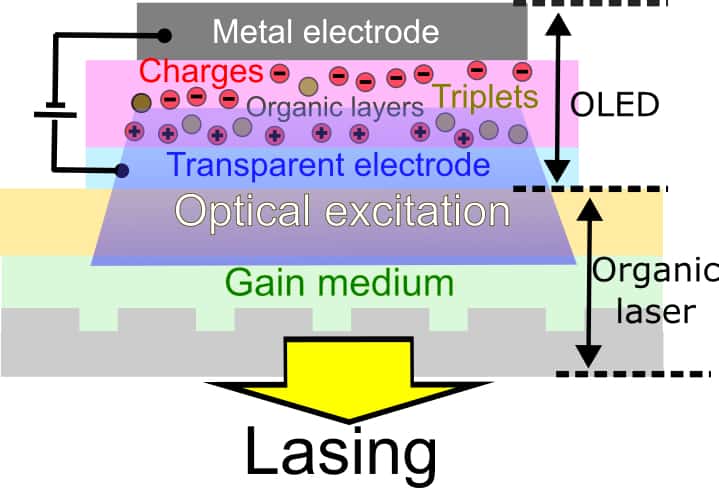
A schematic of the device. The organic LED is at the top – organic layers in between contacts. A voltage is applied to it, injecting charges and generating light that then excites the organic laser (lower half of figure). The organic laser contains a grating, applies feedback and also diffracts some of the laser light out of the structure – the yellow arrow in the figure. (Courtesy: Kou Yoshida)

Researchers at St Andrews University in Scotland have made the first organic semiconductor laser that does not require a separate light source to operate – something that had proved extremely challenging. The new all-electrically-driven laser is more compact than previous devices and operates in the visible region of the electromagnetic spectrum. As such, its developers say it might find use in applications such as sensing and spectroscopy.

Τρίτη 14 Νοεμβρίου 2023

Petition calls on UK to save JET fusion experiment from closure


Petition calls on UK to save JET fusion experiment from closure

01 Nov 2023


Hot topic: For over the past decade, JET has been carrying out “ITER relevant” experiments, in anticipation of the opening of giant fusion reactor in Cadarache, France (courtesy: EUROfusion)

More than 750 people have signed a petition against the planned closure of the Joint European Torus (JET), a major fusion experiment that has been running in the UK for almost 40 years. The UK Atomic Energy Authority (UKAEA), which operates JET, plans to shut down the nuclear fusion reactor in early 2024. The petition says the closure of JET would be “a serious scientific blow” that will have a “negative impact” on the worldwide fusion community.

JET has been carrying out fusion experiments since it opened in 1984. Over the past decade or so it has been doing “ITER relevant” experiments, in anticipation of the opening of the ITER fusion reactor, which is currently being built in Cadarache, France. In 2011, for example, JET had a refit of its plasma wall to include a mixture of tungsten and beryllium tiles so that scientists can gain a better understanding for how ITER’s beryllium plasma wall will perform.

What the movie Oppenheimer can teach today’s politicians about scientific advice

What the movie Oppenheimer can teach today’s politicians about scientific advice

13 Nov 2023 Robert P Crease


US authorities celebrated Robert Oppenheimer for developing atomic weapons but sidelined him when he wanted to advise them on their use. It’s an episode that has many lessons for us today, says Robert P Crease


Moment of reckoning Cillian Murphy (centre, at microphone) playing J Robert Oppenheimer in a scene from the 2023 movie Oppenheimer that recreates his hearing of the US Atomic Energy Commission in 1954. (Courtesy: Universal Pictures)

One of the scariest moments in Robert Oppenheimer’s career was not shown in Oppenheimer, the recent blockbuster movie. That moment occurred during the contentious hearing on his security clearance, which concerned Oppenheimer’s role on a committee to advise the US government on nuclear weapons. Ostensibly about his loyalty to America, the hearing also revealed deeper concerns about his left-wing sympathies and opposition to an early project to build a hydrogen bomb.

Quantum dot pioneers win Nobel Prize for Chemistry


Quantum dot pioneers win Nobel Prize for Chemistry

04 Oct 2023 Michael Banks


This year's chemistry laureates. (Courtesy: III Niklas Elmehed/Nobel Prize Outreach)

The Nobel Prize for Chemistry has been won by Moungi Bawendi, Louis Brus and Alexei Ekimov for “the discovery and synthesis of quantum dots”.


Quantum dots are extremely small particles just a few atoms in size and their properties allow them to emit light at specific wavelengths. Since the 1930s physicists had known that, in theory, quantum effects could arise in nanoparticles that would give them unusual characteristics, but for decades it was difficult to create such materials in the laboratory.