Αναζήτηση αναρτήσεων

Σάββατο 17 Φεβρουαρίου 2024

Kink in cosmic ray spectrum puzzles astrophysicists


Kink in cosmic ray spectrum puzzles astrophysicists

15 Feb 2024
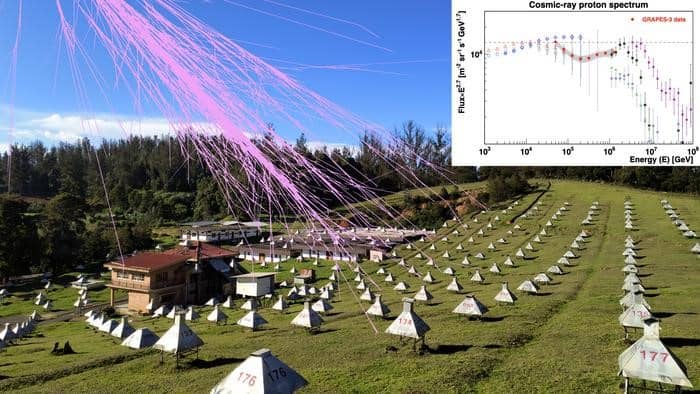


Kinky particles: the GRAPES-3 experiment in Ooty, India depicted with a simulated cosmic ray shower. The inset shows the cosmic ray proton spectrum measurement by GRAPES-3 along with observations by other space and ground-based experiments. (Courtesy: TIFR)

Using observations from the GRAPES-3 muon detector, physicists in India and Japan have explored a poorly understood region of the cosmic ray energy spectrum in unprecedented detail. Fahim Varsi at the Indian Institute of Technology Kanpur and colleagues identified a previously unseen feature in the form of a kink in the spectrum.

First-in-human study reveals potential of biology-guided radiotherapy


First-in-human study reveals potential of biology-guided radiotherapy

16 Feb 2024


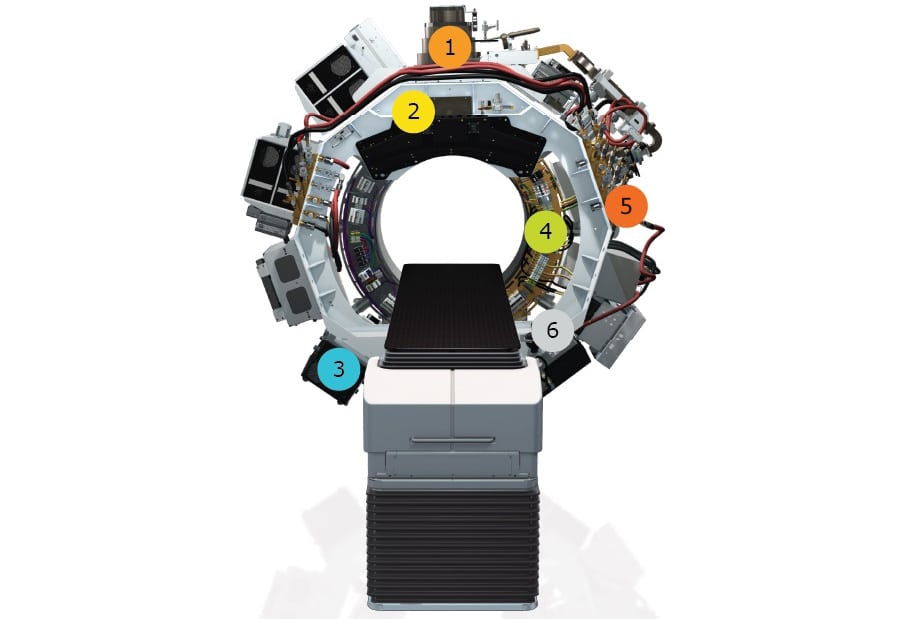
Inside the machine Key components of the RefleXion X1 radiotherapy system: 1) 6 MeV electron beam linac; 2) multileaf collimator; 3) 16-slice fan-beam kVCT; 4) dual 90-degree PET arcs; 5) ring gantry that rotates at 60 RPM; 6) megavoltage detector. (Courtesy: RefleXion Medical)

SCINTIX biology-guided radiotherapy (BgRT), performed on the RefleXion X1 linac, is a radiation delivery modality that uses real-time positron emission tomography (PET) to guide radiotherapy beamlets to radiolabelled tumours. Such guidance offers the potential to compensate for motion during treatments, reduce treatment volumes for moving tumours and increase intra-fraction treatment accuracy. In a first-in-human study, researchers in the US have now shown that SCINTIX dose distributions calculated from PET data were accurate and deliverable to lung or bone tumours.

Focused ultrasound plus plaque-reducing drugs could slow Alzheimer’s progression


Focused ultrasound plus plaque-reducing drugs could slow Alzheimer’s progression

24 Jan 2024


Deliver the drugs Researchers at the West Virginia University Rockefeller Neuroscience Institute, shown in the MRI suite’s control area, plan the focused ultrasound treatment for blood–brain barrier opening. (Courtesy: WVU Rockefeller Neuroscience Institute)

Non-invasive low-frequency focused ultrasound (FUS), delivered in combination with intravenously administered microbubbles, can temporarily open the blood–brain barrier (BBB) and enable drugs that combat Alzheimer’s disease to enter the brain and reach their therapeutic targets. The combination of an amyloid-beta plaque-reducing drug followed by FUS is proving to be safe and more effective in reducing plaque deposits in the brain than drug therapy alone. While not curing Alzheimer’s disease, reduction of plaque can reduce the disease’s cognitive impact and slow its progression.

Metal-free graphene quantum dots show potential for cancer treatment


Metal-free graphene quantum dots show potential for cancer treatment

13 Feb 2024


Chemodynamic therapy Schematic illustration showing the role of graphene quantum dots, derived from red blood cell membranes, as nanozymes for tumour catalytic therapy. (Courtesy: FHIPS)

A team of researchers in China has pioneered the use of novel metal-free graphene quantum dots (GQDs) for chemodynamic therapy, an emerging non-invasive cancer treatment. The breakthrough paves the way for an efficient and cost-effective means of improving the catalytic activity of GQDs, while addressing the toxicity concerns linked with metal-based nanozyme treatments.

Τετάρτη 31 Ιανουαρίου 2024

Machine learning takes the hassle out of cold-atom experiments


Machine learning takes the hassle out of cold-atom experiments

31 Jan 2024 Margaret Harris


Automatic adjustments: A view into the vacuum chamber containing the Tübingen group's rubidium magneto-optical trap (MOT). The frequency of the MOT lasers is controlled by a reinforcement learning agent. (Courtesy: Malte Reinschmidt)

Cold atoms solve many problems in quantum technology. Want a quantum computer? You can make one from an array of ultracold atoms. Need a quantum repeater for a secure communications network? Cold atoms have you covered. How about a quantum simulator for complicated condensed-matter problems? Yep, cold atoms can do that, too.

AI tools for materials research and nanotechnology


AI tools for materials research and nanotechnology

30 Jan 2024 Sponsored by IOP Publishing


Join the audience for a live webinar at 9 p.m. GMT/4 p.m. EST on 27 February 2024, sponsored by the IOP Publishing journal, Nano Futures, to explore the rapidly progressing field of intelligent nanotechnology

(Courtesy: iStock/koto_feja)

In recent years there have been several technological and scientific developments made possible due to the convergence between machine learning and physics at the nanoscale. This webinar examines this rapidly progressing field of ‘intelligent nanotechnology’ and brings together four leading researchers from within it.

During the webinar, hosted by Nano Futures, we will learn about some of the most recent developments and breakthroughs that are taking place, the projected direction that the field may take into the future, and the most critical challenges currently posed.

A snapshot of noble gas atoms emerges from within a graphene sandwich


A snapshot of noble gas atoms emerges from within a graphene sandwich

29 Jan 2024 Isabelle Dumé


Trapped clusters: Xenon nanoclusters between two graphene layers, with sizes between two and ten atoms. (Courtesy: Manuel Längle)


Scientists at the Universities of Vienna, Austria and Helsinki, Finland have captured the first direct images of clusters of room-temperature noble gas atoms by confining them in a “sandwich” made from two layers of graphene. Taken using a transmission electron microscope, the images could aid fundamental condensed-matter physics research and might have applications in quantum technology.