Αναζήτηση αναρτήσεων

Παρασκευή 2 Μαΐου 2025

Fluid electrodes make soft, stretchable batteries


Fluid electrodes make soft, stretchable batteries

01 May 2025 Isabelle Dumé
Photo showing four blue-gloved hands pulling at the corners of the battery, which resembles a coil of black gel on a clear plastic surface. The gel and the surface are visibly deformed by being pulled.
Bendy battery: Researchers at Linköping University have developed a battery that can take any shape. (Courtesy: Thor Balkhed)


Researchers at Linköping University in Sweden have developed a new fluid electrode to make a soft, malleable battery that can recharge and discharge over 500 cycles while maintaining its high performance. The device, which continues to function even when stretched to twice its length, might be used in next-generation wearable electronics.

Futuristic wearables such as e-skin patches, e-textiles, and even internal e-implants on the organs or nerves will need to conform far more closely to the contours of the human body than today’s devices can. To fulfil this requirement of being soft, stretchable, and flexible, such devices will need to be made from mechanically pliant components powered by soft, supple batteries. Today’s batteries, however, are mostly rigid. They also tend to be bulky because long-term operations and power-hungry functions such as wireless data transfer, continuous sensing, and complex processing demand plenty of stored energy.

Two-dimensional metals make their debut


Two-dimensional metals make their debut

14 Apr 2025 Isabelle Dumé
a researcher working in a glovebox
A researcher from the Chinese Academy of Sciences' Institute of Physics conducts research on two-dimensional (2D) metals in Beijing. (Courtesy: Chinese Academy of Sciences' Institute of Physics/Handout via Xinhua)

Researchers from the Institute of Physics of the Chinese Academy of Sciences have produced the first two-dimensional (2D) metal sheets. At just angstroms thick, these metal sheets could be an ideal system for studying the fundamental physics of the quantum Hall effect, 2D superfluidity and superconductivity, topological phase transitions, and other phenomena that feature tight quantum confinement. They might also be used to make novel electronic devices such as ultrathin low-power transistors, high-frequency devices, and transparent displays.

Axion quasiparticle appears in a topological antiferromagnet

Axion quasiparticle appears in a topological antiferromagnet

02 May 2025 Isabelle Dumé
Photo of Jian-Xiang Qiu and Suyang Xua posing with the apparatus they used to detect axion quasiparticles. The apparatus comprises lasers and other components mounted on an optical table. They're wearing laser safety glasses.
Adventures with axions: Jian-Xiang Qiu (left) and Suyang Xu with their experiment. (Courtesy: Dylan Goodman/The Harvard Gazette)
Physicists have observed axion quasiparticles for the first time in a two-dimensional quantum material. In addition to having applications in materials science, the discovery could aid the search for fundamental axions, which are promising (but so far hypothetical) candidates for the unseen dark matter pervading our universe.

Theorists first proposed axions in the 1970s to solve a puzzle involving the strong nuclear force and charge-parity (CP) symmetry. In systems that obey this symmetry, the laws of physics are the same for a particle and the spatial mirror image of its oppositely charged antiparticle.

Τρίτη 29 Απριλίου 2025

Grete Hermann: the quantum physicist who challenged Werner Heisenberg and John von Neumann


Grete Hermann: the quantum physicist who challenged Werner Heisenberg and John von Neumann

22 Apr 2025

Part of our International Year of Quantum Science and Technology coverage

Sidney Perkowitz uncovers the pioneering work of the German physicist and philosopher Grete Hermann, who sparred with the likes of Werner Heisenberg and John von Neumann – but whose contributions to quantum science have only recently come to light

Grete Hermann


In the early days of quantum mechanics, physicists found its radical nature difficult to accept – even though the theory had successes. In particular Werner Heisenberg developed the first comprehensive formulation of quantum mechanics in 1925, while the following year Erwin Schrödinger was able to predict the spectrum of light emitted by hydrogen using his eponymous equation. Satisfying though these achievements were, there was trouble in store.

Long accustomed to Isaac Newton’s mechanical view of the universe, physicists had assumed that identical systems always evolve with time in exactly the same way, that is to say “deterministically”. But Heisenberg’s uncertainty principle and the probabilistic nature of Schrödinger’s wave function suggested worrying flaws in this notion. Those doubts were famously expressed by Albert Einstein, Boris Podolsky and Nathan Rosen in their “EPR” paper of 1935 (Phys. Rev. 47 777) and in debates between Einstein and Niels Bohr.

Tennis-ball towers reach record-breaking heights with 12-storey, 34-ball structure


Tennis-ball towers reach record-breaking heights with 12-storey, 34-ball structure

18 Apr 2025

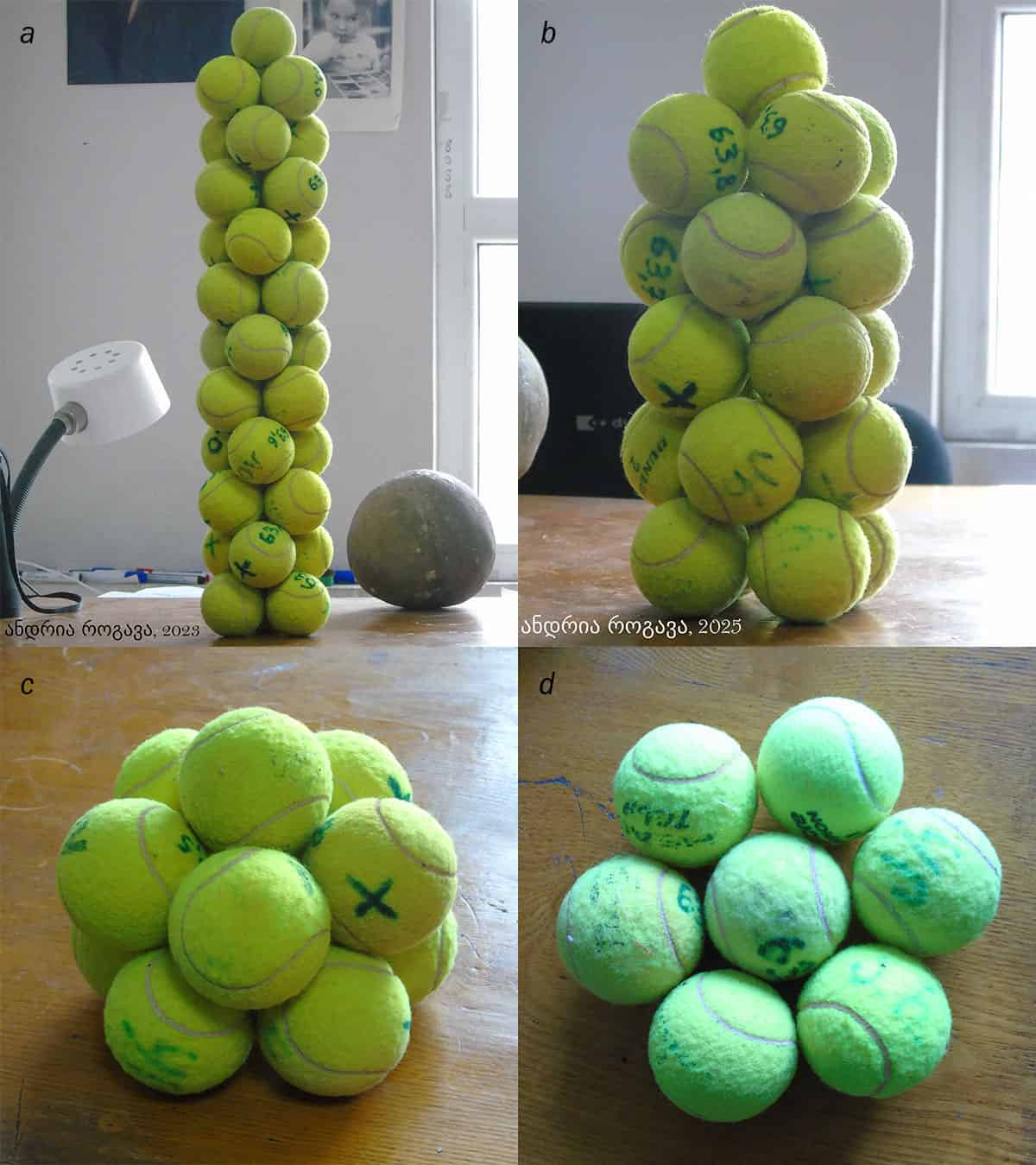
How high can you go with towers made from tennis balls? Andria Rogava brings you his crazy, new 12-storey edifice.

Four photos of tennis ball towers: 34 balls with base 3n+1; 21 balls with base 4n+1; 11 balls with base 5n+1; and six balls in a single layer


A few years ago, I wrote in Physics World about various bizarre structures I’d built from tennis balls, the most peculiar of which I termed “tennis-ball towers”. They consisted of a series of three-ball layers topped by a single ball (“the locker”) that keeps the whole tower intact. Each tower had (3n + 1) balls, where n is the number of triangular layers. The tallest tower I made was a seven-storey, 19-ball structure (n = 6). Shortly afterwards, I made an even bigger, nine-storey, 25-ball structure (n = 8).

Superconducting device delivers ultrafast changes in magnetic field


Superconducting device delivers ultrafast changes in magnetic field

23 Apr 2025
Magnetic step generation
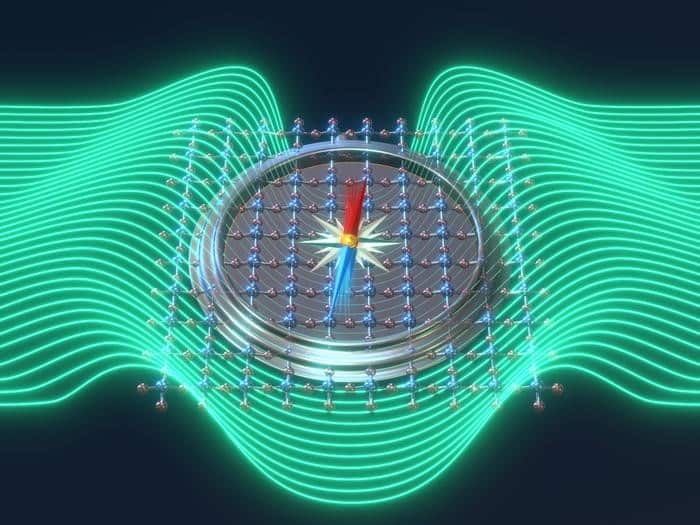
How it works Artist’s impression of how an ultrafast disruption of superconductivity in a YBCO thin film triggers an abrupt magnetic field quench, setting off dynamics in a neighbouring magnetic system. (Courtesy: Giovanni de Vecchi and Joerg M Harms/MPSD)


Precise control over the generation of intense, ultrafast changes in magnetic fields called “magnetic steps” has been achieved by researchers in Hamburg, Germany. Using ultrashort laser pulses, Andrea Cavalleri and colleagues at the Max Planck Institute for the Structure and Dynamics of Matter disrupted the currents flowing through a superconducting disc. This alters the superconductor’s local magnetic environment on very short timescales – creating a magnetic step.


Magnetic steps rise to their peak intensity in just a few picoseconds, before decaying more slowly in several nanoseconds. They are useful to scientists because they rise and fall on timescales far shorter than the time it takes for materials to respond to external magnetic fields. As a result, magnetic steps could provide fundamental insights into the non-equilibrium properties of magnetic materials, and could also have practical applications in areas such as magnetic memory storage.

Dual-robot radiotherapy system designed to reduce the cost of cancer treatment


Dual-robot radiotherapy system designed to reduce the cost of cancer treatment

23 Apr 2025
University of Victoria research team
KOALA research team Left to right: Mai Ibraheam, Olivia Masella, Joshua Chapman, Magdalena Bazalova-Carter and Jacob Atkinson. (Courtesy: Daniel Cecchi, University of Victoria)


Researchers at the University of Victoria in Canada are developing a low-cost radiotherapy system for use in low- and middle-income countries and geographically remote rural regions. Initial performance characterization of the proof-of-concept device produced encouraging results, and the design team is now refining the system with the goal of clinical commercialization.

This could be good news for people living in low-resource settings, where access to cancer treatment is an urgent global health concern. The WHO’s International Agency for Research on Cancer estimates that there are at least 20 million new cases of cancer diagnosed annually and 9.7 million annual cancer-related deaths, based on 2022 data.