General Fusion lays off staff due to ‘unexpected and urgent financing constraints’
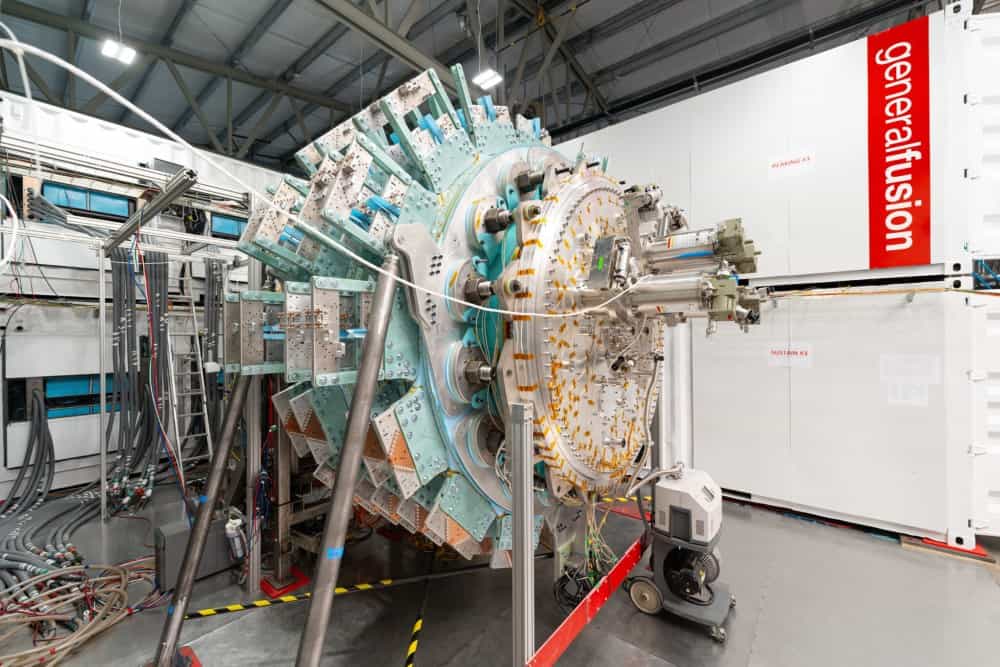 |
The Canadian firm General Fusion is set to lay off about 25% of its 140-strong workforce and scale back the operation of its fusion device, dubbed Lawson Machine 26 (LM26). The announcement was made in an open letter published on 5 May by the company’s chief executive Greg Twinney. The move follows what the firm says is an “unexpected and urgent financing constraint”.
Founded in 2002 by the Canadian plasma physicist Michel Laberge, General Fusion is based in Richmond, British Columbia. It is one of the first private fusion companies and has attracted more than $325 million in funding from both private investors, including Amazon founder Jeff Bezos, and the Canadian government.
The firm is pursuing commercial fusion energy via Magnetized Target Fusion (MTF) technology, based on the concept of an enclosed, liquid-metal vortex. Plasma is injected into the center of the vortex before numerous pistons hammer on the outside of the enclosure, compressing the plasma and sparking a fusion reaction; the resulting heat is absorbed by the liquid metal.
LM26 switched on in 2023 and is designed to achieve fusion conditions of over 100 million kelvin. Over the past couple of years, the machine has achieved several milestones, including generating a magnetized plasma in the machine’s target chamber in March. Last week, General Fusion also said that LM26 had successfully compressed a large-scale magnetized plasma with lithium.
The firm aimed to achieve a “scientific breakeven equivalent” in the coming years, with the goal of potentially building a commercial-scale machine using the technology in the 2030s. But that timescale now looks unlikely as General Fusion announces plans to downscale its efforts due to funding issues. In his letter, Twinney said the firm has “proven a lot with a lean budget”.
Challenging environment
“Today’s funding landscape is more challenging than ever as investors and governments navigate a rapidly shifting and uncertain political and market climate,” says Twinney. “We are ready to execute our plan, but are caught in an economic and geopolitical environment that is forcing us to wait.” But he insists that General Fusion, which his seeking new investors, remains an “attractive opportunity”.
Andrew Holland, chief executive of the non-profit Fusion Industry Association, told Physics World that the “nature of private enterprise is that business cycles go up and go down” and claims that excitement about fusion is growing around the world. “I hope that business cycles and geopolitics don’t interrupt the good work of scientific advancement,” he says. “I’m hopeful investors see the value being created with every experiment.”

Michael Banks is the news editor of Physics World magazine.
FROM PHYSICSWORLD.COM 7-10-2025

Δεν υπάρχουν σχόλια:
Δημοσίευση σχολίου