Watching how grasshoppers glide inspires new flying robot design
 |
While much insight has been gleaned from how grasshoppers hop, their gliding prowess has mostly been overlooked. Now, researchers at Princeton University have studied how these gangly insects deploy and retract their wings, which has inspired a new approach to flying robots.
Typical insect-inspired robot designs are often based on bees and flies. They feature constant flapping motion, yet that requires a lot of power, so the robots either carry heavy batteries or are tethered to a power supply.
Grasshoppers, however, are able to jump and glide as well as flap their wings, and while they are not the best gliding insect, they have another trick as they are able to retract and unfurl their wings.
Grasshoppers have two sets of wings, the forewings and hindwings. The front wing primarily serves protection and camouflage, while the hind wing supports flight. The hindwing is corrugated, allowing it to fold neatly like an accordion.
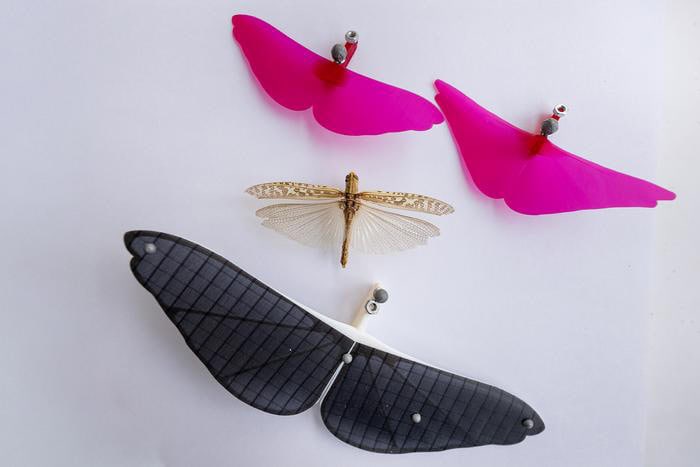
A team of engineers, biologists, and entomologists analysed the wings of the American grasshopper, also known as the bird grasshopper, due to its superior flying skills. They took CT scans of the insects and then used the findings to 3D-print model wings. They attached these wings to small frames to create grasshopper-inspired gliders, finding that their performance was on par with that of actual grasshoppers.
The team also tweaked certain wing features, such as shape, camber, and corrugation, finding that a smooth wing produced gliding that was more efficient and repeatable than a corrugated one. “This showed us that these corrugations might have evolved for other reasons,” notes Princeton engineer Aimy Wissa, who adds that “very little” is known about how grasshoppers deploy their wings.
The researchers say that further work could yield new ways to extend the flight time of insect-sized robots without the need for heavy batteries or tethering. “This grasshopper research opens up new possibilities not only for flight, but also for multimodal locomotion,” adds Lee. “By combining biology with engineering, we’re able to build and ideate on something completely new.”

Michael Banks is the news editor of Physics World magazine.
FROM PHYSICSWORLD.COM 17/1/2026

Δεν υπάρχουν σχόλια:
Δημοσίευση σχολίου