Αναζήτηση αναρτήσεων

Παρασκευή 10 Ιανουαρίου 2020

three-body calculations suggest how black holes get close enough to merge
three-body calculations suggest how black holes get close enough to merge

07 Jan 2020
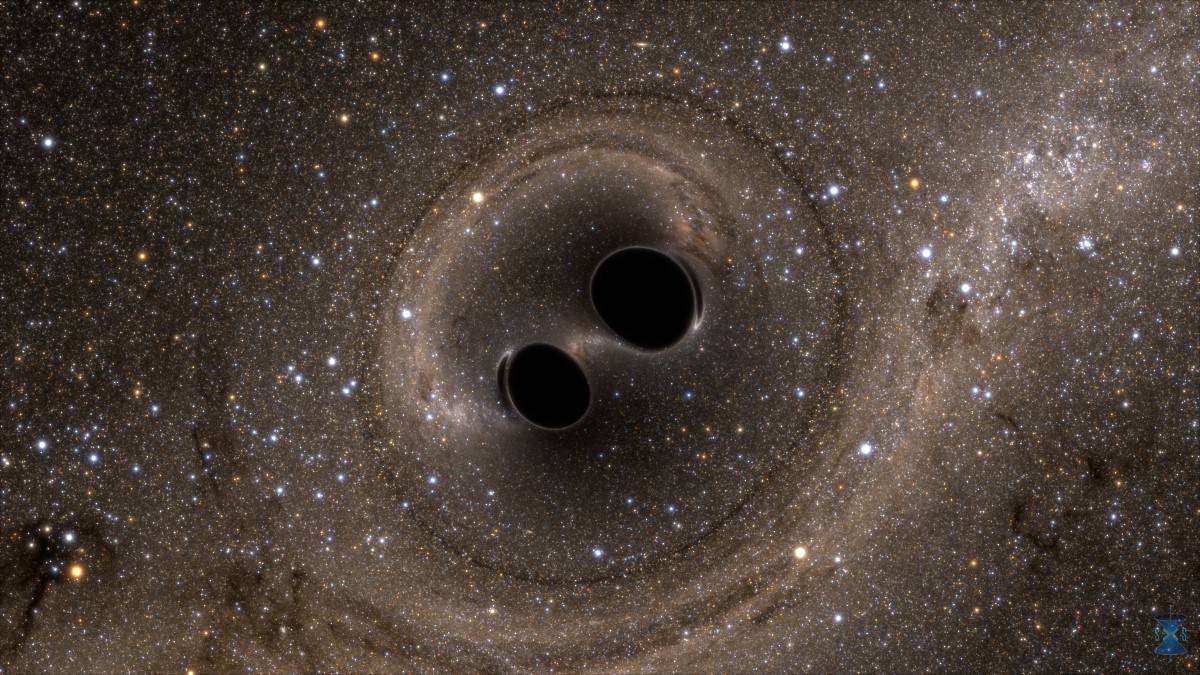
Merging black holes
Getting close: artistic impression of merging black holes (Courtesy: SXS/CC BY-NC 3.0)


A statistical solution to the infamous three-body problem of classical physics could explain why the LIGO-Virgo gravitational-wave detectors have observed numerous black-hole mergers.

The three-body problem involves three classical objects (such as stars, planets or even black holes) orbiting and interacting with one another. In principle, the behaviour of a three-body system at a future time in its evolution is uniquely determined by the initial conditions of the system. However, infinitesimal changes in these initial conditions can accumulate over time to become huge differences in outcomes. As it is never possible to measure initial conditions with infinite precision, it is therefore never possible to use them to predict long-term outcomes – a signature of deterministic chaos.


A general closed-form solution of the three-body problem does not exist, but if the objects are very different in mass, the system can be approximated by two-body problems with small perturbations from the third object. Things become more daunting, however, when the three masses are similar. Now, astrophysicists in the US have built computer models of such “non-hierarchical” triple systems. Created by Nicholas Stone of the Hebrew University of Jerusalem (who did the work while at Columbia University in New York) and Nathan Leigh of University of Concepción in Chile, the simulations could help to explain why LIGO-Virgo have seen an abundance of gravitational-wave signals from merging black holes.

LIGO–Virgo claims another neutron-star merger 09 Jan 2020 Hamish Johnston


LIGO–Virgo claims another neutron-star merger

09 Jan 2020 Hamish Johnston


Gravitational waves from the merger of two neutron stars were observed by the LIGO Livingston detector on 25 April 2019 – according to an international team of astrophysicists in the LIGO and Virgo collaborations. This is the second time that a signal from such an event has been seen and the merger is puzzling astrophysicists because it appears to have created an object with “unusually high mass”.


In a paper that has been submitted to The Astrophysical Journal Letters, the researchers say that the merger occurred about 500 million light-years away. The above video is a simulation of the merger process and the gravitational waves it produced.

The signal (dubbed GW 190425) was not recorded by the LIGO Hanford detector, which was not operating at the time, nor was it detected by the Virgo detector.

Τετάρτη 1 Ιανουαρίου 2020

Σκουλήκια ξυδιού


Σκουλήκια ξυδιού

Έχετε δει ποτέ ένα σκουλήκι ξυδιού σε ένα μπουκάλι ξίδι μηλίτη; Πιθανότατα όχι. Ίσως να εκπλαγείτε να μάθετε ότι τα μικροσκοπικά στρογγυλά σκουλήκια, που συνήθως ονομάζονται σκουλήκια ξυδιού (Turbairix aceti (Anguillula)). βρίσκονται στο μη επεξεργασμένο ξύδι και αποτελούν πρόβλημα για τους παραγωγούς ξυδιού. Δεν θα τα βρείτε στο ξύδι που πωλείται στο τοπικό σούπερ μάρκετ επειδή το ξύδι αυτό έχει παστεριωθεί. Στην πραγματικότητα, τα σκουλήκια ξυδιού δεν καταναλώνουν το ίδιο το ξύδι. μάλλον τρέφονται με τα βακτήρια ξιδιού που ζουν στο ξίδι μηλίτη.