Photon frequency doubler is controlled by light
21 Jan 2020
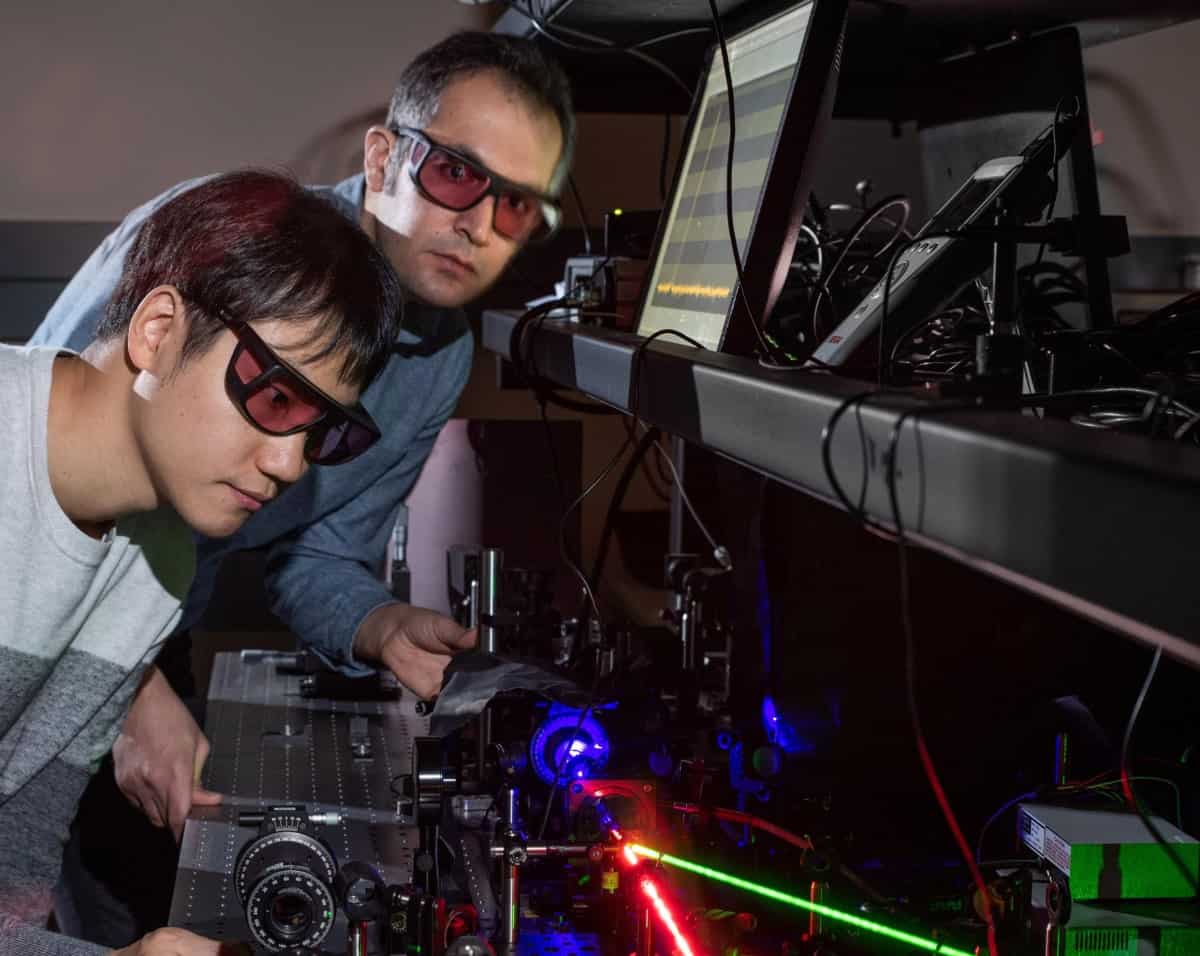
A way of using light to convert a normal optical material into a frequency doubler has been developed by Mohammad Taghinejad and colleagues at the Georgia Institute of Technology. The technique could have a range of applications from creating all-optical information-processing devices to studying quantum-mechanical tunnelling.
Frequency doubling is an optical effect that occurs in spatially asymmetrical materials that have a second-order nonlinear susceptibility. Two photons with the same frequency can interact with the material and combine to form a single photon with twice the frequency of the original photons. While most crystalline materials do not have the appropriate asymmetry in the bulk, frequency doubling can occur at surfaces and interfaces. However, relying on these very thin regions is not ideal for creating practical devices.


 Compact and efficient: prototype of a working, pocket-sized neutron detector made with semiconductor rich in lithium-6. (Courtesy: Northwestern University/Argonne National Laboratory)