Αναζήτηση αναρτήσεων

Τετάρτη 16 Δεκεμβρίου 2020

Therapeutics firms share inaugural prize for health physics


Therapeutics firms share inaugural prize for health physics

21 Jul 2020 Margaret Harris


Companies that use physics to unlock next-generation drugs for respiratory disorders and enable advanced cancer treatments are the first recipients of a new award for early-stage companies in healthcare and medicine. Nebu~Flow, a University of Glasgow spin-out that is commercializing an acoustic nebulizer, and Cellular Highways, a Cambridge-based start-up that develops microfluidic devices for use in cell therapies, each received the inaugural Lee Lucas Award and £5000 in prize money as part of the annual Business Awards presented by the Institute of Physics (IOP).


Speaking on 15 July at the first of two webinars dedicated to the 2020 Business Awards, IOP vice-president for business James McKenzie praised Cellular Highways, Nebu~Flow and 11 other award-winning companies for their work in bringing physics-based products to the market.

Magnetic illusion’ can create magnetic fields at a distance


Magnetic illusion’ can create magnetic fields at a distance

04 Dec 2020


Physicists in the UK and Spain claim that they have found a way to generate and manipulate magnetic fields at a distance. This opens up the possibility of projecting magnetic fields into inaccessible spaces and enables the remote cancellation of magnetic sources, the researchers say. One application of this technique could be improving the control of magnetic microbots and nanoparticles within the human body, for medical applications such as drug delivery and magnetic hyperthermia therapies.

In recent years, metamaterials have enabled scientists to manipulate magnetic fields in unexpected ways, such as creating a magnetic cloak that can make an object magnetically undetectable and magnetic wormholes, which transport a magnetic field from one point in space to another.

Sound waves in fermionic superfluid are studied in a ‘beautiful’ experiment


Sound waves in fermionic superfluid are studied in a ‘beautiful’ experiment

05 Dec 2020


The acoustic properties of an ultracold fermion gas have been measured either side of the superfluid transition temperature in an experiment that has been described as “near perfect” and “beautiful”. The results could have significant implications for understanding everything from superconductors to the aftermath of the Big Bang.


Superfluidity occurs at very low temperatures when bosons such as helium-4 form a single, macroscopic quantum ground state. As well as being able to flow indefinitely without losing kinetic energy, a superfluid can famously climb uphill over a barrier to reach an energy minimum. Some fermions such as helium-3 can also form a superfluid by first pairing up to form bosons.

The European Spallation Source: an overview: Cryogenics makes the European Spallation Source a hot property in neutron science


Cryogenics makes the European Spallation Source a hot property in neutron science
06 Jul 2020


Cryogenics is a core enabling technology at the European Spallation Source, a next-generation neutron-science facility under construction in Sweden. Joe McEntee talks to John G Weisend II, group leader for specialized technical services at ESS, about the secrets of success at ultralow temperatures


Large-scale neutron facilities – one of the mainstays of Europe’s “big science” infrastructure – are routinely used by researchers to understand material properties on the atomic scale, spurring advances across a spectrum of scientific discovery – from clean energy and environmental technology to pharma and healthcare, from structural biology and nanotech to food science and cultural heritage. Industry users, meanwhile, use neutrons to probe deep into engineering components, gaining unique insights into the stresses and strains that affect turbine blades, gas pipelines, fuel cells and the like.

Big science, of course, keeps thinking bigger – and neutron science is no exception. For the neutron user community, in fact, a decade of revolution rather than evolution is hoving into view as construction progresses on the European Spallation Source (ESS), a €1.84bn accelerator-driven neutron source in Lund, Sweden.

Physicists fine tune chemical reaction rates for ultracold molecules


Physicists fine tune chemical reaction rates for ultracold molecules

12 Dec 2020


A new technique to cool reactive molecules to temperatures low enough to achieve quantum degeneracy – something not generally possible before – has been created by researchers in the US. In this temperature regime, the dominance of quantum effects over thermal fluctuations should allow researchers to study new quantum properties of molecules. As a first example, the researchers demonstrated how a slight change in applied electric field can alter the reaction rate between molecules by three orders of magnitude.

DNA origami makes 3D superconducting nanostructures


DNA origami makes 3D superconducting nanostructures

25 Nov 2020 Isabelle Dumé


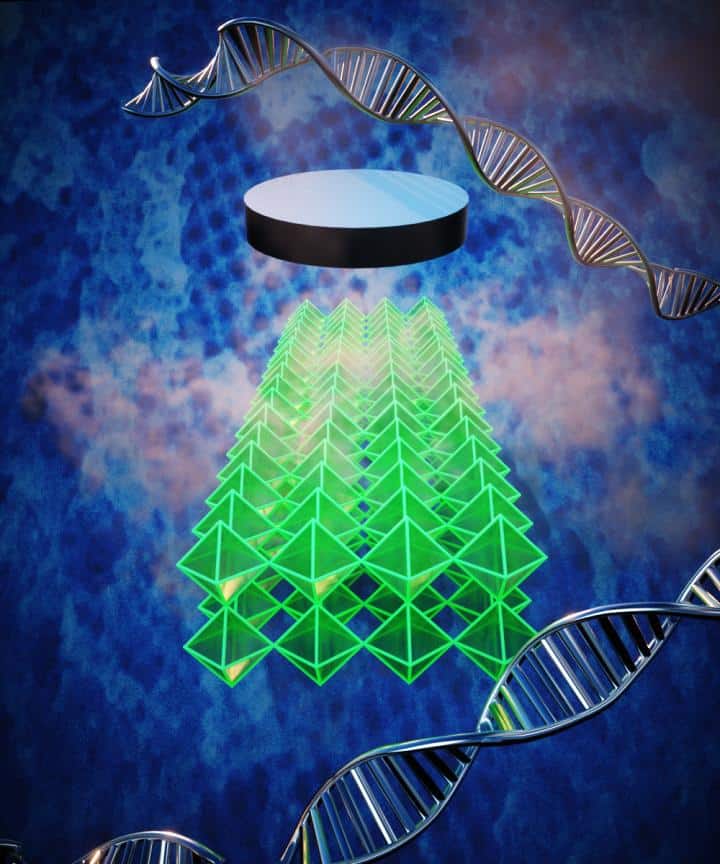
Researchers in the US and Israel have developed a way to make 3D superconducting nanostructures by combining DNA with niobium and silicon. This new technique might be used to make signal amplifiers that enhance the speed and accuracy of quantum computers as well as ultrasensitive magnetic field sensors for medical and geophysics applications.

While traditional nanofabrication techniques like electron-beam lithography can produce one-dimensional and two-dimensional superconducting nanostructures, their ability to produce three-dimensional structures is limited.

New family of quasiparticles appears in graphene


New family of quasiparticles appears in graphene

30 Nov 2020 Isabelle Dumé


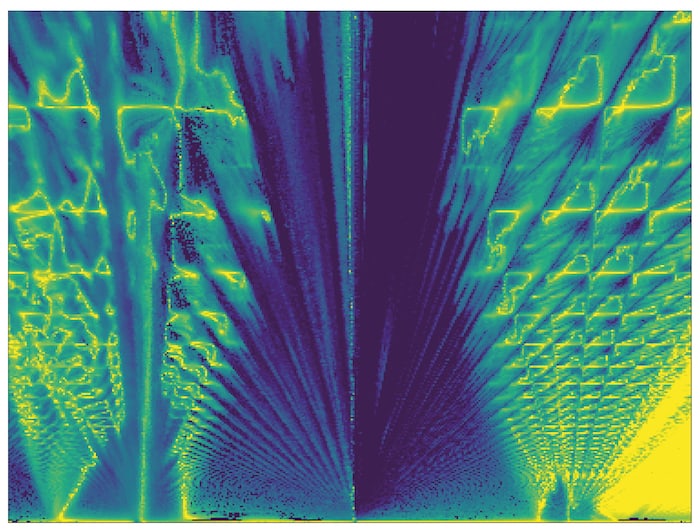
Researchers at the University of Manchester in the UK have identified a new family of quasiparticles in superlattices made from graphene sandwiched between two slabs of boron nitride. The work is important for fundamental studies of condensed-matter physics and could also lead to the development of improved transistors capable of operating at higher frequencies.

In recent years, physicists and materials scientists have been studying ways to use the weak (van der Waals) coupling between atomically thin layers of different crystals to create new materials in which electronic properties can be manipulated without chemical doping. The most famous example is graphene (a sheet of carbon just one atom thick) encapsulated between another 2D material, hexagonal boron nitride (hBN), which has a similar lattice constant.