Αναζήτηση αναρτήσεων

Τετάρτη 22 Μαρτίου 2023

Colloidal mixture exists in up to six phases at once


Colloidal mixture exists in up to six phases at once

14 Feb 2023 Isabelle Dumé


Two-phase equilibrium: A binary colloidal mixture can exist in up to six phases at the same time. (Courtesy: R Tuiner)

A binary colloidal mixture can exist in up to six phases at the same time, according to new theoretical work by researchers in the Netherlands and France. The result, obtained using a simple algebraic model, has applications for predicting the phase stability of common colloidal materials such as paint and mayonnaise.

Tried our cryptic medical-physics word search? Here’s the solution


Tried our cryptic medical-physics word search? Here’s the solution

01 Mar 2023


How well do you know your medical physics? Here are the answers to our cryptic word search, created by Ian Randall.


Answers

Wireless put hit music in pronoun, killing cancer cells [RADIOTHERAPY]

Exposure measurement? Note sounds like beautiful proportion [DOSIMETRY]

Particle physicists rarely order tapas or nachos, initially [PROTON]

Πέμπτη 16 Μαρτίου 2023

Friction at the microscale depends unexpectedly on sliding speed


Friction at the microscale depends unexpectedly on sliding speed

02 Feb 2023 Isabelle Dumé


Speed-dependent friction. (Courtesy: Department of Physics, University of Basel and Scixel)

Friction at the atomic scale appears to depend on the speed at which two surfaces move past each other. This surprising behaviour was observed as the tip of an atomic force microscope (AFM) moves along a graphene coating, and researchers at the universities of Basel in Switzerland and Tel Aviv in Israel say it results from surface corrugation induced by a mismatch in graphene’s lattice structure. The finding, together with observations that the frictional force scales differently in different velocity regimes, could have applications in devices such as hard disks and moving components in satellites or space telescopes that require ultralow friction.

From barren sands to extreme architecture: building the first Martian metropolis


From barren sands to extreme architecture: building the first Martian metropolis

15 Mar 2023


Fast and furious Justin Hollander’s book is a whistle-stop tour of the particular demands of settling on Mars. (Courtesy: NASA)

Much has been written on the history and immediate future of space exploration – particularly with regard to the present race to put the first humans on Mars. So, it is refreshing to take a more long-term, forward-looking perspective on the subject, with urban planning expert Justin Hollander in his new book, The First City on Mars: an Urban Planner’s Guide to Settling the Red Planet.

Hydrogel helps grow new tissue in areas of brain damage


Hydrogel helps grow new tissue in areas of brain damage

10 Mar 2023 Tami Freeman


Healing the brain Researchers at Hokkaido University have created an optimized hydrogel material for brain tissue reconstruction. (Courtesy: Satoshi Tanikawa et al Scientific Reports)

Brain haemorrhage and brain cancer are major causes of death and disability worldwide. The brain is particularly vulnerable to ischemic damage, in which loss of blood supply leads to the loss of brain tissue volume and the formation of a cavity. And unlike other parts of the body where spontaneous wound healing processes occurs, loss of neuronal tissue is irreversible.

Personalized approach improves cervical cancer treatment


Personalized approach improves cervical cancer treatment

14 Mar 2023 Serene Pauly


Brachytherapy afterloader Brachytherapy plays a key role in the treatment of locally advanced cervical cancer. (Courtesy: Elekta)

Cervical cancer is the fourth most common cancer among women globally. According to the World Health Organization, there were an estimated 604 000 new cases and 342 000 deaths in 2020. While surgery and chemotherapy can be used to treat early-stage disease, locally advanced cervical cancer is typically managed with a combination of chemoradiation and brachytherapy.

Real-time monitoring of brain tissue oxygenation could personalize radiotherapy


Real-time monitoring of brain tissue oxygenation could personalize radiotherapy

16 Mar 2023
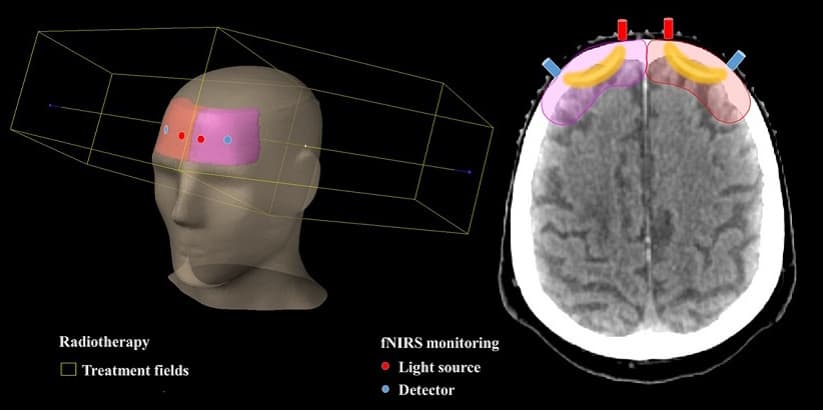
Tracking oxygenation A functional near-infrared spectroscopy device attached to the patient’s forehead measures changes in haemoglobin and tissue oxygenation levels as the patient receives a dose of radiation. (Courtesy: T Myllylä et al J. Biomed. Opt. 10.1117/1.JBO.28.1.015002)

Blood flow and oxygen supply to tumours change over the first few weeks of radiotherapy. Scientists currently believe that reoxygenation occurs due to tumour shrinkage, decreased oxygen consumption and increased perfusion. Clinicians hope that these and other possible changes might be exploited to improve a patient’s response to radiation therapy.