Loop quantum cosmology may explain the smoothness of the cosmic microwave background
Repulsive gravity at the quantum scale would have flattened out inhomogeneities in the early universe
 |
In classical physics, gravity is universally attractive. At the quantum level, however, this may not always be the case. If vast quantities of matter are present within an infinitesimally small volume – at the centre of a black hole, for example, or during the very earliest moments of the universe – spacetime becomes curved at scales that approach the Planck length. This is the fundamental quantum unit of distance, and is around 1020 times smaller than a proton.
In these extremely curved regions, the classical theory of gravity – Einstein’s general theory of relativity – breaks down. However, research on loop quantum cosmology offers a possible solution. It suggests that gravity, in effect, becomes repulsive. Consequently, loop quantum cosmology predicts that our present universe began in a so-called “cosmic bounce”, rather than the Big Bang singularity predicted by general relativity.
 |
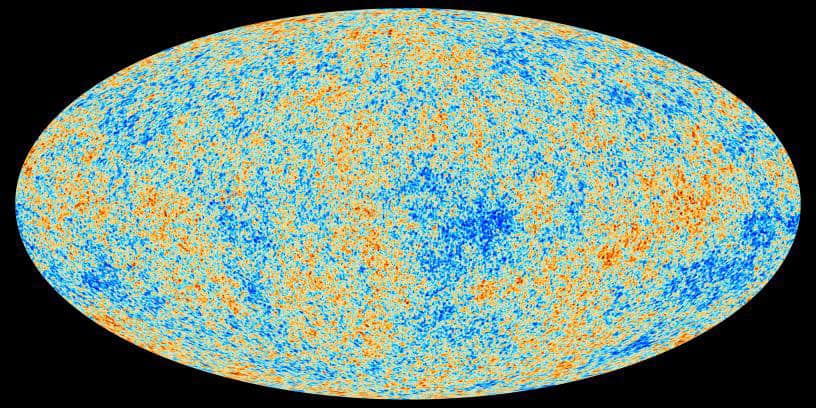
In a recent paper published in EPL, Edward Wilson-Ewing, a mathematical physicist at the University of New Brunswick, Canada, explores the interplay between loop quantum cosmology and a phenomenon sometimes described as “the echo of the Big Bang”: the cosmic microwave background (CMB). This background radiation pervades the entire visible universe, and it stems from the moment the universe became cool enough for neutral atoms to form. At this point, light could suddenly travel through space without being continually scattered by the plasma of electrons and light nuclei that existed before. This freshly liberated light makes up the CMB, so studying it offers clues to the early universe.