Αναζήτηση αναρτήσεων

Παρασκευή 28 Αυγούστου 2020

Protons could be lighter than we thought

Protons could be lighter than we thought

24 Aug 2020 Isabelle Dumé
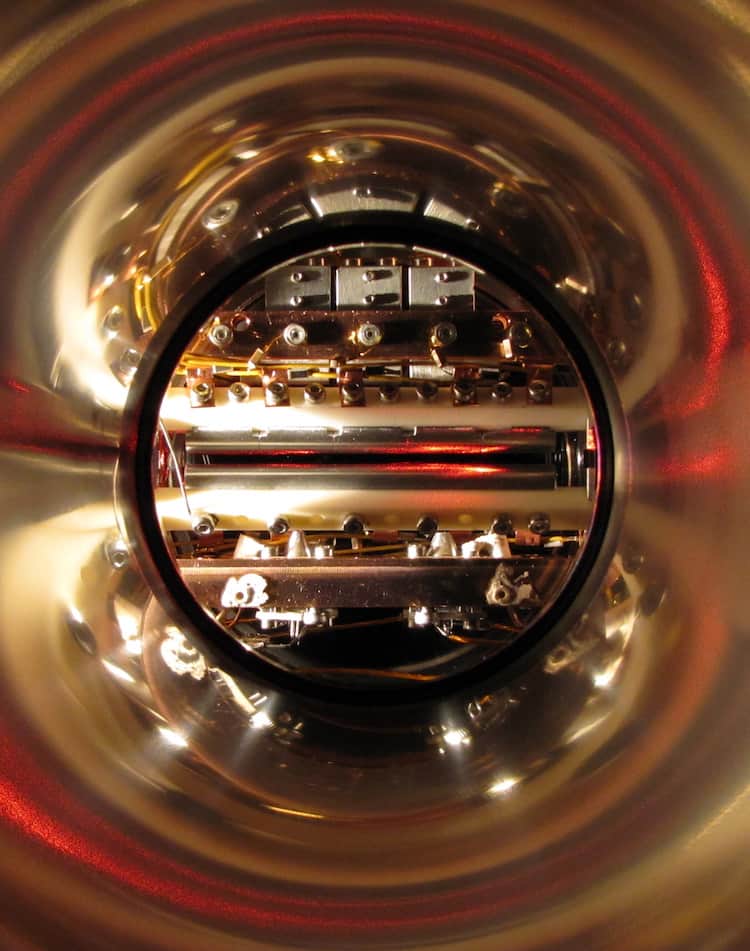


The most precise measurement to date of the proton-electron mass ratio suggests that the proton may be lighter than previously thought. The result, from researchers in the Netherlands and France, provides a crucial independent cross-check with previous measurements of the ratio, which yielded inconsistent values.

The proton-electron mass ratio is an important quantity in physics and a benchmark for molecular theory. It can be determined by measuring the rotations and vibrations of ordinary molecular hydrogen ions (H2+) and comparing them to similar ro-vibrational measurements in their deuterated cousins (HD+). Both entities are the very simplest bound systems that can be termed “molecules”, and as such they are ideal for probing models of fundamental physics. Indeed, when researchers first performed measurements of ro-vibrational transitions in HD+ 40 years ago, they suggested that the results could be used to test the theory of quantum electrodynamics (QED) in molecules.

Τρίτη 25 Αυγούστου 2020

Acoustic imaging promises real-time dose measurement for FLASH radiotherapy

Acoustic imaging promises real-time dose measurement for FLASH radiotherapy

18 Aug 2020 Laura Patricia Kaplan


Ultrahigh dose rate radiation therapy (FLASH) is currently one of the hottest topics in radiotherapy research. Several animal studies (and recently, a first-in-human case report) have shown that the probability of radiotherapy side effects can be greatly reduced when the radiation dose rate is ramped up from the standard 0.1 Gy/s to 40 Gy/s or more.

In order to use such high dose rate treatments safely, it is imperative to continuously monitor where and how much dose is really being deposited in the patient. This is currently only possible for tumours on or close to the skin surface where dosimeters can be placed easily. Researchers at the University of Michigan have now proposed a new method to measure dose, even deep within a patient, while simultaneously obtaining images of the radiation target and surrounding tissue. They have published the details of their study in Medical Physics.

‘World’s smallest’ imaging device takes a closer look at heart disease

‘World’s smallest’ imaging device takes a closer look at heart disease

24 Aug 2020 Ben Lewis


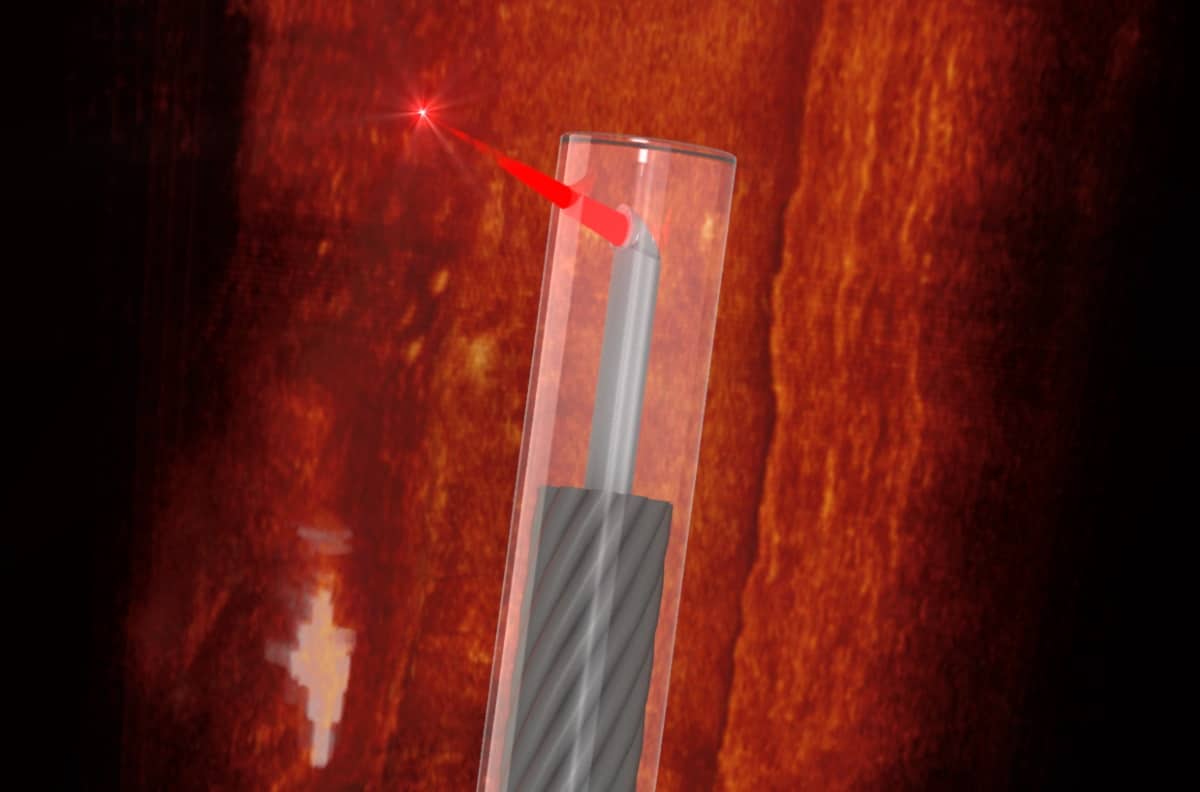
To successfully diagnose diseases and disorders, doctors need the best possible tools to see inside the human body. Imaging the body’s tightest spaces without causing damage, however, can be tricky and necessitates camera-like devices that are smaller than was previously possible to engineer. An international team of researchers has now overcome these technical challenges to produce a camera that is small enough to see inside even the narrowest blood vessels.

The team, led by researchers from the University of Adelaide and the University of Stuttgart, has manufactured the smallest 3D imaging probe ever reported. They used 3D micro-printing to put a miniature lens onto the end of an optical fibre that is the same thickness as a human hair. Together with a sheath to protect the surrounding tissue and a special coil to help it rotate and create 3D images, the entire probe is less than half a millimetre across – the same thickness as a few sheets of paper.

Κυριακή 23 Αυγούστου 2020

Did a supernova trigger the late Devonian extinction?

Did a supernova trigger the late Devonian extinction?

30 Jul 2020


The explosion of a nearby star could have caused a mass extinction that occurred long ago on Earth. That is the conclusion of a study by an international team of scientists, which suggests that this scenario could be confirmed by looking for a plutonium isotope in fossils.


Around 359 million years ago, at the boundary between the Devonian and Carboniferous periods, the Earth suffered an intense loss of species diversity that lasted for at least 300,000 years. Called the Hangenberg Crisis, the event is thought to have been caused by long-lasting ozone depletion, which would have allowed much more of the Sun’s ultraviolet (UV) radiation to reach and harm life on Earth.

How to hack a self-driving car

How to hack a self-driving car

18 Aug 2020
Taken from the August 2020 issue of Physics World. Members of the Institute of Physics can enjoy the full issue via the Physics World app.


Cars that drive themselves may one day improve road safety by reducing human error – and hopefully deaths by accidents too. However, the hardware and software behind the technology opens up a range of opportunities to hackers, as Stephen Ornes finds out


One morning in March 2019, a brand new, cherry-red Tesla Model 3 sat in front of a Sheraton hotel in Vancouver, Canada. Once they were inside the car, Amat Cama and Richard Zhu, both tall and lean twentysomethings, needed only a few minutes. They exploited a weakness in the browser of the “infotainment” system to get inside one of the car’s computers. Then they used the system to run a few lines of their own code, and soon their commands were appearing on the screen.

They’d hacked the Tesla.

Cama and Zhu got the car, but they weren’t thieves. They’re a pair of legendary “white hats” – good-guy hackers who find, exploit and reveal vulnerabilities in devices that connect to the Internet, or other devices. A car packed with self-driving features could be the ultimate prize for hackers who can’t resist a challenge.

Grasshopper jumping on a Bloch sphere, red bricks store electrical energy, dynamics of jail dodgeball

Grasshopper jumping on a Bloch sphere, red bricks store electrical energy, dynamics of jail dodgeball

14 Aug 2020 Hamish Johnston


A few years ago, the physicists Olga Goulko, Damián Pitalúa-García and Adrian Kent proposed the grasshopper problem. Think of a grasshopper that hops a fixed distance in a random direction. If the grasshopper begins at a random position on a lawn, which shape of lawn has the highest probability of retaining the grasshopper?


It turns out that the answer is not a circle or other simple shape, but rather a rich variety of different shapes at different jump sizes. What is more, the work provides useful insight into Bell-type inequalities relating probabilities of the spin states of two separated quantum-entangled particles.

The future of flying antennas

The future of flying antennas

20 Aug 2020
Taken from the 2020 Physics World Instruments & Vacuum Briefing. Members of the Institute of Physics can enjoy the full issue via the Physics World app.


Designing equipment that meets stringent size and mass restrictions for use on aircraft brings extra challenges for instrument developers, as Tamara Clelford explains


Antennas are used for a huge range of applications, from mobile phones and “smart” WiFi-connected appliances to GPS and systems that track aircraft and help pilots land safely. These systems usually have a few things in common: the antenna itself, which manipulates electromagnetic radiation in the radio and microwave parts of the spectrum; a receiver (if the system receives signals); and a transmitter (if the system transmits). Over the years, several distinct types of antennas have come into common use, with designs, frequencies and operating power levels that depend strongly on their purpose. Examples include patch antennas in mobile phones, wire antennas in household radio receivers, and reflector antennas for satellite TV.

Within this antenna “zoo”, the antennas attached to flying structures are unique in several respects. Stringent mass and size restrictions make their design more complicated, and they must be able to cope with several challenges over and above meeting basic radio-frequency (RF) requirements. These problems are most acute for radar systems, which require a highly directional beam that can be scanned in different directions.