Αναζήτηση αναρτήσεων

Σάββατο 20 Δεκεμβρίου 2025

Zero-point motion of atoms measured directly for the first time


Zero-point motion of atoms measured directly for the first time

05 Sep 2025 Isabelle Dumé
Artist's impression of iodopyridine molecule (represented by a ball-and-stick model) being exploded by a bright purple line representing an ultrashort, high-intensity X-ray laser pulse
Zero-point motion capture: Ultrashort, high-intensity X-ray laser pulses trigger controlled explosions of molecules, making it possible to capture high-resolution images of molecular structures. (Courtesy: Till Jahnke / Goethe University Frankfurt)
Physicists in Germany say they have measured the correlated behaviour of atoms in molecules prepared in their lowest quantum energy state for the first time. Using a technique known as Coulomb explosion imaging, they showed that the atoms do not simply vibrate individually. Instead, they move in a coupled fashion, exhibiting fixed patterns.

According to classical physics, molecules with no thermal energy – for example, those held at absolute zero – should not move. However, according to quantum theory, the atoms making up these molecules are never completely “frozen”, so they should exhibit some motion even at this chilly temperature.

Qubit ‘recycling’ gives neutral-atom quantum computing a boost


Qubit ‘recycling’ gives neutral-atom quantum computing a boost

18 Dec 2025 Anna Demming
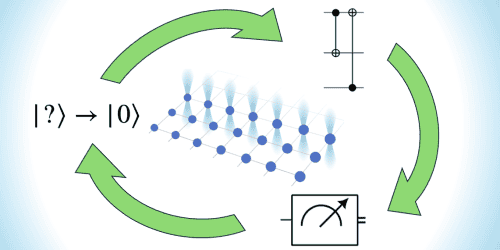
Diagram showing a lattice of atoms surrounded by green recycling arrows. The spaces between the arrows are labelled with the kets |?> arrow |o> representing initiation, a small diagram showing atomic transitions, and an arrow on a dial representing readout
Non-profligate protocol: A schematic of the atom recycling approach. (Courtesy: M Norcia/Atom Computing)
Errors are the bugbear of quantum computing, and they’re hard to avoid. While quantum computers derive their computational clout from the fact that their qubits can simultaneously hold multiple values, the fragility of qubit states ramps up their error rates. Many research groups are therefore seeking to reduce or manage errors so they can increase the number of qubits without compromising the overall system.

A team at the US-based firm Atom Computing is now reporting substantial success in this area thanks to a multi-part strategy for keeping large numbers of qubits operational in quantum processors based on neutral atoms.

Order and Disorder - Part 1, The Story of Energy 4k


Order and Disorder - Part 1, The Story of Energy 4k

Order and Disorder - Part 2, The Story of Information 4k


Order and Disorder - Part 2, The Story of Information 4k

An atomic system acts like a quantum Newton’s cradle


An atomic system acts like a quantum Newton’s cradle

17 Dec 2025
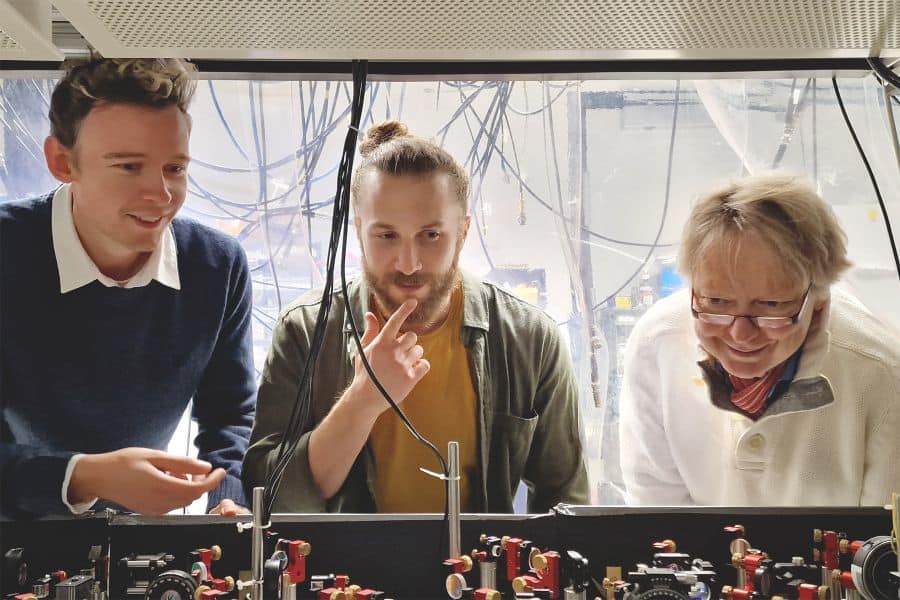
Photo of three men standing behind an optical table
Quantum gas team: Frederik Møller, Philipp Schüttelkopf and Jörg Schmiedmayer in their laboratory at TU Wien. (Courtesy: TU Wien)
Atoms in a one-dimensional quantum gas behave like a Newton’s cradle toy, transferring energy from atom to atom without dissipation. Developed by researchers at the TU Wien, Austria, this quantum fluid of ultracold, confined rubidium atoms can be used to simulate more complex solid-state systems. By measuring transport quantities in this “perfect” atomic system, the team aims to gain a deeper understanding of how transport phenomena and thermodynamics behave at the quantum level.

Physical systems transport energy, charge, and mass in various ways. Electrical currents streaming along a wire, heat flowing through a solid, and light travelling down an optical fibre are just three examples.

Radioactive BEC could form a ‘superradiant neutrino laser’


Radioactive BEC could form a ‘superradiant neutrino laser.’

04 Oct 2025
Graphic illustrating the condensation of atoms
Cool and creative Building a superradiant neutrino laser would be a significant challenge. (Courtesy: iStock/Vitacops)
Radioactive atoms in a Bose–Einstein condensate (BEC) could form a “superradiant neutrino laser” in which the atomic nuclei undergo accelerated beta decay. The hypothetical laser has been proposed by two U.S. researchers who claim it could be built and tested. While such a neutrino laser has no obvious immediate applications, further developments could potentially assist in the search for background neutrinos from the Big Bang – an essential goal of neutrino physicists.

Neutrinos – the ghostly particles produced in beta decay – are notoriously difficult to detect or manipulate because of the weakness of their interaction with matter. They cannot be used to make a conventional laser because they would pass straight through mirrors unimpeded. More fundamentally, neutrinos are fermions rather than bosons such as photons.

Nobel Minds 2025


Nobel Minds 2025