Qubit ‘recycling’ gives neutral-atom quantum computing a boost
 |
Errors are the bugbear of quantum computing, and they’re hard to avoid. While quantum computers derive their computational clout from the fact that their qubits can simultaneously hold multiple values, the fragility of qubit states ramps up their error rates. Many research groups are therefore seeking to reduce or manage errors so they can increase the number of qubits without compromising the overall system.
A team at the US-based firm Atom Computing is now reporting substantial success in this area thanks to a multi-part strategy for keeping large numbers of qubits operational in quantum processors based on neutral atoms. “These capabilities allow for the execution of more complex, longer circuits that are not possible without them,” says Matt Norcia, one of the Atom Computing researchers behind this work.
While neutral atoms offer several advantages over other qubit types, they traditionally have significant drawbacks for one of the most common approaches to error correction. In this approach, some of the entangled qubits are set aside as so-called “ancillaries”, used for mid-circuit measurements that can indicate how a computation is going and what error correction interventions may be necessary.
In neutral-atom quantum computing, however, such interventions are generally destructive. Atoms that are not in their designated state are simply binned off – a profligate approach that makes it challenging to scale up atom-based computers. The tendency to discard atoms is particularly awkward because the traps that confine atoms are already prone to losing atoms, which introduces additional errors while reducing the number of atoms available for computations.
Reduce, re-use, replenish
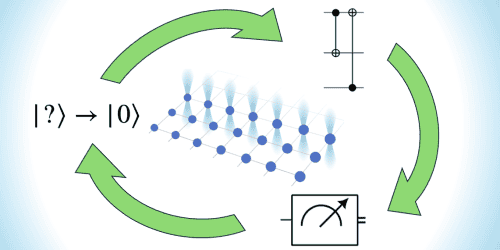
As well as demonstrating protocols for performing measurements to detect errors in quantum circuits with little atom loss, the researchers at Atom Computing also showed they could re-use ancillary atoms – a double-pronged way of retaining more atoms for calculations. In addition, they demonstrated that they could replenish the register of atoms used in the computation from a spatially separated reservoir in a magneto-optic trap without compromising the quantum state of the atoms already in the register.
Norcia argues that these achievements—replacing atoms from a continuous source while reducing the number of atoms that must be replaced initially —are key to running computations without running out of atoms. “To our knowledge, any useful quantum computations will require the execution of many layers of gates, which will not be possible unless the number of atoms can be maintained at a steady-state level throughout the computation,” he tells Physics World.
Cool and spaced out
Norcia and his collaborators at Microsoft Quantum, the Colorado School of Mines and Stanford University worked with ytterbium (Yb) atoms, which he describes as “natural qubits” since they have two ground states. A further advantage is that the transitions between these qubit states and other states used for imaging and cooling are weak, allowing researchers to couple only one qubit state to these different states at a time. The team also leveraged a previously developed approach for mid-circuit measurement that scatters light from only one qubit state without disturbing the other, making it less destructive.
Still, Norcia tells Physics World, “the challenge was to re-use atoms, and key to this was cooling and performance.” To this end, they first had to shift the atoms undergoing mid-circuit measurements away from the atoms in the computational register, to avoid scattering laser light off the latter. They further avoided laser-related collateral damage by designing the register such that the measurement and cooling light were not at the resonant wavelength of the register atoms. Next, they demonstrated that they could cool previously measured atoms for reuse in the calculation. Finally, they showed that they could non-disruptively replenish these atoms with others from a magneto-optical trap positioned 300 nm below the tweezer arrays that held the atoms for the computational register.
Mikhail Lukin, a physicist at Harvard University, US, who has also worked on the challenges of atom loss and re-use in scalable, fault-tolerant neutral atom computing, has likewise recently reported successful atom re-use and diminished atom loss. Although Lukin’s work differs from that of the Atom Computing team in various ways – using rubidium instead of ytterbium atoms and a different approach for low atom loss mid-circuit measurements, for starters – he says that the work by Norcia and his team “represents an important technical advance for the Yb quantum computing platform, complementing major progress in the neutral atom quantum computing community in 2025”.
The research appears in Physical Review X.

Anna Demming is a science journalist based in the UK
FROM PHYSICSWORLD.COM 20/12/2025

Δεν υπάρχουν σχόλια:
Δημοσίευση σχολίου