Pierre Agostini, Ferenc Krausz, and Anne L’Huillier win the 2023 Nobel Prize for Physics
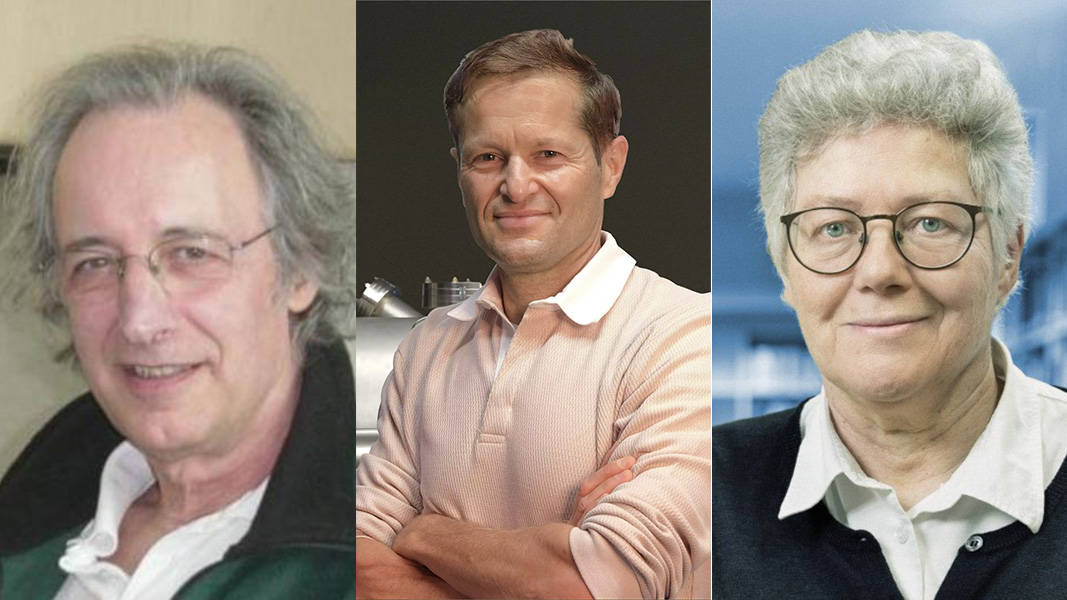 |
Pierre Agostini, Ferenc Krausz, and Anne L’Huillier have won the 2023 Nobel Prize for Physics for “experimental methods that generate attosecond pulses of light for the study of electron dynamics in matter”.
L’Huillier is based at Sweden’s Lund University; Krausz is at the Max Planck Institute of Quantum Optics and the Ludwig-Maximilians University of Munich in Germany; and Agostini is at Ohio State University in the US. The prize is worth 11 million kronor (approximately $1 million) and is split equally among the winners. The award will be presented in Stockholm on 10 December 2023.
Speaking by phone at the prize announcement, L’Huillier said she was teaching when she received the news and only answered after the third or fourth call. “The last half hour of my lecture was a bit difficult to do…For me, teaching is very, very important!”
L’Huillier added, “This prize really means a lot. It’s the most prestigious prize, and I’m so happy to get it. It’s incredible. There are not so many women who get this prize, so it’s exceptional.”
Difficult experiments
She also emphasized the importance of fundamental research, noting that the work of the three laureates is now being applied in practice after many years of development. She added that the Holy Grail of the field is to control key aspects of critical chemical reactions, such as photosynthesis. “I was personally fascinated by this field from the start, which is why I continued with it for many, many years. But it’s a slow field with difficult experiments.”
Speaking after the award was announced, Nobel Committee for Physics member Mats Larsson explained the significance of the trio’s research, noting that it has boosted our understanding of electron behaviour in chemistry and materials science.
“To me, I think the most exciting thing is that, over a very long period, [the laureates] have been working very hard both to understand the fundamental physics and then to develop the technology to really open the world of electrons, which are the workhorse for all of us, and we never had access to earlier. That’s fantastic. We can study electron dynamics in atoms, molecules, and condensed matter and, in a fundamentally different way, understand how things work. It’s definitely a new world.”
He added that the laureates’ work “won’t affect our lives now, but will in the future, with applications in molecular fingerprinting and in the semiconductor industry. Molecular fingerprinting is used to detect changes in your blood cells. If you can find these changes and identify them as caused by disease, that’s a huge advantage”.
A life in science
Krausz was born in Mór, Hungary, in 1962. He studied theoretical physics at Eötvös Loránd University, graduating in 1985. After a stint as a researcher at the Budapest University of Technology and Economics, in 1988, Krausz moved to the Vienna University of Technology, where he held various positions. In 2004, he moved to the Ludwig Maximilian University of Munich, where he also became a director of the Max Planck Institute for Quantum Optics in Garching, Munich.
L’Huillier was born in 1958 in Paris. She completed her PhD in 1986 from the Pierre and Marie Curie University in Paris. After positions at the French Alternative Energies and Atomic Energy Commission (CEA), the Chalmers Institute of Technology in Gothenburg, Sweden, and the University of Southern California in Los Angeles in 1995, she moved to Lund University in Sweden, where she has remained since.
Agostini earned his doctoral degree from Aix-Marseille University in 1968. He then became a researcher at CEA Paris-Saclay. He held positions at the University of Southern California, FOM Institute for Atomic and Molecular Physics in Amsterdam, and Brookhaven National Laboratory in the US. In 2005, he joined the Ohio State University, where he is currently based.
L’Huillier, Agostini, and Krausz pioneered the generation of ultrashort light pulses with durations in the attosecond (10−18 s or 1 as) range. This is roughly the timescale on which electrons in atoms, molecules, and materials interact to drive chemical reactions and material properties. Attosecond pulses allow researchers to observe these processes unfold, providing profound insights into the chemical and material world. However, such short pulses are incredibly difficult to create, manipulate, and detect in laboratory experiments.
Plateau of harmonics
L’Huillier’s contributions to the field began in the 1980s, when she studied the high-frequency harmonics of ultraviolet light generated when an infrared laser pulse is transmitted through noble gases. Under the right conditions, these harmonics can interfere to create pulses of light. To make a very short pulse, light across a broad band of frequencies must be combined. Indeed, the shorter the pulse, the wider the required light bandwidth. L’Huillier and colleagues at CEA-Saclay discovered that higher-harmonic generation (HHG) in noble gases produces a vast plateau of harmonics that can be combined to generate ultrashort ultraviolet pulses.
However, generating sound pulses that could be characterized proved very difficult. It was not until 2001 that Agostini created a train of pulses with a duration of 250 a. While working at CEA-Saclay, his team recombined the ultrashort ultraviolet pulses with the original infrared light to generate an interference pattern that allowed him to characterize the pulse length and repetition rate.
Around the same time, Krausz was working at Vienna University of Technology, where he and his colleagues developed a technique to separate individual ultrashort pulses from a pulse train. These isolated pulses were 650 as long and were used to study a process in which electrons are removed from their atoms.
Ever shorter pulses
More recently, it has become possible to generate pulses with durations of just tens of attoseconds. The work of Krausz, L’Huillier, and Agostini has inspired a growing community of attosecond scientists to use ever-shorter pulses to study electron behaviour across a range of systems. Studies include measurements of electron binding energies and electron oscillations in molecules and materials.
The technique is also starting to be used in more practical applications. For example, the presence of a molecule in a medical sample could someday be determined by the unique signal emitted by its electrons after being excited by ultrashort light pulses.
Theoretical physicist Kenneth Schafer from Louisiana State University has worked with both L’Huillier and Agostini since the 1990s and says he is “extremely happy” for them. “[L’Huillier] is an amazing scientist and human being, and Agostini is a towering figure in both electron and photon physics over the last 50 years,” Schafer told Physics World. “Agostini has time and again pushed the field forward, and this is just one of his many discoveries that is celebrated today.”
Schafer adds that all three laureates have advanced the field of attosecond science and are “committed to finding a deeper understanding of their results,” so he believes the Nobel committee has made the right choice. “[Their work] has resulted in close collaborations between experimentalists and theorists, and they are to be commended for it,” he says. “But the basic discoveries are theirs alone.”
That view is supported by attosecond researcher Mauro Nisoli of the Polytechnic University of Milan, who has collaborated with both Krausz and L’Huillier since the 1990s. Nisoli told Physics World that he is “delighted” that the field has been recognized and that the trio's recognition is “well deserved”.
“Attosecond science has become a very active field of research, with prominent applications in atomic, molecular, and solid-state physics,” adds Nisoli. “Agostini, L’Huillier, and Krausz carried out pioneering and crucial experiments, which led to the development of the attosecond research field.”Anne L’Huillier spoke to Physics World’s Valerie Jamieson in 2002 at the IUPAP First International Conference on Women in Physics about career obstacles facing female physicists. You can read more in “Liberté, égalité and fraternité”.
Ferenc Krausz wrote a feature about attosecond physics for Physics World in 2001. It was called “From femtochemistry to attophysics“.
Pierre Agostini wrote an article for Physics World on creating femtosecond light pulses and their potential applications. It was published back in 1989 and is called “Shifts in atomic understanding”.
IOP Publishing, which publishes Physics World, has created an online collection of journal articles and papers by this year’s Nobel laureates and those from previous years. You can read these and related documents in the 2023 Nobel Prize Collection.

Physics World‘s Nobel prize coverage is supported by Oxford Instruments Nanoscience, a leading supplier of research tools for the development of quantum technologies, advanced materials, and nanoscale devices. Visit nanoscience.oxinst.com to find out more.

Hamish Johnston is an online editor of Physics World
from physicsworld.com 12/12/2025

Δεν υπάρχουν σχόλια:
Δημοσίευση σχολίου