A fluid-based laser scanning technique could improve brain imaging
 |
Using a new type of low-power, compact, fluid-based prism to steer the beam in a laser scanning microscope could transform brain imaging and help researchers better understand neurological conditions such as Alzheimer’s disease.
The “electrowetting prism” utilized was developed by a team led by Juliet Gopinath from the electrical, computer and energy engineering and physics departments at the University of Colorado at Boulder (CU Boulder) and Victor Bright from CU Boulder’s mechanical engineering department, as part of their ongoing collaboration on electrically controllable optical elements for improving microscopy techniques.
“We quickly became interested in biological imaging, and work with a neuroscience group at the University of Colorado Denver Anschutz Medical Campus that uses mouse models to study neuroscience,” Gopinath tells Physics World. “Neuroscience is not well understood, as illustrated by the neurodegenerative diseases that don’t have good cures. So a great benefit of this technology is the potential to study, detect, and treat neurodegenerative diseases such as Alzheimer’s, Parkinson’s, and schizophrenia,” she explains.
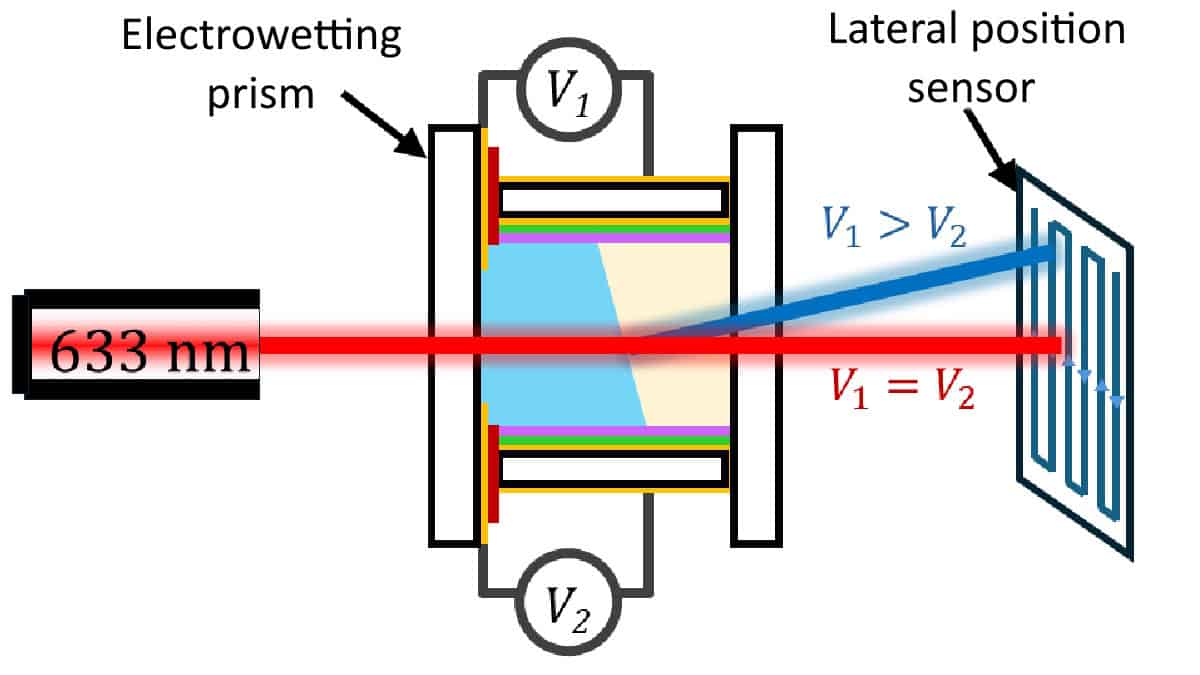
The researchers fabricated their patented electrowetting prism using custom deposition and lithography methods. The device consists of two immiscible liquids housed in a 5 mm tall, 4 mm diameter glass tube, with a dielectric layer on the inner wall coating four independent electrodes. When an electric field is produced by applying a potential difference between a pair of electrodes on opposite sides of the tube, it changes the surface tension and therefore the curvature of the meniscus between the two liquids. Light passing through the device is refracted by a different amount depending on the tilt angle of the meniscus (and on the optical properties of the chosen liquids), enabling beams to be steered by varying the voltage applied to the electrodes.
Beam steering for scanning in imaging and microscopy can be achieved via several means, including mechanically controlled mirrors, glass prisms, or acousto-optic deflectors (in which a sound wave is used to diffract the light beam). However, unlike the new electrowetting prisms, these methods consume excessive power. They are not small or lightweight enough to be used for miniature microscopy of neural activity in the brains of living animals.
In tests reported in Optics Express, the researchers integrated their electrowetting prism into an existing two-photon laser scanning microscope and successfully imaged individual 5 µm-diameter fluorescent polystyrene beads and large clusters of those beads.
They also used computer simulation to study how the liquid–liquid interface moved, and found that when a sinusoidal voltage is used for actuation, at 25 and 75 Hz, standing wave resonance modes occur at the meniscus – a result closely matched by a subsequent experiment that showed resonances at 24 and 72 Hz. These resonance modes are essential for enhancing device performance because they increase the meniscus tilt angle, thereby enabling optical beams to be steered over a larger angular range, thereby minimizing distortions during two-dimensional raster scanning.
Bright explains that this research was built on previous work in which an electrowetting prism was used in a benchtop microscope to image a mouse brain. He cites seeing the individual neurons as a standout moment that, coupled with the current results, shows their prism is now “proven and ready to go”.
Gopinath and Bright caution that “more work is needed to allow human brain scans, such as limiting voltage requirements, allowing the device to operate at safe voltage levels, and miniaturization of the device to allow faster scan speeds and acquiring images at a much faster rate”. However, they add that miniaturization would also make the device useful for endoscopy, robotics, chip-scale atomic clocks, and space-based satellite communication.
The team has already begun investigating two other potential applications: LiDAR (light detection and ranging) systems and optical coherence tomography (OCT). Next, the researchers “hope to integrate the device into a miniaturized microscope to allow imaging of the brain in freely moving animals in natural outside environments,” they say. “We also aim to improve the packaging of our devices so they can be integrated into many other imaging systems.”
Sharon Ann Holgate is a freelance science writer and broadcaster specialising in physics and technology
FROM PHYSICSWORLD.COM 17/12/2025

Δεν υπάρχουν σχόλια:
Δημοσίευση σχολίου