Phase shift in optical cavities could detect low-frequency gravitational waves
 |
A network of optical cavities could be used to detect gravitational waves (GWs) in an unexplored range of frequencies, according to researchers in the UK. Using technology already within reach, the team believes that astronomers could soon search for ripples in spacetime across the milli-Hz frequency band, from 10⁻⁵ Hz to 1 Hz.
GWs were first observed a decade ago and since then the LIGO–Virgo–KAGRA detectors have spotted GWs from hundreds of merging black holes and neutron stars. These detectors work in the 10 Hz–30 kHz range. Researchers have also had some success at observing a GW background at nanohertz frequencies using pulsar timing arrays.
However, GWs have yet to be detected in the milli-Hz band, which should include signals from binary systems of white dwarfs, neutron stars, and stellar-mass black holes. Many of these signals would emanate from the Milky Way.
Several projects are now underway to explore these frequencies, including the space-based interferometers LISA, Taiji, and TianQin, as well as satellite-borne networks of ultra-precise optical clocks. However, these projects remain several years away.
Multidisciplinary effort
Joining these efforts was a collaboration called QSNET, which was within the UK’s Quantum Technology for Fundamental Physics (QTFP) programme. “The QSNET project was a network of clocks for measuring the stability of fundamental constants,” explains Giovanni Barontini at the University of Birmingham. “This programme brought together physics communities that normally don’t interact, such as quantum physicists, technologists, high energy physicists, and astrophysicists.”
QTFP ended this year, but not before Barontini and colleagues had made essential strides in demonstrating how milli-Hz GWs could be detected using optical cavities.
Within an ultrastable optical cavity, light at specific resonant frequencies repeatedly bounces between a pair of opposing mirrors. When this resonant light is produced by a particular atomic transition, the frequency of the light in the cavity is exact and can serve as the ticking of a highly stable clock.
“Ultrastable cavities are a main component of modern optical atomic clocks,” Barontini explains. “We demonstrated that they have reached sufficient sensitivities to be used as ‘mini-LIGOs’ and detect gravitational waves.”
When such a GW passes through an optical cavity, the spacing between its mirrors does not change in any detectable way. However, QSNET results have led Barontini’s team to conclude that milli-Hz GWs alter the phase of the light inside the cavity. What is more, they conclude that this effect would be detectable in the most precise optical cavities currently available.
“Methods from precision measurement with cold atoms can be transferred to gravitational-wave detection,” explains team member Vera Guarrera. “By combining these toolsets, compact optical resonators emerge as credible probes in the milli-Hz band, complementing existing approaches.”
Ground-based network
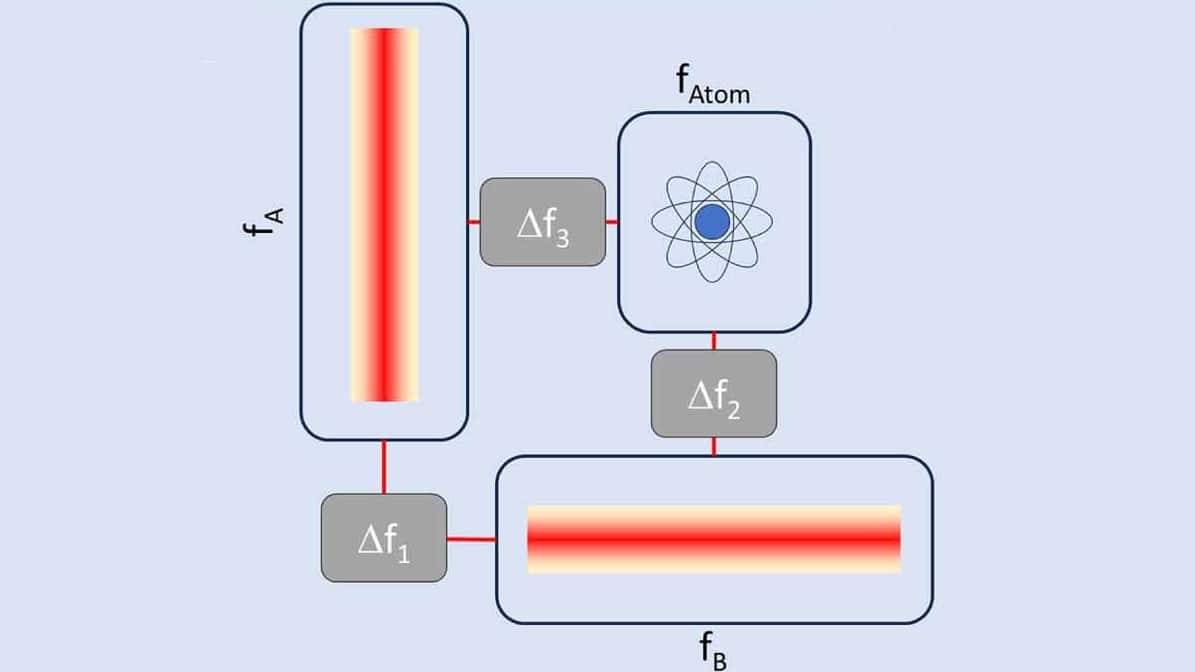
Their compact detector would comprise two optical cavities at 90° to each other, each operating at a different frequency, and an atomic reference at a third frequency. The phase shift caused by a passing gravitational wave is revealed by a change in the interference between the three frequencies. The team proposes linking multiple detectors to create a global, ground-based network. This, they say, could detect a GW and also locate its source position in the sky.
By harnessing this existing technology, the researchers hope that future studies could enable a new era of discovery of GWs in the milli-Hz range, far sooner than many projects currently in development.
“This detector will allow us to test astrophysical models of binary systems in our galaxy, explore the mergers of massive black holes, and even search for stochastic backgrounds from the early universe,” says team member Xavier Calmet at the University of Sussex. “With this method, we have the tools to start probing these signals from the ground, opening the path for future space missions.”
Barontini adds, “Hopefully this work will inspire the build-up of a global network of sensors that will scan the skies in a new frequency window that promises to be rich in sources – including many from our own galaxy,”.
The research is described in Classical and Quantum Gravity.
Sam Jarman is a science writer based in the UK
FROM PHYSICSWORLD.COM 17/12/2025

Δεν υπάρχουν σχόλια:
Δημοσίευση σχολίου