Tumour-specific radiofrequency fields suppress brain cancer growth
 |
A research team at Wayne State University School of Medicine in the US has developed a novel treatment for glioblastoma, based on exposure to low levels of radiofrequency electromagnetic fields (RF EMF). The researchers demonstrated that the new therapy slows the growth of glioblastoma cells in vitro and, for the first time, showed its feasibility and clinical impact in patients with brain tumours.
The study, led by Hugo Jimenez and reported in Oncotarget, uses a device developed by TheraBionic that delivers amplitude-modulated 27.12 MHz RF EMF throughout the entire body, via a spoon-shaped antenna placed on the tongue. Using tumour-specific modulation frequencies, the device has already received US FDA approval for the treatment of patients with advanced hepatocellular carcinoma (HCC, a liver cancer), and its safety and effectiveness are currently being assessed in clinical trials in patients with pancreatic, colorectal, and breast cancers.
In this latest work, the team investigated its use in glioblastoma, an aggressive and difficult-to-treat brain tumour.
To identify the specific frequencies required to treat glioblastoma, the team used a previously developed noninvasive biofeedback method to study patients with various cancer types. The process involves measuring variations in skin electrical resistance, pulse amplitude, and blood pressure while individuals are exposed to low-intensity amplitude-modulated frequencies. The approach can identify frequencies, typically between 1 Hz and 100 kHz, that are specific to a single tumour type.
Jimenez and colleagues first examined the impact of glioblastoma-specific amplitude-modulated RF EMF (GBMF) on glioblastoma cells, exposing various cell lines to GBMF for 3 h per day at the exposure level used for patient treatments. After one week, GBMF decreased the proliferation of three glioblastoma cell lines (U251, BTCOE-4765, and BTCOE-4795) by 34.19%, 15.03% and 14.52%, respectively.
The team notes that the level of this inhibitive effect (15–34%) is similar to that observed in HCC cell lines (19–47%) and breast cancer cell lines (10–20%) treated with tumour-specific frequencies. A fourth glioblastoma cell line (BTCOE-4536) was not inhibited by GBMF, likely due to unknown factors.
Next, the researchers examined the effect of GBMF on cancer stem cells, which are responsible for treatment resistance and cancer recurrence. The treatment decreased the tumour sphere-forming ability of U251 and BTCOE-4795 cells by 36.16% and 30.16%, respectively, values comparable to those observed in HCC and breast cancer cells.
Notably, these effects were only induced by frequencies associated with glioblastoma. Exposing glioblastoma cells to HCC-specific modulation frequencies had no measurable impact and was indistinguishable from sham exposure.
By examining the underlying mechanisms of treatment, the researchers hypothesized that, as observed in breast cancer and HCC, glioblastoma cell proliferation is mediated by T-type voltage-gated calcium channels (VGCCs). In the presence of a VGCC blocker, GBMF did not inhibit cell proliferation, confirming that GBMF-mediated inhibition of cell proliferation depends on T-type VGCCs, particularly the calcium channel CACNA1H.
The team also found that GBMF blocks the growth of glioblastoma cells by modulating the “Mitotic Roles of Polo-Like Kinase” signalling pathway, leading to disruption of the cells’ mitotic spindles, critical structures in cell replication.
A clinical first
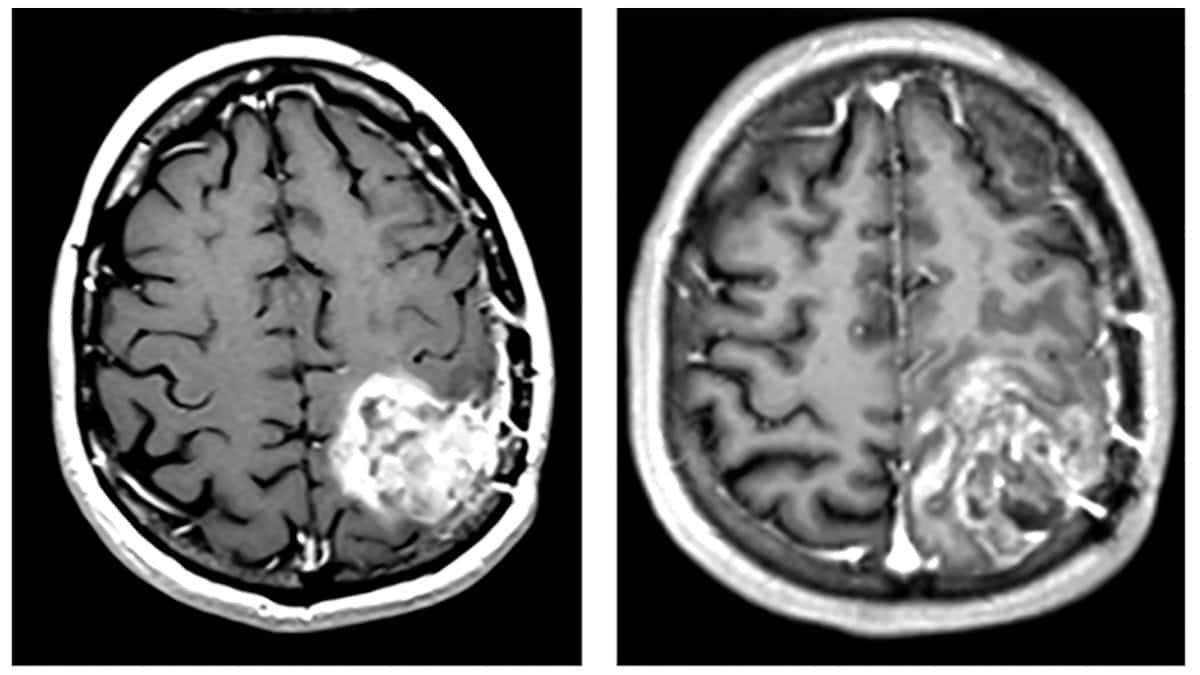
Finally, the researchers used the TheraBionic device to treat two patients: a 38-year-old patient with recurrent glioblastoma and a 47-year-old patient with the rare brain tumour oligodendroglioma. The first patient showed clinical and radiographic benefit following treatment; the second exhibited stable disease and tolerated the treatment well.
“This is the first report showing feasibility and clinical activity in patients with brain tumour,” the authors write. “Similarly to what has been observed in patients with breast cancer and hepatocellular carcinoma, this report shows the feasibility of this treatment approach in patients with malignant glioma and provides evidence of anticancer activity in one of them.”
The researchers add that a previous dosimetric analysis of this technique measured a whole-body specific absorption rate (SAR, the rate of energy absorbed by the body when exposed to RF EMF) of 1.35 mW/kg and a peak spatial SAR (over 1 g of tissue) of 146–352 mW/kg. These values are well within the safety limits set by the ICNIRP (whole-body SAR of 80 mW/kg; peak spatial SAR of 2000 mW/kg). Organ-specific SAR values for grey matter, white matter, and the midbrain also had mean SAR values well within safety limits.
The team concludes that the results justify future preclinical and clinical studies of the TheraBionic device in this patient population. “We are currently in the process of designing clinical studies in patients with brain tumors,” Jimenez tells Physics World.

Tami Freeman is an online editor for Physics World
from physicsworld.com 12/12/2025

Δεν υπάρχουν σχόλια:
Δημοσίευση σχολίου