On Calderon-Zygmund type estimates for nonlocal PDE, Armin Schikorra

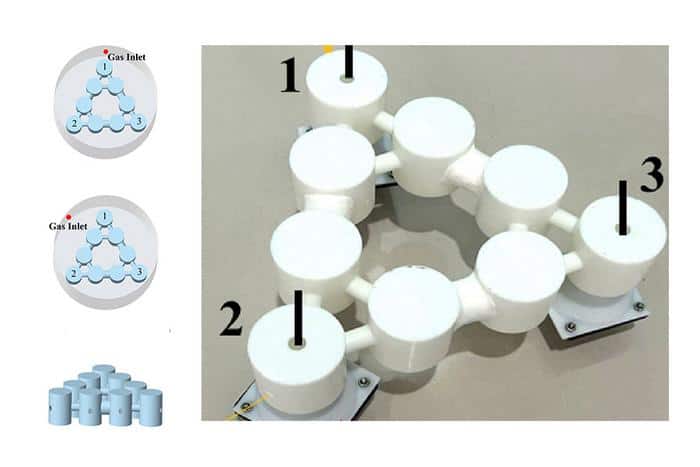 |
A new sensor detects helium leaks by monitoring how sound waves propagate through a topological material – no chemical reactions required. Developed by acoustic scientists at Nanjing University, China, the innovative, physics-based device is compact, stable, accurate, and capable of operating at very low temperatures.
Helium is employed in a wide range of fields, including aerospace, semiconductor manufacturing, medical applications, and physics research. Because it is odourless, colourless, and inert, it is essentially invisible to traditional leak-detection equipment such as adsorption-based sensors. Specialist helium detectors are available, but they are bulky, expensive, and highly sensitive to operating conditions.