New sensor uses topological material to detect helium leaks
 |
A new sensor detects helium leaks by monitoring how sound waves propagate through a topological material – no chemical reactions required. Developed by acoustic scientists at Nanjing University, China, the innovative, physics-based device is compact, stable, accurate, and capable of operating at very low temperatures.
Helium is employed in a wide range of fields, including aerospace, semiconductor manufacturing, medical applications, and physics research. Because it is odourless, colourless, and inert, it is essentially invisible to traditional leak-detection equipment such as adsorption-based sensors. Specialist helium detectors are available, but they are bulky, expensive, and highly sensitive to operating conditions.
A two-dimensional acoustic topological material
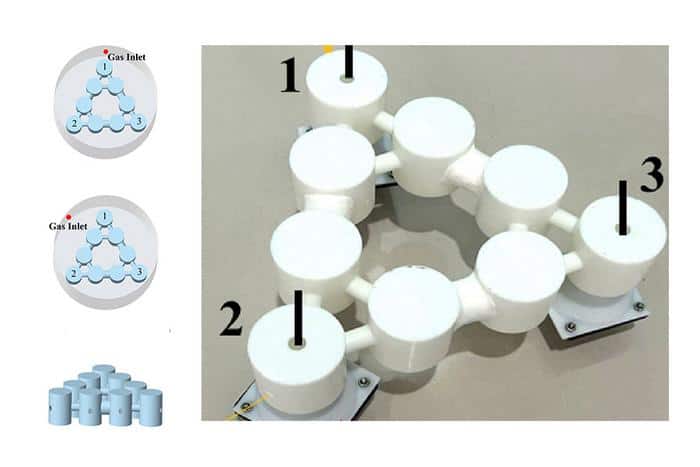
The new device developed by Li Fan and colleagues at Nanjing consists of nine cylinders arranged in three subtriangles, with tubes interconnecting the cylinders. The corners of the sub-triangles touch and the tubes allow air to enter the device. The resulting two-dimensional system has a so-called “kagome” structure and is an example of a topological material – that is, one that contains special, topologically protected, states that remain stable even if the bulk structure contains minor imperfections or defects. In this system, the protected states are the corners.
To test their setup, the researchers placed speakers at the corners that send sound waves into the structure, causing the gas within it to vibrate at a specific frequency (the resonance frequency). When they replaced the air in the device with helium, the sound waves travelled faster, changing the vibration frequency. Measuring this shift in frequency enabled the researchers to determine the helium concentration in the device.
Many advantages over traditional gas sensors
Fan explains that the device works because the interface/corner states are impacted by the properties of the gas within it. This mechanism has many advantages over traditional gas sensors. First, it does not rely on chemical reactions, making it well-suited for detecting inert gases such as helium. Second, the sensor is not affected by external conditions and can therefore operate at extremely low temperatures, which is challenging for conventional sensors that contain sensitive materials. Third, its sensitivity to helium is unchanged, so it does not need to be recalibrated during operation. Finally, it detects frequency changes quickly and rapidly returns to its baseline once helium levels decrease.
As well as detecting helium, Fan says the device can also pinpoint the direction a gas leak is coming from. This is because, as helium begins to fill the device, the corner closest to the gas source is filled first. Each corner thus serves as an independent sensing point, providing the device with spatial sensing capabilities that most traditional detectors lack.
Other gases could be detected
Detecting helium leaks is important in fields such as semiconductor manufacturing, where the gas is used for cooling, and in medical imaging systems that operate at liquid helium temperatures. “We think our work opens an avenue for inert gas detection using a simple device and is an example of a practical application for two-dimensional acoustic topological materials,” says Fan.
While the new sensor was fabricated to detect helium, the same mechanism could also be employed to detect other gases, such as hydrogen, he adds.
Spurred on by these promising preliminary results, which they report in Applied Physics Letters, the researchers plan to extend their fabrication technique to create three-dimensional acoustic topological structures. “These could be used to orientate the corner points so that helium can be detected in 3D space,” says Fan. “Ultimately, we are trying to integrate our system into a portable structure that can be deployed in real-world environments without complex supporting equipment,” he tells Physics World.

Isabelle Dumé is a contributing editor to Physics World
FROM PHYSICSWORLD.COM 5/2/2026

Δεν υπάρχουν σχόλια:
Δημοσίευση σχολίου