Electric field treatment restores movement to rats with spinal injuries
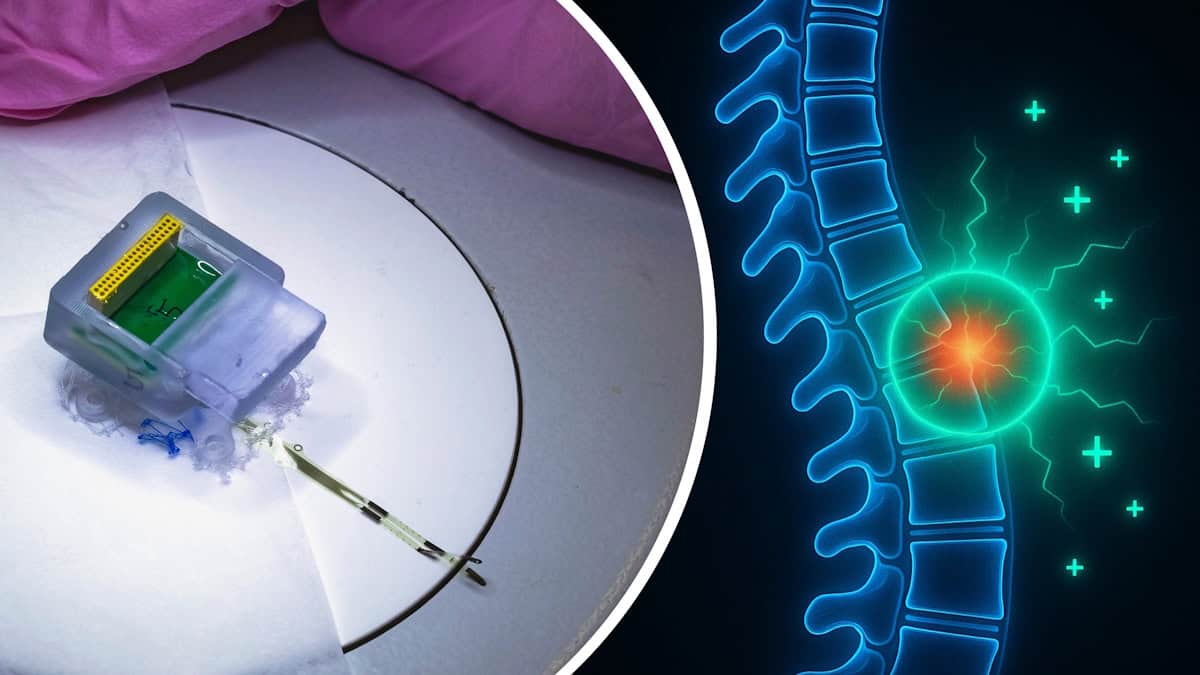 |
Damage to the spinal cord can disrupt communication between the brain and body, with potentially devastating effects. Spinal cord injuries can cause permanent loss of sensory, motor, and autonomic functions, or even paralysis, and there’s currently no cure. To address this inadequacy, researchers at Chalmers University of Technology in Sweden and the University of Auckland in New Zealand have developed an ultrathin bioelectric implant that improved movement in rats with spinal cord injuries.
The implant works by delivering a low-frequency pulsed electric field (EF) across the injury site – an approach that shows promise in promoting regeneration of axons (nerve fibres) and improving outcomes. Traditional EF treatments, however, rely on metal electrodes that are prone to corrosion. In this latest study, described in Nature Communications, the researchers fabricated stimulation electrodes from sputtered iridium oxide films (SIROF), which exhibit superior durability and stability to their metal counterparts.
The team further enhanced the EF treatment by placing the electrodes directly on the spinal cord to deliver stimulation directly to the injury site. Although this subdural positioning requires more invasive surgery than the epidural placement used previously, it should deliver stronger stimulation while using an order of magnitude less power than epidural electrodes.
“We chose subdural stimulation because it avoids the shunting effect of cerebrospinal fluid, which is highly conductive and can weaken the electric field when electrodes are placed epidurally,” explains co-lead researcher Lukas Matter from Chalmers University of Technology. “Subdural placement puts the electrodes directly on the spinal cord, allowing for stronger and more precise stimulation with lower current.”
Restoring motion and sensation
Matter and collaborators tested the implants in rats with spinal cord injuries, using 200 μm diameter SIROF electrodes placed on either side of the injury site. The animals received 1 h of EF treatment daily for the first 7–11 days, and then on weekdays only for up to 12 weeks.
To compare EF treatment with natural healing (unlike humans, rats can recover after spinal cord injury), the researchers assessed hind-limb function in both treated and untreated rats. They found that during the first week, the non-treated group recovered faster than the treated group. From week 4 onwards, however, treated rats showed significantly improved locomotion and coordination compared with non-treated rats, indicating greater recovery of hind-limb function.
The treated rats continued to improve through the end of the study (week 12), whereas the untreated rats showed no further improvement after week 5. At week 12, all treated animals exhibited consistent coordination between the front and hind limbs, whereas only 20% of untreated rats struggled to move smoothly.
The team also assessed the recovery of mechanical sensation by touching the animals’ paws with a metal filament. Treated rats withdrew their paws faster than non-treated rats, suggesting a recovery of touch sensitivity – though the researchers note that this may reflect hypersensitivity.
“This indicates that the treatment supported recovery of both movement and sensation,” says co-lead researcher Bruce Harland from the University of Auckland in a press statement. “Just as importantly, our analysis confirmed that the treatment did not cause inflammation or other damage to the spinal cord, demonstrating that it was not only effective but also safe.”
Durable design
To confirm the superior stability of SIROF electrodes, the researchers conducted benchtop tests that mimicked in vivo conditions. The SIROF electrodes showed no signs of dysfunction or delamination, while platinum electrodes corroded and failed.
“Platinum electrodes are prone to degradation over time, especially at high charge densities, due to irreversible electrochemical reactions that cause corrosion and delamination, ultimately compromising their long-term stability,” says Matter. “SIROF enables reversible charge injection through surface-bound oxidation states, minimizing the generation of potentially toxic stimulation byproducts and enhancing their stimulation capabilities.”
In contrast with previous studies, the researchers did not see any change in axon density around the lesion site. Matter suggests some possible reasons for this finding: “The 12-week time point may have been too late to capture early signs of regeneration. The injury itself created a large cystic cavity, which may have blocked axon growth. Also, electric field treatment might improve recovery through protective or alternative mechanisms, not necessarily by promoting new axon growth”.
The researchers are now developing an enhanced version of the implant with larger PEDOT-based electrodes, enabling higher charge densities without compromising biocompatibility. This will allow them to assess a broader range of field strengths and pulse durations in order to determine the optimal treatment conditions. They also plan to test the implant in larger animal models and hope to elucidate the mechanisms underlying the locomotion improvement using ex vivo models.
As for the possibility of future clinical implementation, senior author Maria Asplund of Chalmers University envisions a temporary, possibly biodegradable, subdural implant that safely delivers low-frequency EF therapy. “This could be implanted early after spinal cord injury to support axon regrowth and reduce the follow-up damage that occurs after the injury itself,” she tells Physics World.

Tami Freeman is an online editor for Physics World
from physicsworld.com 20/2/2026

Δεν υπάρχουν σχόλια:
Δημοσίευση σχολίου