CERN upgrade to LHCb experiment threatened by UK funding cuts
 |
A major upgrade to the LHCb experiment at CERN is under threat after the UK did not commit any further contributions towards the project. The decision by the UK Research and Innovation (UKRI) to defund the plan means that, unless the decision is overturned, the experiment will now likely finish operation in 2033.
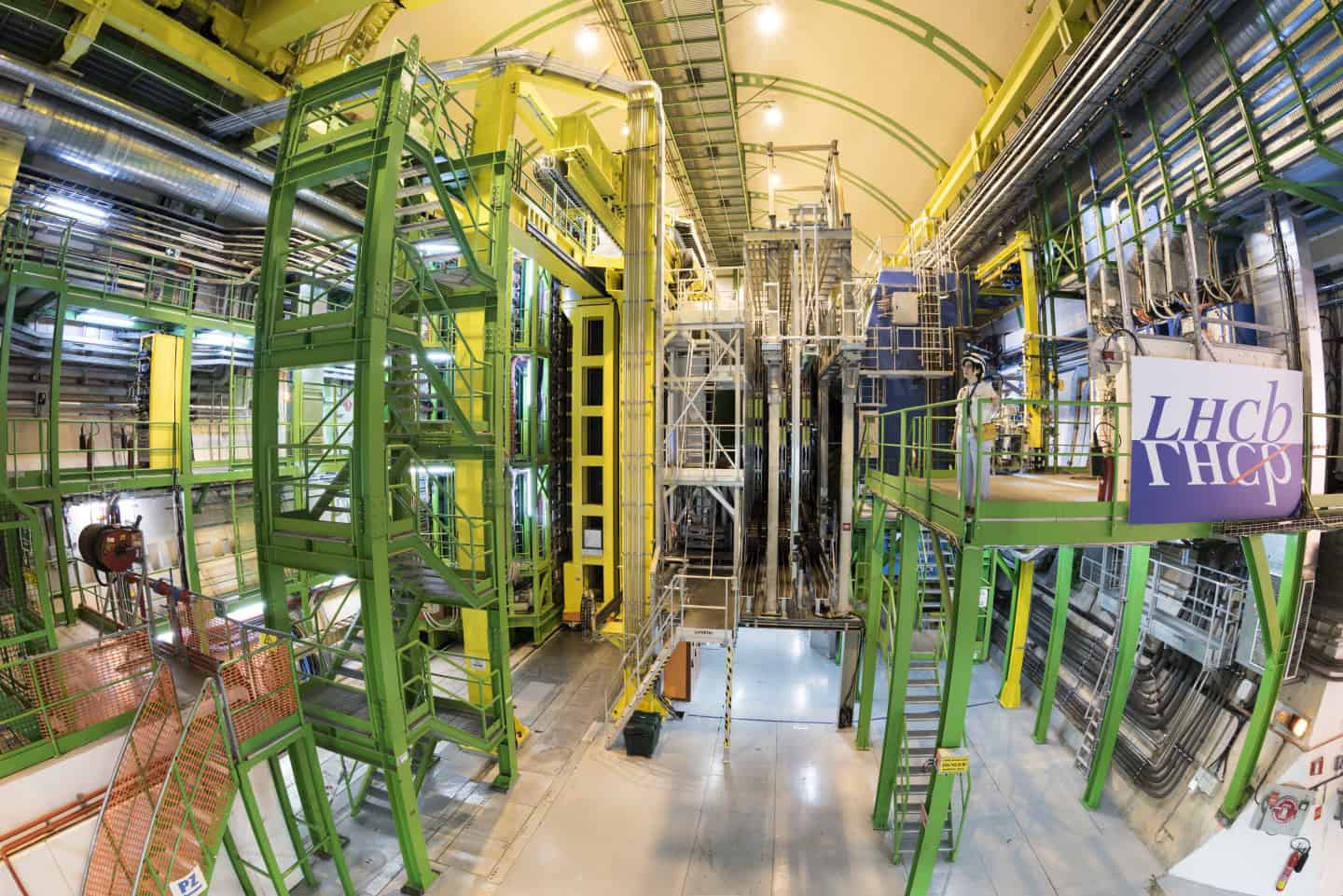
LHCb is one of the four large experiments based at the Large Hadron Collider (LHC) at CERN. It specializes in measuring the parameters of charge-parity (CP) violation in the interactions of b- and c-hadrons, studies that help explain the matter-antimatter asymmetry in the universe.
LHCb began recording data in 2009, when the LHC began operations, and began its main research programme in 2010.
At the end of 2018, there was a shutdown for upgrades, which were completed in 2022. That led to a vast increase in the amount of data the experiment could collect, allowing significant improvements in precision for many measurements.
The detector is expected to operate until 2033, by which time it would have reached the end of its lifetime after years of intense radiation damage.
LHCb is operated by the LHCb collaboration, which comprises about 1700 scientists and technicians from over 100 institutions in 22 countries worldwide, and work on the machine has already resulted in over 800 publications.
The UK is one of the leading countries working on LHCb – four of the eight spokespeople for the experiment have come from the UK – and over the past decade, physicists from the UK have been planning an upgrade to the experiment dubbed LHCb Upgrade II.
This would take advantage of the upgrade to the LHC – the High-Luminosity LHC (HL-LHC) – and offer an order-of-magnitude increase in luminosity over upgrade I.
The second upgrade would provide another boost in capability to answer questions such as whether all CP-violation phenomena are consistent with the Standard Model of particle physics or require an extended theory, as well as how the strong interaction binds together the exotic tetraquark and pentaquark states that have been discovered by LHCb.
At a cost of about £150m, with the construction phase beginning in 2027, the upgrade components would be installed by 2035 before collecting data for five to six years until the HL-LHC is shut down in 2040.
UK researchers submitted a proposal to the UKRI infrastructure fund in 2021 to begin work on the upgrade and were awarded £49.4m in 2022.
Some £5m has been spent on the pre-construction phase, in which agreements have been made with international partners on the scope and design of the improved detector.
Yet on 19 December, researchers working on the project were sent a letter telling them that the remaining funding has “not been prioritised” and will now be cancelled.
“It was a complete shock,” says Tim Gershon from the University of Warwick, who is principal investigator for the project in the UK and is set to become spokesperson for the international collaboration in July.
‘Out in the cold’
The Science and Technology Facilities Council’s (STFC) core budget has remained relatively flat, rising from £835m to £842m from 2026 to 2030. Yet the council said that projects would need to be cut due to inflation, rising energy costs, and “unfavourable movements in foreign exchange rates,” which have increased STFC’s annual costs by over £50m.
The STFC, one of the main funding councils within UKRI, has already said it needs to reduce spending from the core budget by at least 30% compared with 2024/2025 levels. At the same time, it announced that it will need to reduce the number of projects funded by its infrastructure fund.
It’s like paying to heat your house but then sitting outside in the coldTim Gershon
Four projects will now not be prioritised. They include two UK national facilities: the Relativistic Ultrafast Electron Diffraction and Imaging facility and the mass spectrometry centre, C‑MASS.
The other two are international particle-physics projects: the upgrade to LHCb, as well as a contribution to the Electron-Ion Collider at Brookhaven National Laboratory, which is currently being built by a collaboration of 40 countries.
“This is more terrible news for physics, for the UK, and for global scientific progress. The withdrawal of funding in this abrupt way is incredibly damaging to our international reputation as a science superpower and could cause long-term damage to the UK economy,” notes Paul Howarth, president-elect of the Institute of Physics, which publishes Physics World. “But even more important is the harm this cut will cause to human understanding of the universe and human progress.”
Gershon adds that the LHCb collaboration was not asked for any input before the decision was made, and since then they have trying to work out what it means.
“The UK pays the CERN subscription, which pays for the accelerator, but needs to also invest in experiments to obtain scientific return from this,” says Gershon. “It’s like paying to heat your house but then sitting outside in the cold.”
It might be possible to get funding from elsewhere in the short-term to cover the initial work on the upgrade, but Gershon says that without investment from UKRI/STFC, the project will be dead, as it would not be possible for international partners to go ahead without UK involvement on the timescale dictated by the LHC schedule.
That would mean the LHCb stops operating from 2033 and does not take advantage of the HL-LHC. “The move also goes against the European Strategy for Particle Physics roadmap, of which the top priority is fully exploiting the HL-LHC,” says Gershon. “Without LHCb upgrade, it won’t be possible to do that.”
Howarth adds that there are “demonstrable impacts on UK growth and prosperity” for such research. “An earlier upgrade to the LHCb experiment generated about £15m in contracts for more than 80 UK companies,” he adds. “This funding cut means the upgrade is unlikely to go ahead, so all this business for UK innovators is lost. We urge the government to step back and consider how its new funding strategy will impact UK science.”

Michael Banks is the news editor of Physics World magazine
from physicsworld.com 20/2/2026

Δεν υπάρχουν σχόλια:
Δημοσίευση σχολίου